


CompuLab i.MX952 Linux-capable module showcases 2.5GbE, Wi-Fi 6 and PCIe Gen 3
Sep 17, 2026 — by Giorgio Mendoza 12 views
CompuLab has introduced the UCM-iMX952, a 28 x 40mm System-on-Module based on NXP’s i.MX952 processor. The module supports up to 16GB of LPDDR5 or LPDDR4X memory and 128GB of eMMC storage, along with PCIe Gen 3, 2.5GbE, Wi-Fi 6, Bluetooth 5.4, and multiple display and camera interfaces.
The NXP i.MX952 is available on the module in dual- or quad-core Arm Cortex-A55 configurations, with clock speeds up to 1.7GHz. The processor also integrates an Arm Mali-G310 GPU supporting OpenGL ES 3.2, Vulkan 1.2, and OpenCL 3.0, along with a 4K video processing unit and an eIQ Neutron NPU for machine-learning acceleration.
— ADVERTISEMENT —
Real-time and low-power processing is handled by Arm Cortex-M7 and Cortex-M33 cores, operating at up to 800MHz and 333MHz, respectively.
Memory configurations range from 4GB to 16GB using LPDDR5 or LPDDR4X connected through a 32-bit interface. Onboard eMMC storage is available in capacities from 16GB to 128GB and is used for the bootloader, operating system, and general-purpose data.

NXP i.MX 952 block diagram
Display connectivity includes two four-lane LVDS interfaces that can alternatively operate as a single eight-lane interface, supporting resolutions up to 1080p60. The four-lane MIPI-DSI interface supports up to 4K30 or 3840 x 1440 at 60Hz, with a maximum data rate of 2.5Gbps per lane.
For camera applications, the module provides MIPI-CSI connectivity configurable as either one four-lane interface or two two-lane interfaces. Digital audio support includes up to five SAI interfaces for protocols such as I2S, AC97, TDM, and codec/DSP connections.
Networking options include 2.5GbE through an SGMII interface and an optional 10/100/1000Mbps Ethernet PHY. The 2.5GbE interface shares its signals with PCIe Gen 3 x1, while a separate RGMII interface is available for connecting an external Ethernet PHY.

UCM-iMX952 block diagram
Optional wireless connectivity is provided through an Ezurio SONA NX611 module based on the NXP IW611 chipset. It supports IEEE 802.11ax Wi-Fi and Bluetooth 5.4 and connects to the processor through SDIO. Two MHF4 connectors are provided for 2.4GHz Wi-Fi/Bluetooth and auxiliary 2.4/5GHz Wi-Fi antennas.
Other interfaces include two USB 2.0 ports, up to eight UARTs, three CAN-FD interfaces, eight SPI buses, six I2C interfaces, two SD/SDIO interfaces, six PWM signals, eight ADC channels, and up to 94 GPIOs. Many of these signals are multiplexed across the module’s carrier-board connectors.

UCM-iMX952 SoM
For camera applications, the module provides MIPI-CSI connectivity configurable as either one four-lane interface or two two-lane interfaces. Digital audio support includes up to five SAI interfaces for protocols such as I2S, AC97, TDM, and codec/DSP connections.
Networking options include 2.5GbE through an SGMII interface and an optional 10/100/1000Mbps Ethernet PHY. The 2.5GbE interface shares its signals with PCIe Gen 3 x1, while a separate RGMII interface is available for connecting an external Ethernet PHY.

UCM-iMX952 evaluation kit block diagram
CompuLab also provides the SB-UCM-iMX95 carrier board for evaluation and development. Display connectivity includes an LVDS interface supporting up to 1366 x 768 at 60Hz and a MIPI-DSI interface supporting up to 1920 x 1080. Headers are also provided for capacitive touchscreens.
Camera support consists of two two-lane MIPI-CSI interfaces exposed through an edge connector. Raspberry Pi camera modules can be connected using CompuLab’s optional EB-EVCAMRPI adapter. Analog audio is provided through a WM8962 codec with separate 3.5mm line-in and line-out jacks.
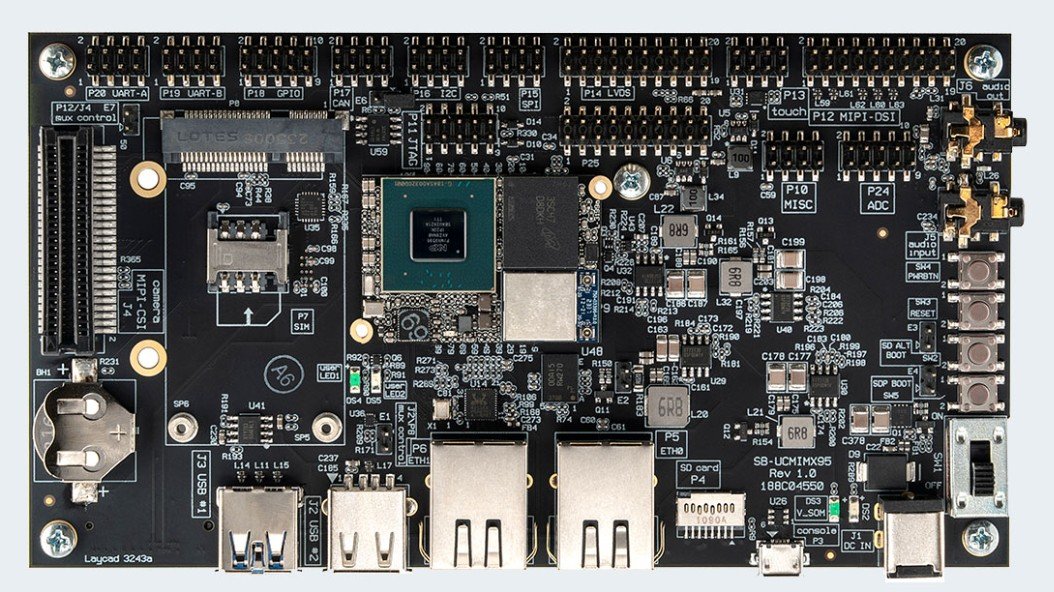
UCM-iMX952 evaluation kit
The carrier board provides two Gigabit Ethernet ports and a mini-PCIe socket for cellular modems, accompanied by an onboard micro-SIM socket. Expansion options also include an M.2 Key-M socket for NVMe storage, a microSD slot, and two USB 2.0 Type-A ports.
Additional interfaces are exposed through 100-mil headers, including two UARTs, CAN/CAN-FD, SPI, I2C, and up to 16 GPIOs. Debug and programming features include a micro-USB serial console, JTAG header, two programmable user LEDs, and a separate micro-USB connection supporting NXP’s SDP/UUU programming protocol.
For software, CompuLab lists Debian Linux, Yocto Project, and RTOS support, along with Board Support Packages, Linux kernel support, U-Boot, and ready-to-run images. The company also lists support for Docker, Microsoft Azure IoT, Node-RED, and Mender-based OTA updates.
Specifications listed for the UCM-iMX952 include:
- Processor:
- NXP i.MX952, dual- or quad-core Arm Cortex-A55 at up to 1.7GHz
- Arm Cortex-M7 up to 800MHz and Cortex-M33 up to 333MHz
- Graphics and AI:
- Arm Mali-G310 GPU with OpenGL ES 3.2, Vulkan 1.2, and OpenCL 3.0
- 4K VPU and eIQ Neutron NPU
- Memory and storage:
- 4GB to 16GB LPDDR5/LPDDR4X
- 16GB to 128GB eMMC
- Display:
- 2x 4-lane LVDS or 1x 8-lane LVDS, up to 1080p60
- 4-lane MIPI-DSI, up to 4K30 or 3840 x 1440 at 60Hz
- Camera and audio:
- MIPI-CSI, configurable as 1x 4-lane or 2x 2-lane
- Up to 5x I2S/SAI
- Networking:
- 2.5GbE SGMII, optional Gigabit Ethernet PHY, and secondary RGMII
- Optional Wi-Fi 6 and Bluetooth 5.4 BLE
- Expansion and I/O:
- PCIe Gen 3 x1 and 2x USB 2.0
- Up to 8x UART, 3x CAN-FD, 8x SPI, and 6x I2C
- Up to 2x SD/SDIO, 6x PWM, 8x ADC, and up to 94x GPIO
- System and debug:
- RTC and JTAG
- Connectors:
- 2x 100-pin, 0.4mm pitch
- Optional 40-pin, 0.4mm pitch
- Power:
- 3.45V to 5.5V input
- 1.8V / 3.3V digital I/O
- Dimensions:
- 28 x 40 x 5mm, 9g
- Operating temperature:
- Commercial: 0°C to 70°C
- Extended: -20°C to 70°C
- Industrial: -40°C to 85°C
Further Information
The UCM-iMX952 Evaluation Kit is listed as coming soon with pricing starting at $645. The kit includes a UCM-iMX952 module, SB-UCM-iMX95 carrier board, 12V power supply, adapters, and cables.
Optional accessories include a 7-inch LVDS display, 5-inch MIPI-DSI display, and Quectel EC25G LTE cellular modem.

Please comment here...