


wolfSSL webinar explores wolfIP network driver and RTOS integration
Sep 14, 2026 — by Giorgio Mendoza 116 views
wolfSSL will host a free webinar on September 30 titled “Porting wolfIP: From Network Drivers to RTOS Integration,” focused on adapting the company’s deterministic TCP/IP stack to new network hardware and real-time operating systems.
Embedded networking stacks can introduce unpredictable behavior when they rely on dynamic memory allocation, background processing, or resources that vary at runtime. Heap fragmentation can lead to allocation failures, while variable allocation times and memory corruption can make networking faults difficult to reproduce and analyze, particularly in real-time and safety-critical systems.
— ADVERTISEMENT —
wolfIP takes a different approach by defining networking resources before runtime. According to wolfSSL, the stack avoids dynamic memory allocation and hidden background threads, instead using compile-time-configured buffers, fixed socket tables, and pre-allocated transmit and receive packet buffers. This gives developers a bounded memory footprint and more predictable runtime behavior.
The webinar will examine how this architecture is maintained when wolfIP is moved to new hardware. The first portion will focus on the interface between the network stack and the underlying network controller, beginning with the packet-processing path through the wolfIP_poll() cycle and the responsibilities of the driver’s polling and transmission functions.
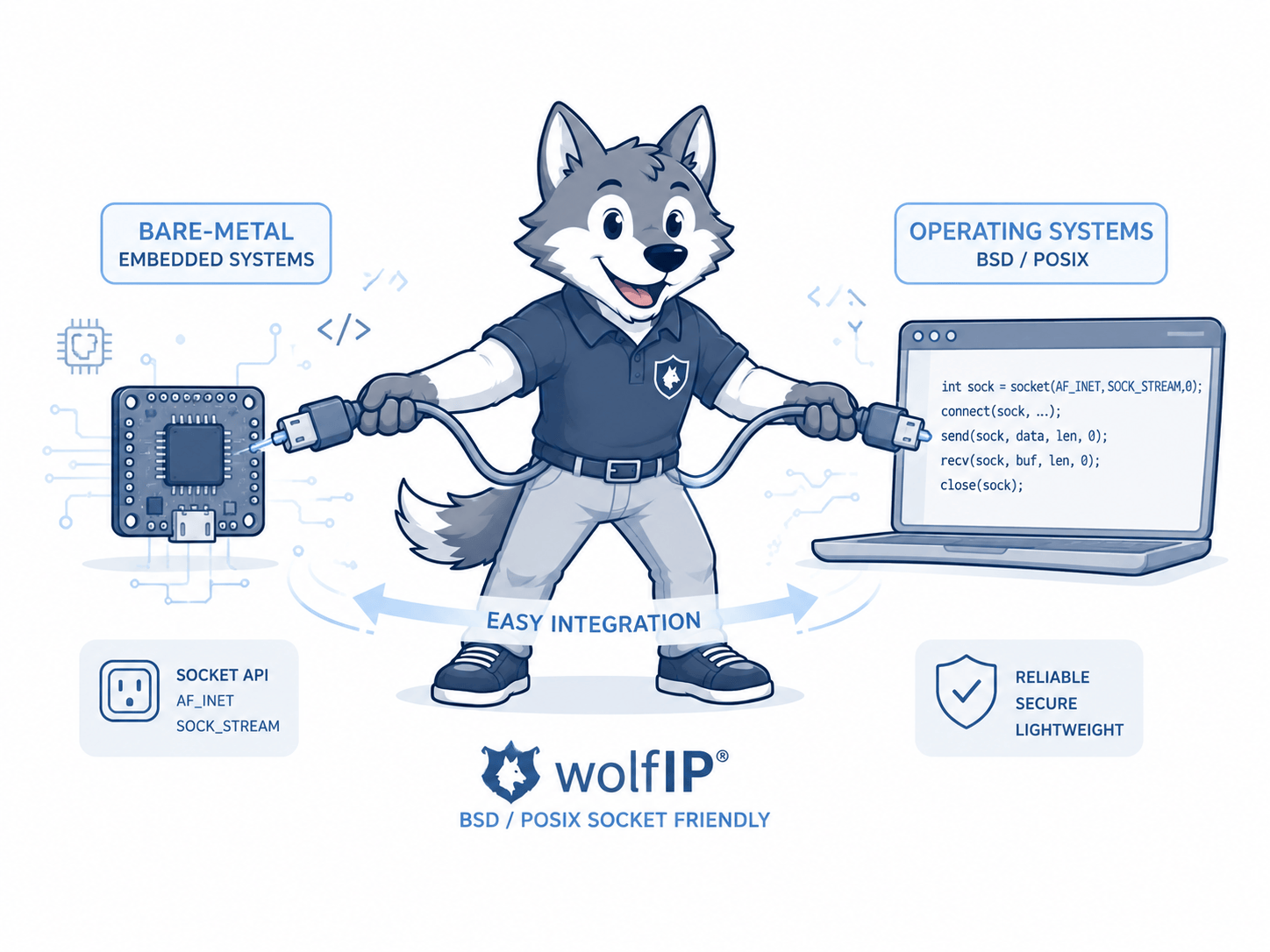
wolfIP integration for bare-metal and BSD/POSIX systems
The session will then move from simpler driver implementations to DMA-based network controllers. These designs require coordination between the processor and DMA engine over descriptor ownership and packet buffers, along with correct memory ordering and cache handling. Improper synchronization can result in corrupted descriptors, reused buffers, or dropped packets when traffic increases.
PHY initialization and the connection between the completed network driver and the higher-level stack will also be covered. wolfSSL describes wolfIP as using a relatively simple network-interface model intended for portability across bare-metal and RTOS environments, while supporting features including IPv4, ARP, ICMP, DHCP, DNS, UDP, TCP, and BSD-like socket APIs.
After the hardware portion, the webinar will address integration with an RTOS. The session will use a Zephyr port as a case study to show how a polling-based network stack can be connected to RTOS tasks, synchronization mechanisms, and blocking socket operations.
wolfSSL logo
One issue involves translating non-blocking network behavior into the blocking socket semantics expected by applications. wolfSSL explains that when an operation cannot immediately proceed, the associated task can wait until a network callback signals that the socket state has changed. Lock scope and wakeup handling are important here, since missed notifications or incorrect locking can leave sockets stalled or cause task deadlocks.
The webinar will also cover DMA rings, buffer ownership, memory ordering, cache coherency, PHY bring-up, task synchronization, network callbacks, and common porting problems that can cause dropped packets, missed wakeups, inconsistent locking, or unreliable initialization.
wolfIP was introduced earlier this year as a lightweight TCP/IP stack aimed at embedded, real-time, and safety-critical systems. Version 1.0.0 is listed with a March 31, 2026 release date. The stack can also be paired with wolfSSL for TLS 1.3 connectivity.
Further Information
The webinar will take place on Wednesday, September 30, 2026, at 11:00 AM EDT, 8:00 AM PDT, 4:00 PM BST, and 5:00 PM CEST. It will be presented by Daniele Lacamera, Senior Software Engineer at wolfSSL.

Please comment here...