


Handheld Linux computer offers i.MX95, Wi-Fi 6 and M.2 expansion
Sep 11, 2026 — by Giorgio Mendoza 500 views
Mecha’s Comet is a modular Linux handheld built around a 3.92-inch AMOLED touchscreen and offered with either an NXP i.MX8M Plus or i.MX95 processor, along with expandable storage, Wi-Fi 6, Bluetooth 5.4, and a magnetic 40-pin interface for keyboard, gamepad, and GPIO extensions. The handheld also provides USB-C connectivity, an 8MP camera, M.2 expansion, and a 4100mAh battery.
Originally launched through Kickstarter in January 2026, the Mecha Comet was offered with either an NXP i.MX8M Plus or i.MX95 platform. The project was fully funded, and both configurations are now available through dedicated product pages on Mecha’s website.
— ADVERTISEMENT —
The i.MX8M Plus configuration uses four Arm Cortex-A53 cores operating at up to 1.8GHz, along with a Cortex-M7 core running at up to 800MHz and a machine-learning accelerator rated at 2.3 TOPS. It is paired with 4GB or 8GB of LPDDR4 and 64GB or 128GB of eMMC storage, while graphics are handled by Vivante GC7000UL 3D and GC520L 2D GPUs. Video processing supports up to 1080p60 H.265, H.264, and VP9 decoding, together with 1080p60 H.265 and H.264 encoding.
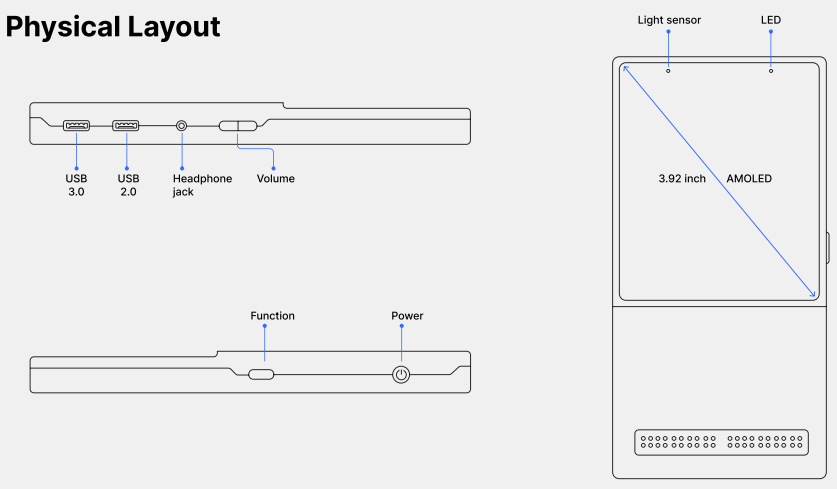
Mecha Comet physical layout
The i.MX95 configuration increases the CPU count to six Arm Cortex-A55 cores operating at up to 1.8GHz, together with a Cortex-M7 core clocked at up to 800MHz. AI acceleration is provided by an NXP eIQ Neutron NPU rated at up to 8 TOPS, while graphics are handled by an Arm Mali-G310 MP2 GPU operating at up to a 1GHz shader clock. Hardware video support includes 4K60 H.265, H.264, and VP9 decoding, along with 4K60 H.265 and H.264 encoding.
Memory options for the i.MX95 version include 4GB or 8GB of LPDDR5 operating at 4266MT/s, paired with 64GB or 128GB of onboard eMMC storage. A microSD slot provides additional removable storage.
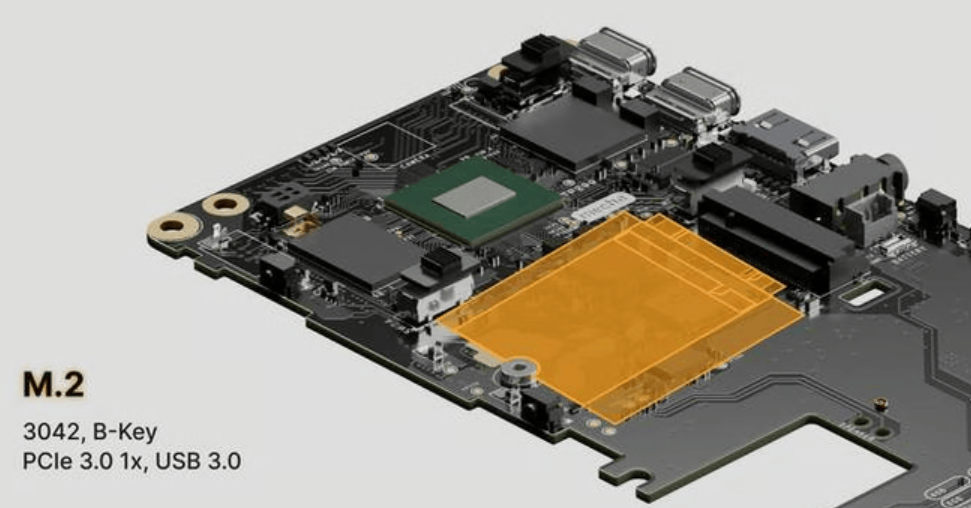
Mecha Comet M.2 expansion slot
The handheld uses a 3.92-inch AMOLED panel with a 1080 × 1240 resolution, 500-nit brightness rating, and five-point capacitive touch support. DisplayPort output over USB Type-C supports external displays at up to 2K60 with audio. The Comet also integrates an 8MP Sony IMX219 camera, a 1.2W speaker, 3.5mm audio jack, and two digital microphones.
Wireless connectivity consists of Wi-Fi 6 and Bluetooth 5.4 with BLE and LE Audio support. Physical connectivity includes two USB 3.0 Type-C ports and one USB 2.0 Type-C port, with USB Power Delivery support up to 24V. Sensors include an accelerometer, gyroscope, magnetometer, and ambient-light sensor, together with a vibration motor and programmable RGB LED.
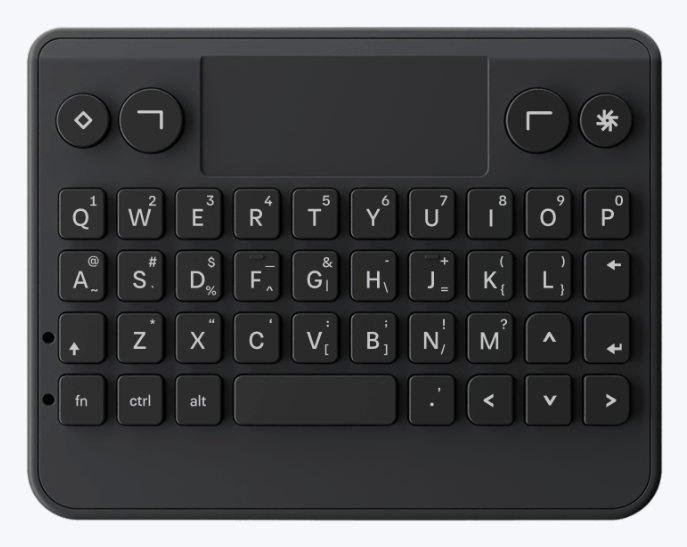
Keyboard Extension
The internal M.2 interface supports PCIe Gen3 x1 and USB 3.0 signals in B-Key 2242 and 3042 formats. It can be used for LTE modems or, through a B-Key-to-M-Key adapter, a 2230 NVMe SSD. Mecha also lists planned or in-development support for LoRa, AI accelerator, and FPGA modules.
According to the company, the base Comet will ship without a cellular modem or antennas. Optional LTE kits will instead add dedicated antenna brackets and RF cabling, with a voice-enabled Quectel EM060K-GL modem planned for selected regions including the U.S., Canada, EU, UK, and India. The modem also supports L1 GNSS.
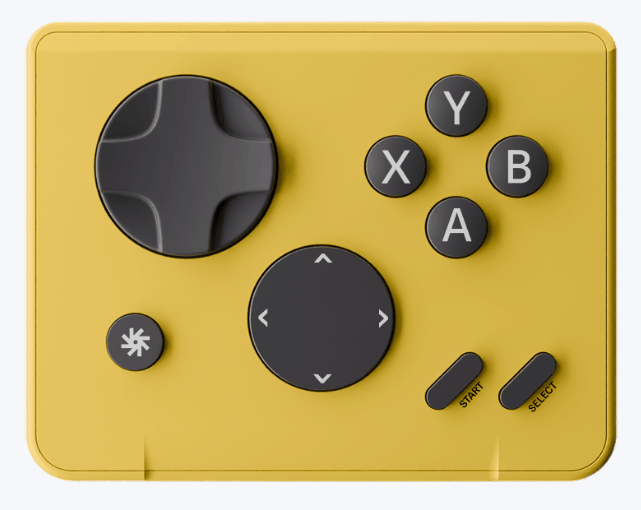
Gamepad Extension
The antenna system is also being prepared for possible future 5G RedCap support by extending coverage into the 3.3GHz to 4.0GHz range. Mecha says this could allow users to replace the LTE modem later with a compatible 5G RedCap module, although 5G modem options are not currently being offered.
The Comet’s extension system uses a magnetic 40-pin interface for attaching accessory modules. Mecha currently lists keyboard, gamepad, and GPIO extensions. The keyboard includes RGB backlighting and QMK compatibility, while the gamepad provides programmable controls and a trackpad. The GPIO extension adds serial-console access, CAN bus connectivity, and general-purpose interfaces. Mecha states that its standard extensions are open hardware and provides documentation and pin diagrams for users developing their own modules.
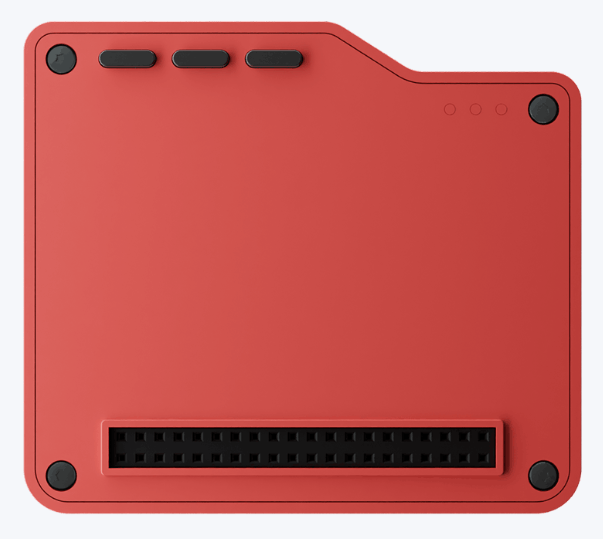
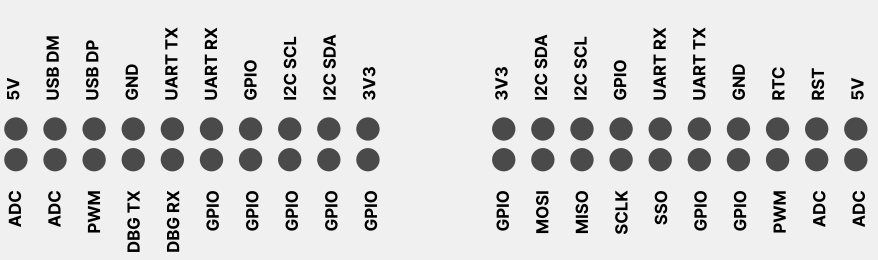
IO Breakout Extension & Pinout
Mechanical drawings, 3D CAD files, repair documentation, and PCB schematics are also part of the company’s open-hardware support. Mecha says PCB source files will be published once the Comet enters mass production.
Recent development work has focused on the i.MX95 hardware revision and system validation. Mecha reported that its first assembled i.MX95 boards were completed around August 31 to September 1, using a 12-layer, 1.2mm PCB populated with approximately 1,190 components. Board bring-up and peripheral testing were underway as of the company’s September update.
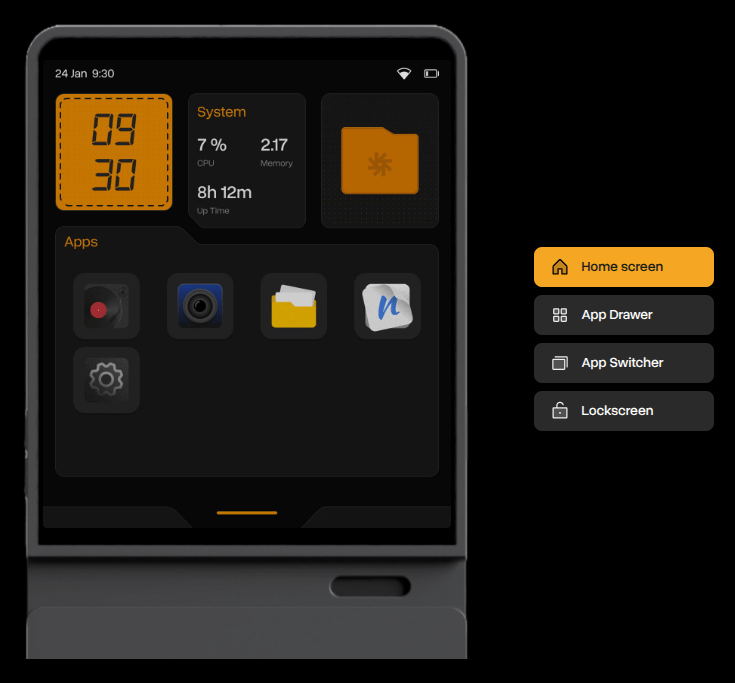
Mechanix OS interface
Power-management work has included Wi-Fi power-save modes, DDR frequency scaling, and display self-refresh. Mecha reported reducing idle consumption from approximately 1.5W to 0.8W in one test by lowering DDR speed during idle, although additional display synchronization work remained in progress.
Software is based on Mecha’s Mechanix distribution, using Linux 6.12 and Fedora 43, with U-Boot 2025.04. Mechanix includes a custom graphical shell and native applications for files, camera, music, and notes, while the bootloader, kernel, and root filesystem are available as open-source projects.
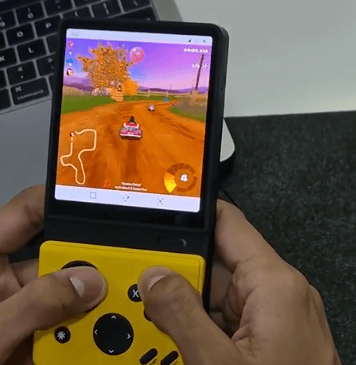
Mecha Comet demo
Mecha has also been developing its own Wayland compositor based on Smithay, along with a Rust-based UI stack and Flutter components. Recent work has included display color correction and USB 3.0 stability fixes, in addition to the power-management changes described above.
Specifications listed for the Mecha Comet include:
| Feature | i.MX8M Plus | i.MX95 |
|---|---|---|
| SoC | NXP i.MX8M Plus | NXP i.MX95 |
| CPU | 4x Cortex-A53 @ up to 1.8GHz | 6x Cortex-A55 @ up to 1.8GHz |
| Auxiliary core | Cortex-M7 @ up to 800MHz | Cortex-M7 @ up to 800MHz |
| AI accelerator | ML accelerator, up to 2.3 TOPS | eIQ Neutron NPU, up to 8 TOPS |
| GPU | Vivante GC7000UL 3D + GC520L 2D | Arm Mali-G310 MP2 |
| Video | Up to 1080p60 H.265/H.264/VP9 decode; 1080p60 H.265/H.264 encode | Up to 4K60 H.265/H.264/VP9 decode; 4K60 H.265/H.264 encode |
| Memory | 4GB or 8GB LPDDR4, 4266MT/s | 4GB or 8GB LPDDR5, 4266MT/s |
| eMMC | 64GB or 128GB | 64GB or 128GB |
| Display | 3.92-inch AMOLED, 1080 × 1240, 500 nits, 5-point touch | Same |
| Display output | DisplayPort over USB-C, up to 2K60 with audio | Same |
| Camera | 8MP Sony IMX219 | Same |
| Wireless | Wi-Fi 6, Bluetooth 5.4, BLE, LE Audio | Same |
| Expansion | PCIe Gen3 x1 M.2 B-Key; microSD; 2230 NVMe support | Same |
| USB | 2x USB 3.0 Type-C; 1x USB 2.0 Type-C | Same |
| Battery | 4100mAh LiPo | Same |
| Sensors | Accelerometer, gyroscope, magnetometer, ambient-light sensor | Same |
| Extension interface | 40-pin magnetic interface | Same |
| Dimensions | 73 × 155 × 14mm | Same |
| Weight | 225g | Same |
Further Information

One of the most interesting pieces of hardware to debut in some time.