


Diamond Technologies Adds New OSM Modules Based on i.MX 91, i.MX 93, and STM32MP2
Nov 22, 2025 — by Giorgio Mendoza 322 views Diamond Technologies, Inc. has introduced three new OSM-based embedded computing modules: the DEC i.MX 91-OSM, DEC i.MX 93-OSM, and DEC MP2-OSM. Designed and supported in the United States, the modules expand the company’s embedded lineup with new processing, connectivity, and edge-level compute options.
The new modules target connected industrial equipment, energy-efficient edge systems, and compact embedded devices. Each product supports an industry-standard OSM-L footprint, allowing reuse of carrier designs across processor families and simplifying future upgrades. The i.MX 91 and i.MX 93 modules extend Diamond’s NXP-based offerings, while the MP2-OSM brings STMicroelectronics’ STM32MP2 processor family into the same mechanical and electrical framework.
— ADVERTISEMENT —
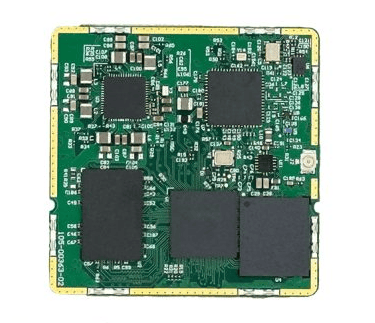
DEC i.MX 91
The DEC i.MX 91-OSM module is built around NXP’s i.MX 91 processor, which combines a single Arm Cortex-A55 core running up to 1.4 GHz with an Arm Cortex-M33 co-processor for secure real-time control. The design focuses on low power consumption, predictable performance, and stable connectivity for cost-sensitive embedded systems. LPDDR4X support up to 2 GB and optional eMMC storage provide a compact memory configuration within the module’s 45 × 45 mm OSM-L form factor.
Connectivity options include dual-band Wi-Fi 6, Bluetooth 5.4, and 802.15.4 for Thread and Matter deployments, in addition to dual Gigabit Ethernet via RGMII with AVB and IEEE 1588 support. Peripheral expansion covers UART, SPI, I²C, I3C, CAN-FD, and up to 64 multiplexed GPIOs. Display interfaces include 24-bit RGB, and camera support includes an 8-bit YUV/RGB parallel input. The module also integrates multiple audio interfaces such as I2S, SAI, PDM, and S/PDIF.
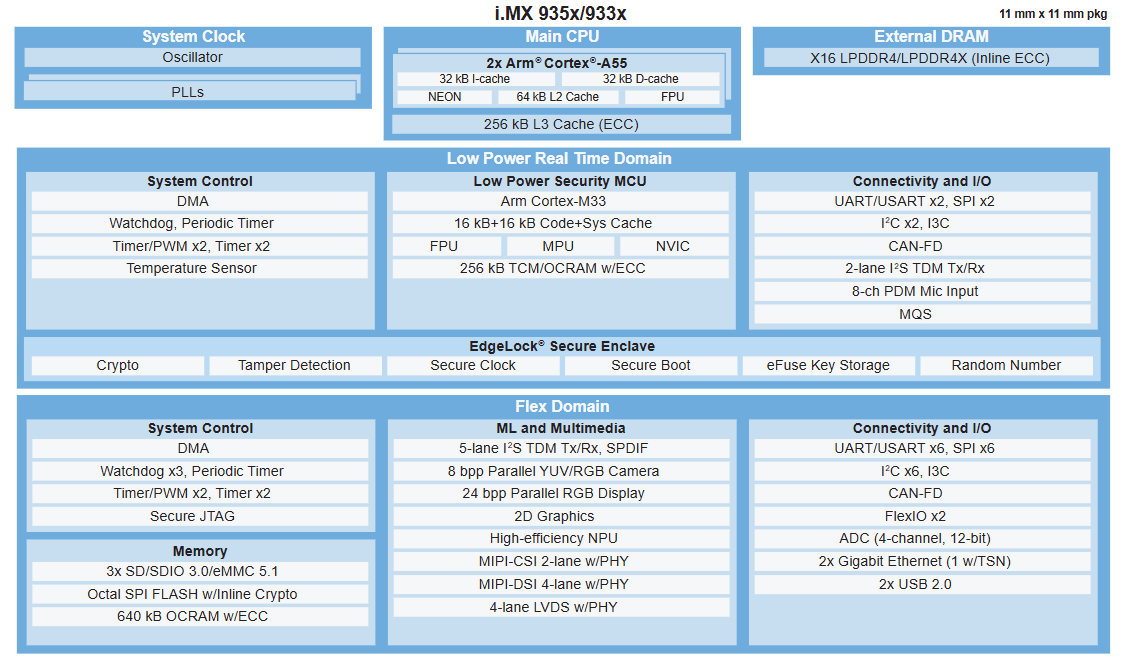
i.MX 93 Family Block Diagram
Diamond’s DEC i.MX 93-OSM extends performance with NXP’s i.MX 93 processor, combining up to two Arm Cortex-A55 cores at 1.7 GHz, an Arm Cortex-M33 for real-time tasks, and an Ethos U-65 microNPU for edge machine learning acceleration. The module supports up to 2 GB of LPDDR4X, configurable eMMC, and the same OSM-L mechanical footprint as the i.MX 91-OSM.
Interfaces include Wi-Fi 6, Bluetooth 5.4, 802.15.4, and dual Gigabit Ethernet with TSN support. Display outputs expand to MIPI-DSI and LVDS in addition to 24-bit RGB. Camera support widens with MIPI CSI-2 at up to 1080p60. The module also provides multiple serial interfaces, CAN-FD, and an on-board low-power RTC.
The i.MX 93-OSM is aimed at intelligent edge processing, industrial automation, medical equipment, and connected systems that benefit from integrated machine learning acceleration.
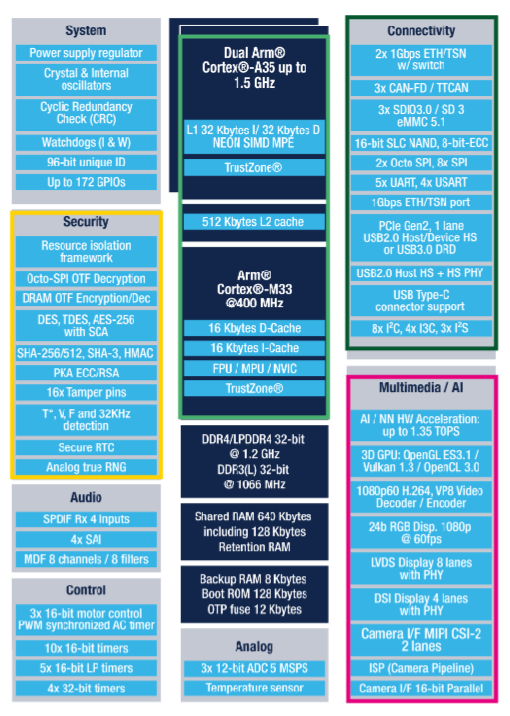
STM32MP2 Family Block Diagram
The DEC MP2-OSM module introduces the STMicroelectronics STM32MP2 family to Diamond’s OSM lineup. It integrates up to two Arm Cortex-A35 cores at 1.5 GHz along with an Arm Cortex-M33 real-time processor. Memory options scale to 4 GB of 32-bit LPDDR4, with configurable eMMC storage.
The STM32MP2 includes an optional NPU providing up to approximately 1.35 TOPS, enabling local AI and ML inference without relying on external processing. Connectivity includes Wi-Fi 6, Bluetooth 5.4, and three Gigabit Ethernet interfaces. High-speed I/O support includes PCIe, USB 2.0, USB 3.0, SD/MMC, CAN-FD, UART, I²C, I3C, and SPI. Display support spans MIPI-DSI and dual-channel LVDS up to 1536p60, while camera input is provided through MIPI CSI-2 at up to 5 MP. Additional features include multiple audio interfaces, up to 64 GPIOs, and JTAG debugging.
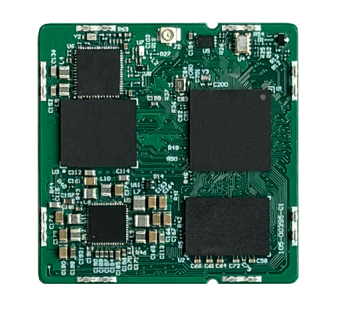
DEC MP2-OSM
This module targets industrial systems, connected devices, and embedded applications that require long-lifecycle components, low power operation, and a consistent OSM hardware format.
All three modules follow the OSM-L specification, measuring 45 × 45 mm and weighing approximately 11 g. The standard provides a consistent mechanical and electrical interface, enabling drop-in replacement or upgrades across processor families.
Further Information
Diamond Technologies has posted preliminary product pages for the modules, but pricing details have not yet been disclosed.

Please comment here...