


Solar-powered PV PI HAT delivers continuous off-grid operation for Raspberry Pi projects
Nov 6, 2025 — by Giorgio Mendoza 5,356 views
Kickstarter recently featured the PV PI, a solar charging HAT designed to power Raspberry Pi and other 5V single board computers from a 12V LiFePO4 battery. The add-on enables continuous 24/7 off-grid operation through MPPT-based solar charging and intelligent power management.
Developed by Melbourne-based engineer Luke Ditria and his team at AutoEcology, the PV PI simplifies solar integration for embedded projects by combining high-current charging, power monitoring, and automated control into a single plug-and-play module.
— ADVERTISEMENT —
It provides true MPPT (Maximum Power Point Tracking) charging for optimal efficiency, allowing batteries to charge quickly and maintain system uptime even during cloudy periods.
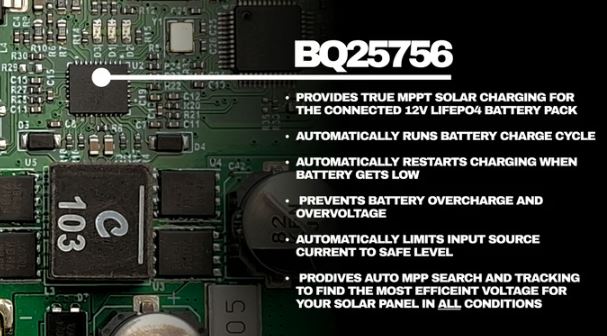
PV PI Onboard BQ25756
The PV PI uses a Texas Instruments BQ25756 charge controller and an STM32F103 microcontroller, which together handle power automation, monitoring, and communication with the Raspberry Pi. The system supports plug-and-play operation, using XT30 connectors for solar and battery inputs and powering the Pi via the standard 40-pin GPIO header.
Additionally, the STM32 MCU provides smart power management features such as configurable 5V control, watchdog-based power cycling, and RTC-based wake-up scheduling. It can monitor battery voltage, automatically restart the Pi once safe voltage thresholds are reached, and cut power during idle periods to conserve energy.
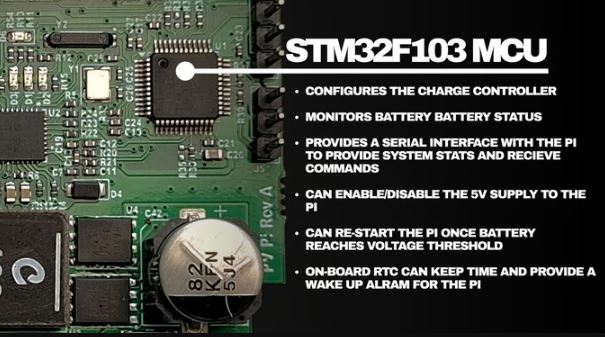
PV PI Onboard STM32F103 MCU
The PV PI also includes a high-current buck/boost converter to regulate 5V output for the Pi and peripherals, maintaining stable operation even as battery levels fluctuate.
Monitoring data and commands are exchanged over UART using the PySerial Python library, which allows integration with compatible SBCs such as Orange Pi, Banana Pi, and some NVIDIA Jetson boards (excluding newer models that require higher input voltages).
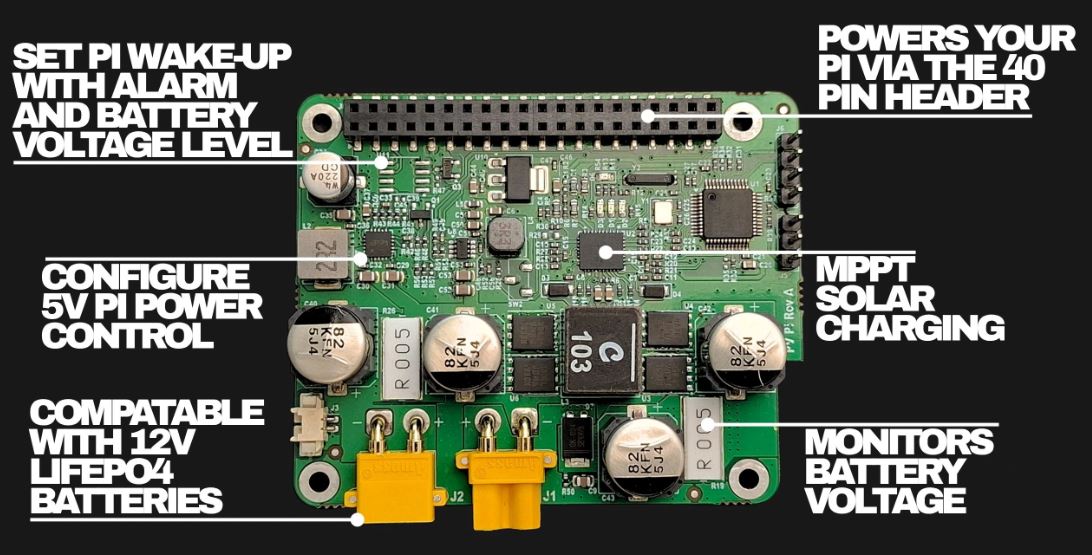
PV PI Main Features Overview
Communication between the PV PI and host board uses a serial interface rather than I²C, ensuring compatibility across platforms. Developers can send and receive system statistics, issue power control commands, and configure charging parameters directly through Python scripts. As mentioned earlier, the onboard STM32 firmware manages the charging logic, solar tracking, and RTC alarms, minimizing software overhead on the main system.
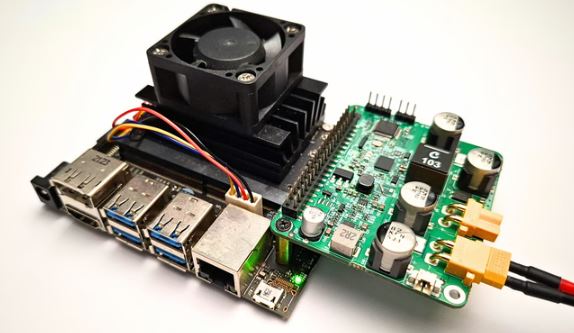
PV PI + NVIDIA Jetson Board
Further Information
The PV PI Kickstarter campaign offers several reward tiers with global shipping planned for March 2026. Backers can pledge AU$99 (≈US$65) for the Ride Solo tier, which includes one PV PI and an accessory pack, or AU$267 (≈US$174) for the Triple Threat bundle with three boards at a 10% discount.
Larger packages include the High Five! tier at AU$420 (≈US$274) for five boards with a 15% discount and The Fleet at AU$790 (≈US$515) for ten boards with a 20% discount.
Each kit includes standoffs, a stackable 40-pin header, and XT30 pigtails for immediate setup. According to a recent project update, the team has completed prototype validation and finalized the production design, adding external 5V and UART breakout headers along with RTC backup power.

Please comment here...