


ODROID-M1S goes Lite with 2GB RAM, NVMe and 4K video
Sep 8, 2026 — by Giorgio Mendoza 385 views Hardkernel has spun its ODROID-M1S into a Lite version, offering a lower-cost configuration of the RK3566-based single-board computer. The board includes 2GB of LPDDR4 memory, soldered eMMC storage, Gigabit Ethernet, HDMI 2.0, MIPI-DSI, USB 3.0, an M.2 NVMe slot, and Ubuntu support.
The ODROID-M1S Lite is based on Rockchip’s RK3566 processor, which integrates four Arm Cortex-A55 cores operating at up to 1.8GHz, a Mali-G52 GPU with two execution engines, and an RKNN neural processing unit rated at up to 0.8 TOPS of INT8 performance.
— ADVERTISEMENT —
Compared with the standard ODROID-M1S, which is offered with 4GB or 8GB of LPDDR4 memory and 64GB of onboard eMMC, the Lite configuration reduces memory and storage to 2GB of LPDDR4 and 32GB of eMMC. Additional storage is available through a microSD slot and an M.2 M-Key connector supporting PCIe 2.1 x1 NVMe SSDs.

ODROID-M1S Lite block diagram
For display output, the board provides an HDMI 2.0 interface supporting resolutions up to 4K at 60Hz, together with a four-lane MIPI-DSI connector. Hardkernel also offers the ODROID-Vu8S, an 8-inch 800 × 1280 capacitive touchscreen that can connect directly to the MIPI-DSI interface for HMI applications.
Networking is handled through a Gigabit Ethernet port using a Realtek RTL8211F transceiver. USB connectivity consists of one USB 3.0 host port, one USB 2.0 host port, and one Micro-USB 2.0 OTG interface, while a separate USB Type-C connector provides 5V power input.
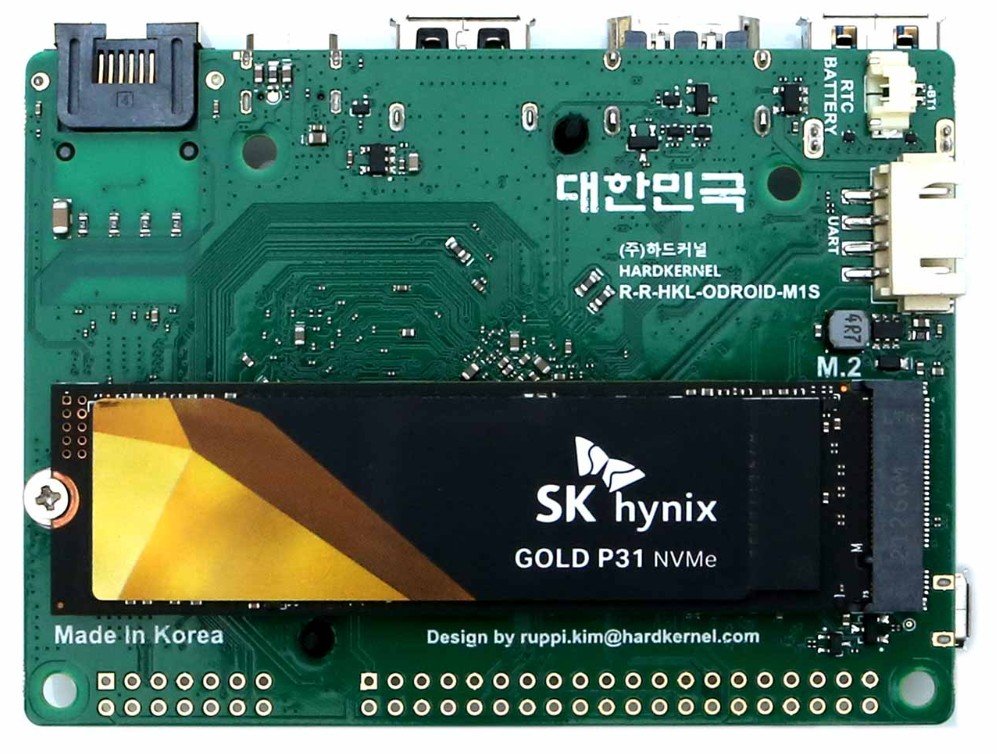
ODROID-M1S with NVMe SSD
Expansion is available through optional 40-pin and 14-pin GPIO headers exposing interfaces including UART, I2C, PWM, ADC, SPI, USB 2.0, analog audio, and power and reset signals. Hardkernel leaves the GPIO headers unpopulated by default as a cost-saving measure and offers header installation as an option.
The board also includes a UART system console, RTC backup-battery connector, system status LEDs, and an M.2 activity indicator. It measures 90 × 65 × 16mm and weighs approximately 52g with the heatsink installed.
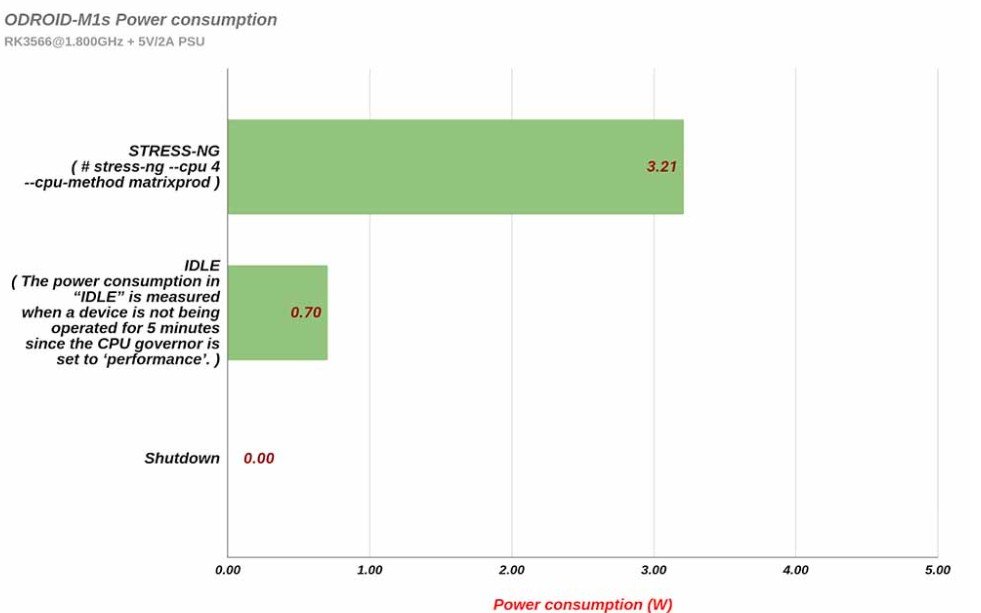
ODROID-M1S Lite power consumption
Hardkernel publishes power measurements showing approximately 3.7W peak consumption during boot with HDMI and Ethernet connected, falling to around 1.5W at the Ubuntu desktop. Idle consumption drops to about 1W in a headless configuration and approximately 0.7W when Ethernet is also disconnected. During a CPU stress test without HDMI or Ethernet, the company measured roughly 3.2W.
The stock heatsink is also intended to provide passive cooling without requiring a fan. In Hardkernel’s testing at an ambient temperature of 25°C, CPU temperature remained below 65°C under sustained load with the heatsink alone. With the board installed inside its enclosure, temperatures remained below 75°C without thermal throttling.

ODROID-M1S thermal stress test
The standard ODROID-M1S supports Android 11, Ubuntu 20.04 LTS, and Ubuntu 22.04 LTS, along with drivers for the Mali GPU, MIPI-DSI, GPIO, NPU, and video-processing hardware. Given the shared RK3566 platform, the Lite version is expected to offer similar software compatibility.
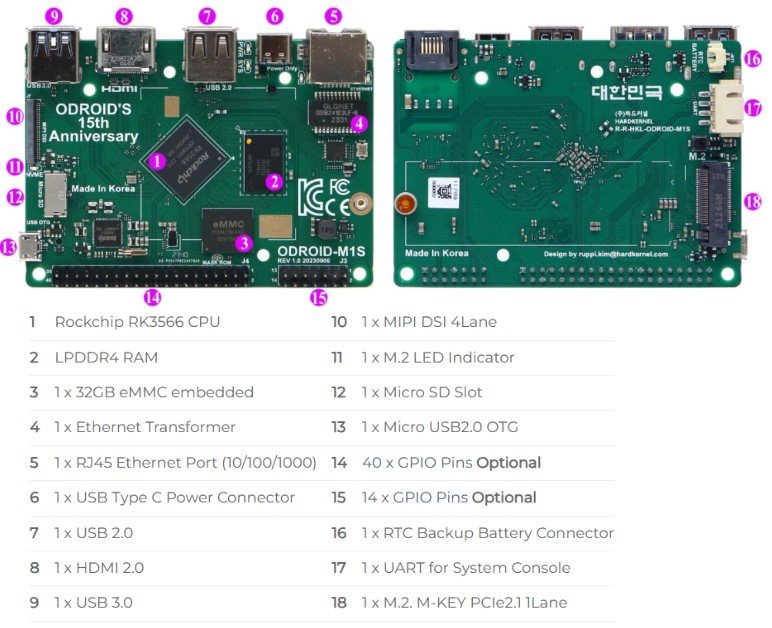
ODROID-M1S Lite features
Documentation available through the ODROID wiki and GitHub repositories covers OS installation, schematics, datasheets, 3D models, KiCad carrier and add-on board resources, bootloader and kernel development, device-tree overlays, GPIO access, UART, PWM, I2C, SPI, CAN, NPU acceleration, VPU support, and display interfaces.
Specifications listed for the ODROID-M1S Lite include:
- Processor:
- Rockchip RK3566
- 4x Cortex-A55 @ up to 1.8GHz
- Graphics:
- Mali-G52 GPU
- AI:
- RKNN NPU
- Up to 0.8 TOPS INT8
- Memory:
- 2GB LPDDR4
- Storage:
- 32GB eMMC
- microSD
- M.2 M-Key PCIe 2.1 x1 NVMe
- Networking:
- Gigabit Ethernet
- Display:
- HDMI 2.0 up to 4K60
- 4-lane MIPI-DSI
- USB:
- USB 3.0 host
- USB 2.0 host
- Micro-USB 2.0 OTG
- Expansion:
- Optional 40-pin GPIO header
- Optional 14-pin GPIO header
- UART, I2C, SPI, PWM, ADC
- Power:
- USB Type-C
- 5V/3A recommended
- Mechanical:
- 90 × 65 × 16mm
- 52g with heatsink
Further Information

Please comment here...