


youyeetoo updates R1 SBC and lists K1 N100-based x86 computer
Jun 10, 2026 — by Giorgio Mendoza 398 views
youyeetoo has updated its R1 single-board computer to version 3.0 and has also listed the K1, a palm-sized x86 edge computer based on Intel’s Alder Lake-N N100 processor. The two systems are aimed at compact AIoT, embedded, industrial, and edge computing applications, but use different processor platforms and expansion layouts.
The youyeetoo R1 v3.0 remains based on the Rockchip RK3588S, an 8nm octa-core processor with four Cortex-A76 cores and four Cortex-A55 cores running at up to 2.4GHz. The board also integrates an Arm Mali-G610 MP4 GPU and a 6 TOPS neural processing unit with support for INT4, INT8, and INT16 mixed-precision workloads through frameworks such as TensorFlow, MXNet, PyTorch, Caffe, and RKNN.
— ADVERTISEMENT —
The updated R1 board keeps the same 100 x 69.3 mm footprint as the previous version, but changes the storage and USB layout. The M.2 M-key area on the bottom side now supports 2280 SSDs, making the layout more suitable for larger storage devices. The new revision also changes the external USB arrangement to four USB-A ports, including three USB 2.0 ports and one USB 3.0 port.
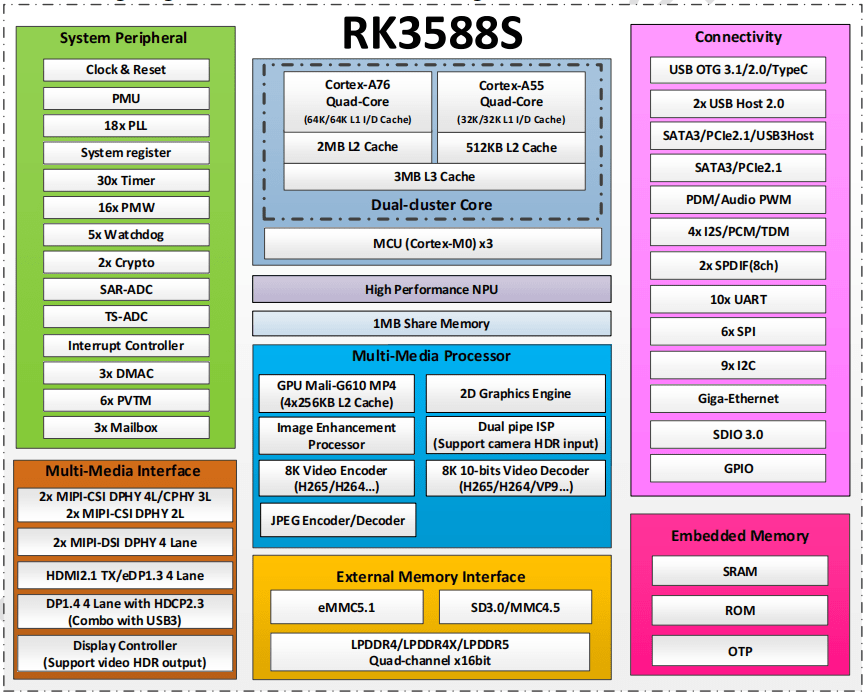
RK3588S SoC block diagram
Unlike the earlier version, the R1 v3.0 no longer includes the USB-C port. Instead, the USB 3.0 interface can operate in host or device mode, selected through a DIP switch on the back of the board.
Memory options include 4GB, 8GB, 16GB, or 32GB of LPDDR4 RAM, along with 32GB, 64GB, 128GB, or 256GB of eMMC storage. The board also includes a microSD card slot and an M.2 M-key socket for NVMe or SATA SSD storage. The same M.2 interface can also be used for 4G LTE expansion through an adapter board.
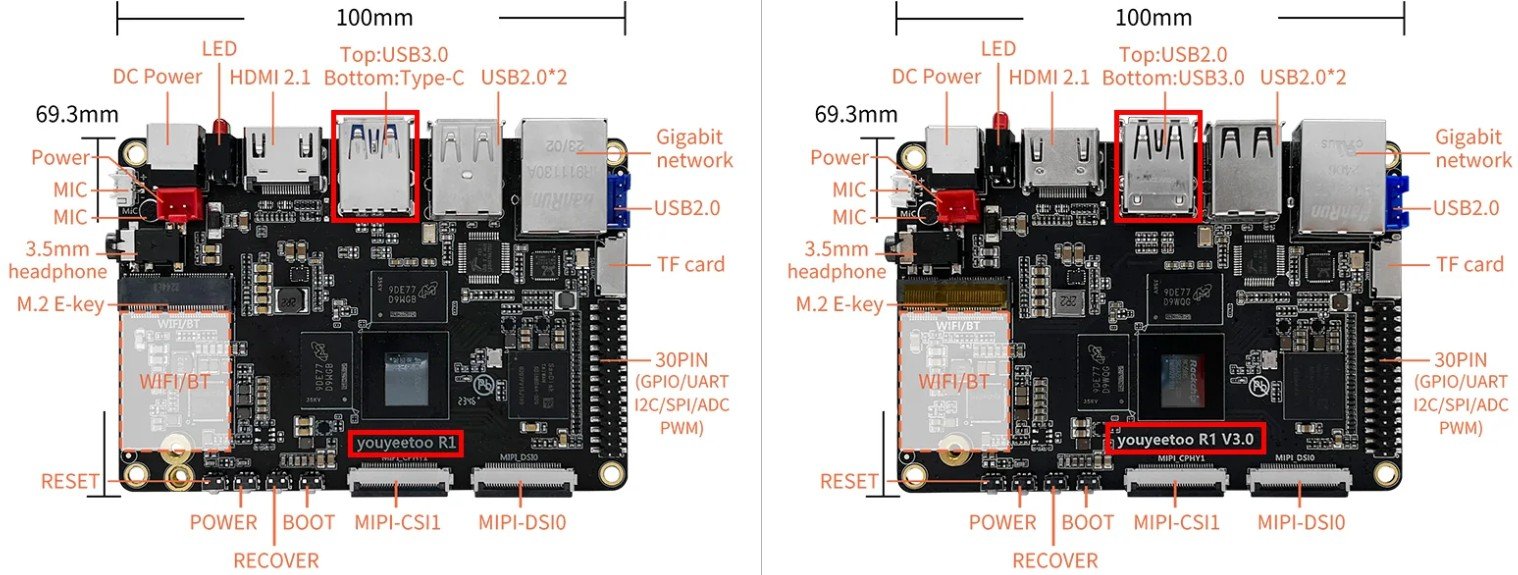
Youyeetoo R1 top view comparison
Display support includes an HDMI 2.1 output with support for up to 8K at 60Hz or 4K at 120Hz. The board also provides two MIPI DSI interfaces for display expansion and two 4-lane MIPI CSI interfaces for cameras. Optional HDMI input is supported up to 4K at 60Hz through an RK628D adapter board connected to the MIPI CSI interface.
For networking, the R1 includes a Gigabit Ethernet port and an M.2 E-key socket for WiFi and Bluetooth modules. youyeetoo lists support for WiFi 5 with Bluetooth 5.0, as well as WiFi 6 with Bluetooth 5.2. The board also includes NFC support with an external antenna connection, with examples for data transfer using Android or iOS phones.
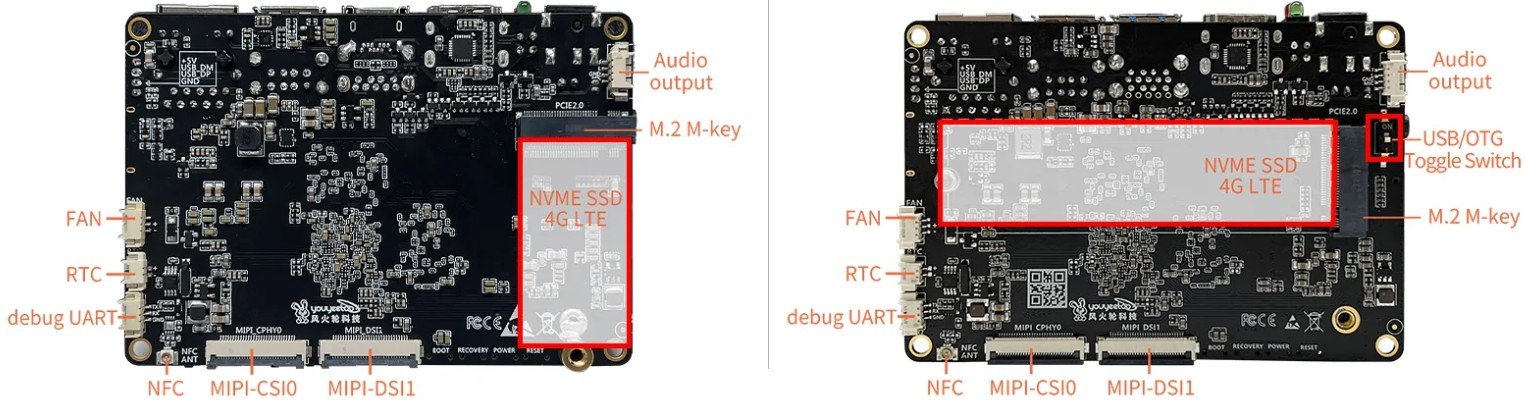
Youyeetoo R1 bottom view comparison
The 30-pin expansion socket provides access to three I2C buses, three UART interfaces, one CAN interface, PWM, two ADC inputs, seven GPIO pins, SPI through pin multiplexing, and 3.3V/5V power pins.
Additional onboard features include a 3.5mm audio jack with microphone support, HDMI audio, onboard microphone, debug UART, programmable red and green LEDs, fan connector, RTC battery connector, and boot, reset, recovery, and power buttons.

Youyeetoo K1 SoM
The second system is the youyeetoo K1, a modular x86 edge computer built around the Intel N100 processor. It uses an 82 x 71 mm core board and a 134 x 92 mm baseboard, with the Alder Lake-N chip providing four cores, four threads, a 0.8GHz base frequency, up to 3.4GHz turbo frequency, Intel UHD Graphics up to 750MHz, and a 6W TDP.

Youyeetoo K1 bottom view
Memory options include 8GB or 16GB of LPDDR5, while onboard eMMC options include 64GB, 128GB, and 256GB depending on configuration. Storage expansion includes an M.2 2280 slot for NVMe or SATA SSDs, along with SATA 3.0 support.
The K1 carrier board provides dual Gigabit Ethernet, optional WiFi 5 or WiFi 6 with Bluetooth through an M.2 E-key module, and optional 4G LTE expansion. Display interfaces include HDMI 2.0, micro-HDMI, MIPI DSI, and eDP, with the HDMI ports supporting up to 4K at 60Hz.

Youyeetoo K1 top view
USB connectivity includes two USB 3.0 ports, two USB 2.0 ports, a USB Type-C port, and additional USB headers. Other I/O includes UART, I2C, SPI, GPIO, PWM, MIPI CSI, audio input and output, RTC, LEDs, power and reset buttons, fan control, software watchdog support, CPU temperature monitoring, and passive NFC support.
The K1 supports Windows 10/11, Ubuntu, and Debian, with documentation for setup, drivers, wireless connectivity, 4G LTE, and basic hardware access. Likewise, the R1 supports Android 13, Debian 11, Ubuntu 22.04, Buildroot, and OpenHarmony, with guides for firmware flashing, system setup, peripherals, camera, NFC, and NPU development.
Further Information
The youyeetoo R1 v3.0 Basic Kit starts at $162.99 with 4GB RAM and 32GB eMMC, while the K1 starts at $209.99 with 8GB LPDDR5 and 128GB eMMC. A higher-end K1 configuration with 16GB LPDDR5 and 256GB eMMC is also listed.

Please comment here...