


Ventuno Q runs Ubuntu on Dragonwing IQ8 with 40-TOPS NPU along with real-time STM32H5
Aug 31, 2026 — by Giorgio Mendoza 672 views Arduino recently opened pre-orders for the Ventuno Q, a dual-processor development board designed for edge AI, robotics, computer vision, and industrial applications. The platform pairs a Qualcomm Dragonwing IQ8 application processor with an STM32H5 microcontroller and ships with Ubuntu pre-installed alongside Arduino’s App Lab development environment.
The Ventuno Q was first shown in March this year and is based on the Qualcomm Dragonwing IQ8 IQ-8275, which integrates an eight-core Qualcomm Kryo CPU, an Adreno 623 GPU, a Spectra 692 image signal processor, and a Hexagon NPU rated for up to 40 dense TOPS of AI acceleration.
— ADVERTISEMENT —
Alongside the application processor is an STM32H5F5 microcontroller from STMicroelectronics based on an Arm Cortex-M33 core running at 250MHz, with 4MB of flash and 1.5MB of RAM. The microcontroller handles deterministic tasks such as motor control, sensor acquisition, PWM, GPIO, and other real-time operations.
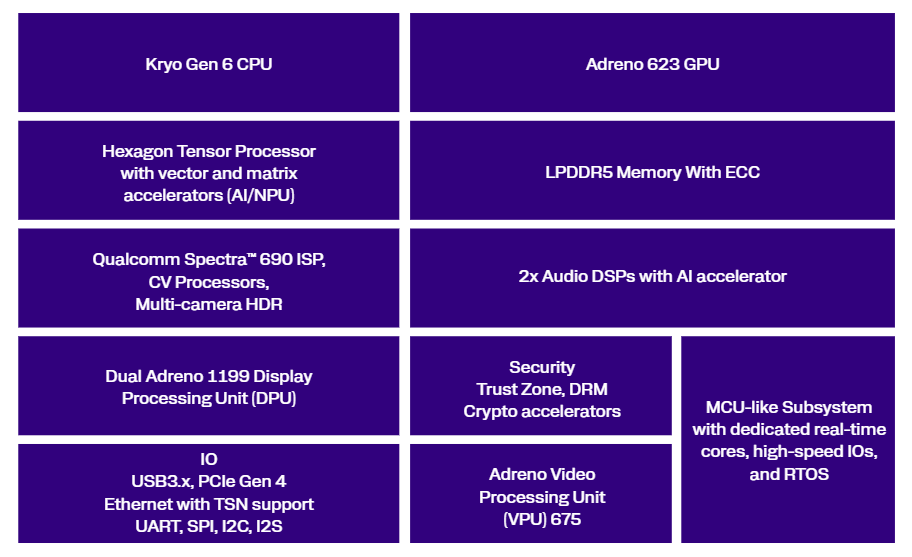
IQ8 series block diagram
Communication between the two processors is handled through an RPC bridge, allowing applications running under Linux on the Dragonwing processor to interact with peripherals and control functions handled by the STM32H5.
The board includes 16GB of LPDDR5 memory arranged as two 8GB devices. The memory capacity allows local AI models to run alongside the operating system and application software, including multimodal language and vision workloads.
Onboard storage consists of 64GB of eMMC for the operating system, AI models, applications, and local data. Additional storage can be added through an M.2 connector supporting NVMe SSDs over a Gen4 interface.
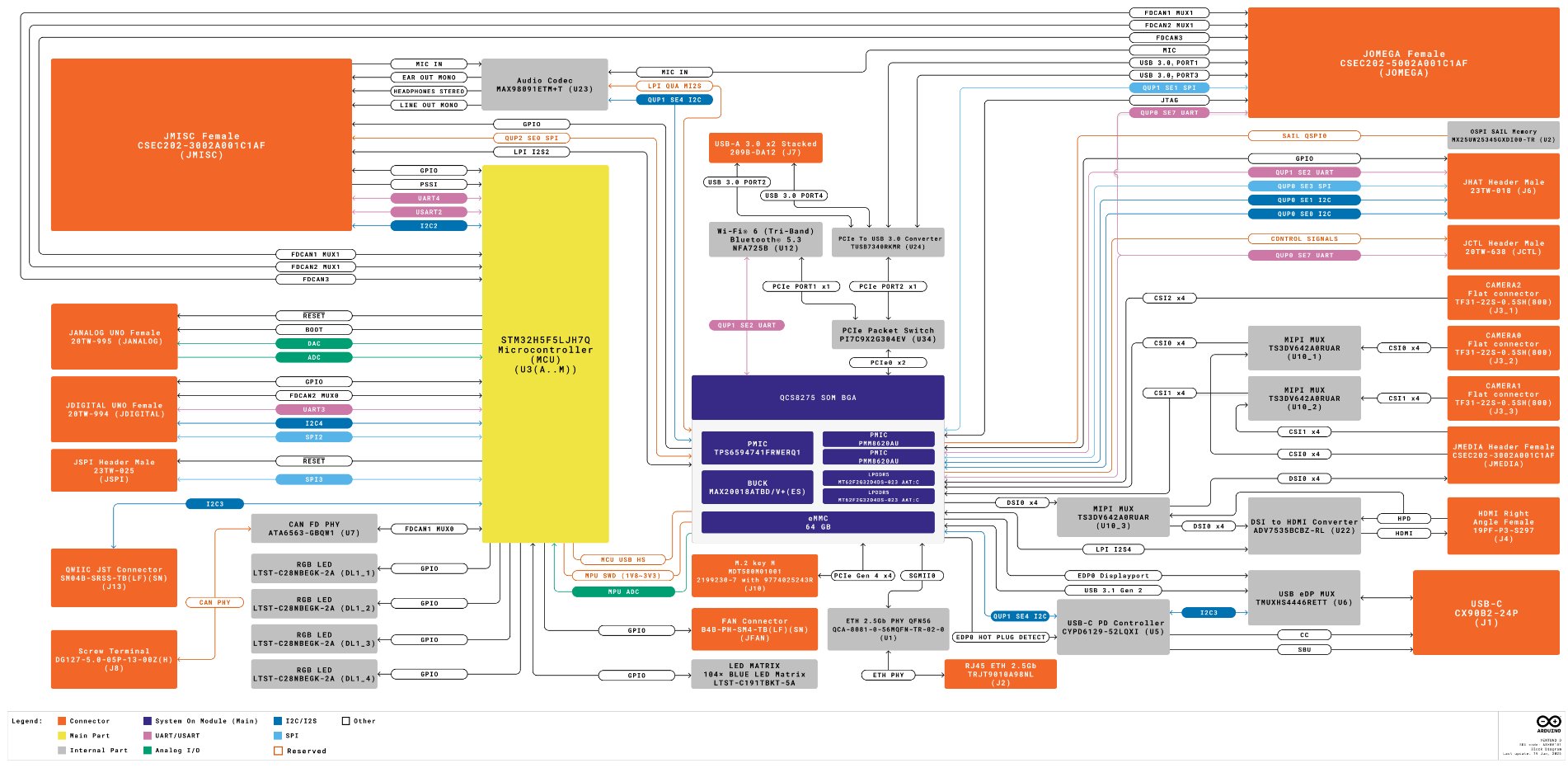
Ventuno Q block diagram
Networking consists of tri-band Wi-Fi 6 operating across the 2.4, 5, and 6GHz bands, Bluetooth 5.3, and a 2.5GbE RJ45 port. Both wireless interfaces use onboard antennas.
Camera connectivity includes three onboard MIPI-CSI connectors, with another two MIPI-CSI interfaces multiplexed through the JMEDIA header. USB cameras are also supported.
Display output includes HDMI and DisplayPort Alt Mode through USB-C, while MIPI-DSI signals are available through the JMEDIA expansion header. USB connectivity consists of two USB 3.0 Type-A ports and a USB Type-C connection supporting host/device role switching, power role switching, and video output. Two additional USB 3.0 interfaces are available through the JOMEGA header.
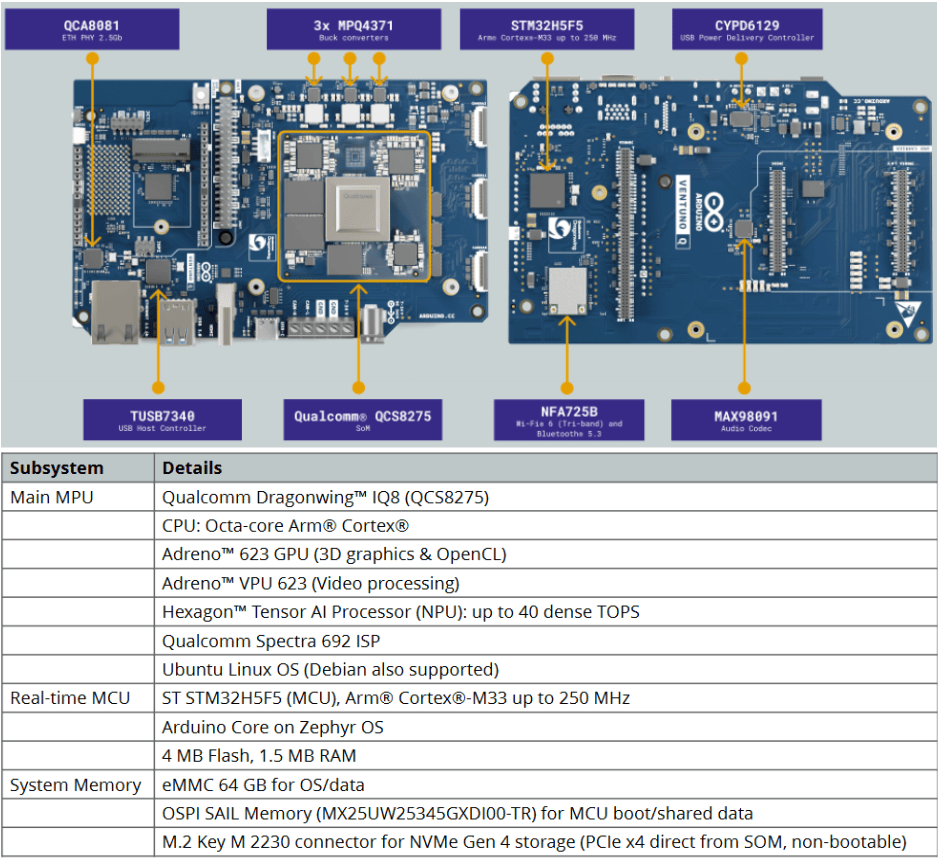
Ventuno Q peripherals part 1
For industrial and robotics applications, the Ventuno Q includes one CAN-FD interface with an onboard PHY exposed through a screw terminal. Three additional CAN-FD interfaces without PHYs are available through JOMEGA, while another CAN-FD interface is exposed through the Arduino UNO shield headers.
The board also retains compatibility with existing Arduino and Raspberry Pi expansion hardware. Standard Arduino UNO shields can be installed directly, while a 40-pin GPIO header provides electrical and mechanical compatibility with Raspberry Pi HATs.
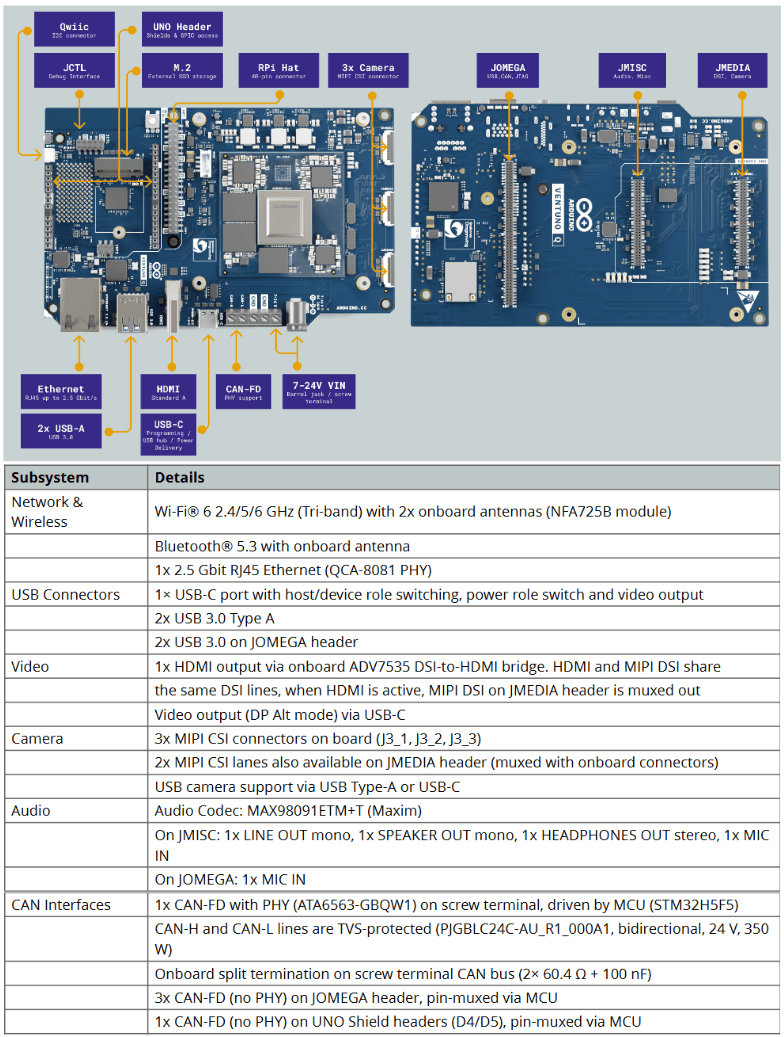
Ventuno Q peripherals part 2
A Qwiic connector supports Arduino Modulino nodes and other Qwiic-compatible peripherals. Additional JMEDIA, JOMEGA, and JMISC connectors provide access to high-speed camera, display, audio, USB, control, and sensor interfaces.
Power can be supplied through the USB-C connector at 5V and up to 3A, a 5.5 × 2.1mm barrel connector accepting 12–24V DC, or a screw terminal accepting 7–24V DC. A 7–24V input is also exposed through JOMEGA.
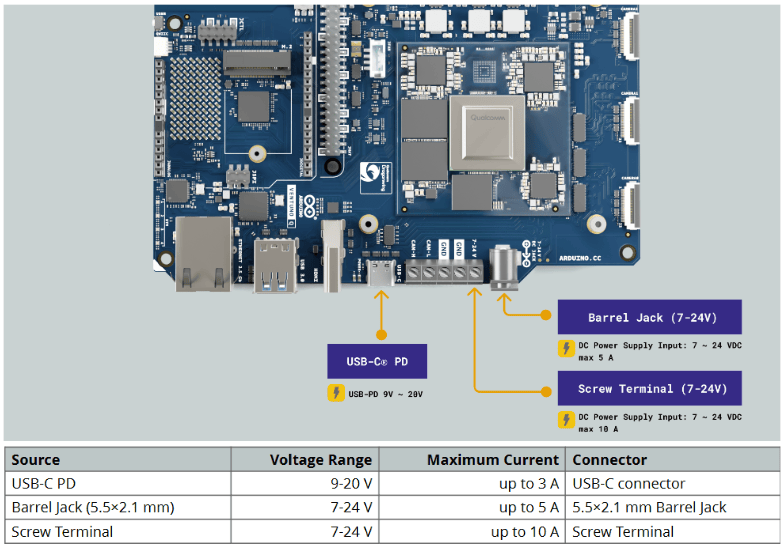
Ventuno Q power input sources
On the software side, Canonical states that the Ventuno Q ships with Ubuntu pre-installed directly on the Dragonwing processor. According to Canonical, this removes the need to manually flash a board support package, configure the kernel, or download platform-specific drivers before beginning development.
The Ubuntu installation is bundled with an Ubuntu Pro license, while Arduino lists upstream Debian support as coming soon. The STM32H5 side runs the Arduino Core on Zephyr RTOS.
The Linux environment is not restricted to Arduino’s own software. Arduino states that developers can use conventional tools including VS Code, PyCharm, Eclipse, Vim, Emacs, Python virtual environments, package managers, Docker containers, SSH-based development, and headless workflows.
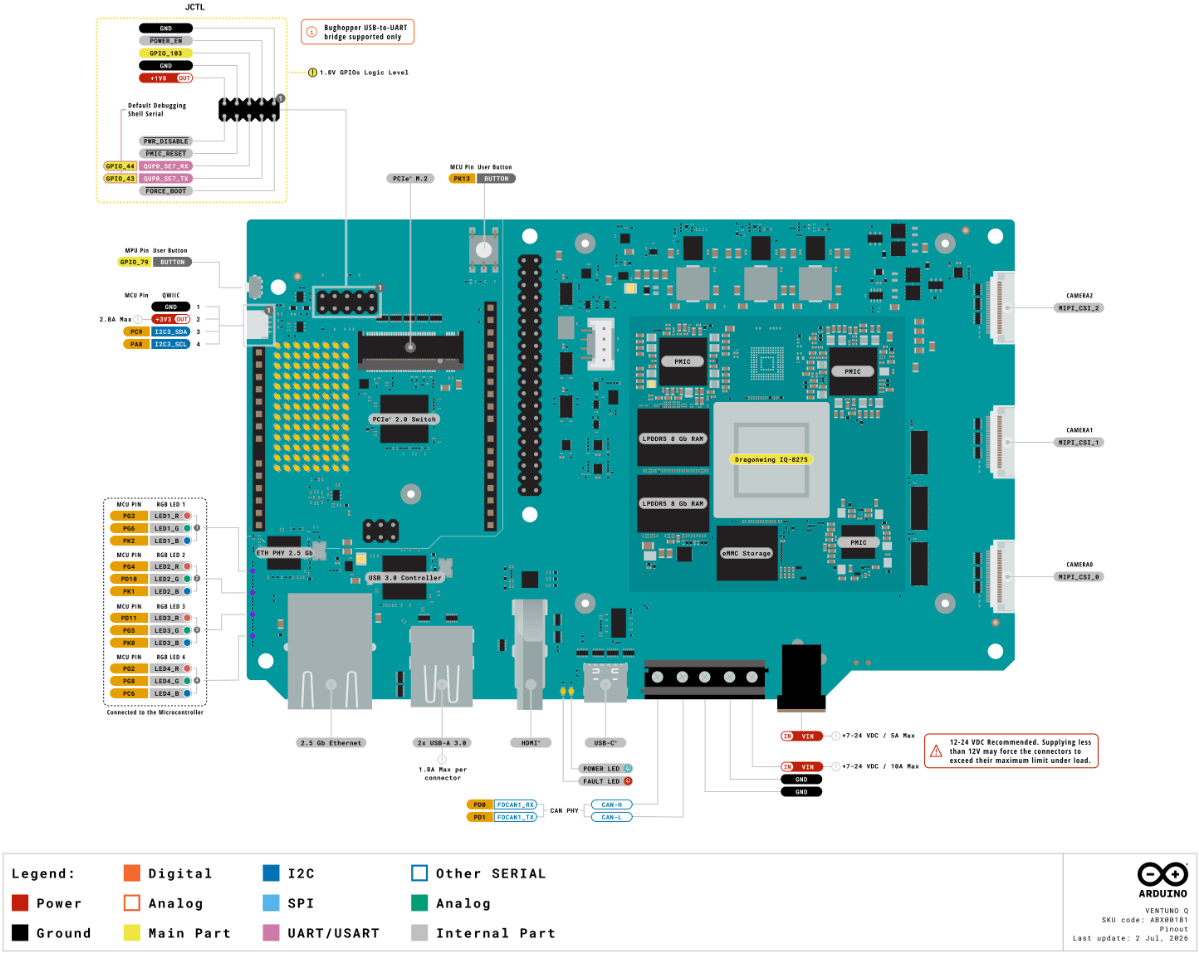
Ventuno Q pinout
Arduino App Lab provides an integrated environment for applications spanning the Linux and microcontroller sides of the board. It can be used to develop applications combining Arduino sketches, Python code, Linux software, and AI models.
Arduino also provides pre-integrated software components, referred to as Bricks, for functions including local language-model inference, vision-language processing, speech recognition, text-to-speech, gesture recognition, and object detection.
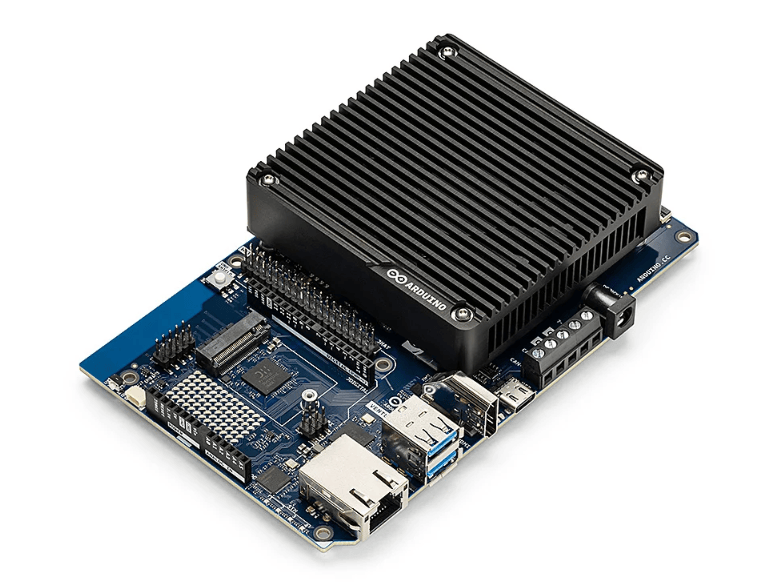
Arduino Ventuno Q
The company currently lists support for Qwen 3 4B as a local large language model, Qwen 2.5 7B and Qwen 3 4B vision-language models, Gemma models, Whisper automatic speech recognition, Melo and Piper text-to-speech, YOLOX object detection, and MediaPipe gesture recognition.
Developers can also bring models from sources such as Hugging Face or train custom models through Edge Impulse, which can optimize and quantize them before deployment to the Ventuno Q.
Specifications listed for the Arduino Ventuno Q include:
- Processor:
- Qualcomm Dragonwing IQ8 IQ-8275
- 8-core Qualcomm Kryo CPU
- Qualcomm Adreno 623 GPU
- Qualcomm Hexagon NPU
- Up to 40 dense TOPS
- Qualcomm Spectra 692 ISP
- Microcontroller:
- STM32H5F5
- Arm Cortex-M33 at 250MHz
- 4MB flash
- 1.5MB RAM
- Arduino Core on Zephyr RTOS
- Memory:
- 16GB LPDDR5
- Storage:
- 64GB eMMC
- M.2 connector for NVMe Gen4 SSDs
- Networking:
- Wi-Fi 6, 2.4/5/6GHz
- Bluetooth 5.3
- 1× 2.5GbE RJ45
- Camera:
- 3× MIPI-CSI connectors
- 2× MIPI-CSI interfaces multiplexed through JMEDIA
- USB camera support
- Display:
- 1× HDMI
- DisplayPort Alt Mode through USB-C
- MIPI-DSI through JMEDIA
- Audio:
- 2× microphone inputs
- Headphone output
- Ear output
- Line output through JMISC
- USB:
- 1× USB-C with host/device role switching and video output
- 2× USB 3.0 Type-A
- 2× USB 3.0 through JOMEGA
- CAN:
- 1× CAN-FD with PHY through screw terminal
- 3× CAN-FD without PHY through JOMEGA
- 1× CAN-FD without PHY through UNO shield headers
- Expansion:
- Arduino UNO shield support
- 40-pin Raspberry Pi HAT-compatible header
- Qwiic
- JMEDIA
- JOMEGA
- JMISC
- Power:
- USB-C: 5V DC, up to 3A
- 5.5 × 2.1mm barrel jack: 12–24V DC
- Screw terminal: 7–24V DC
- JOMEGA: 7–24V DC
- Dimensions:
- 160 × 100 × 25.8mm
Further Information
The Arduino Ventuno Q is listed for pre-order at an introductory price of $299, with Arduino indicating delivery in approximately four weeks. The product page currently directs purchases through approved resellers including DigiKey, Farnell, Mouser, Robu.in, and RS, while Arduino’s own allocation is shown as sold out.

Please comment here...