


Low-Cost Luckfox Pico Pi Boards Offer Linux Development with Ubuntu Support
Mar 29, 2025 — by Giorgio Mendoza 2,701 views
The Luckfox Pico Pi series consists of four models with a Raspberry Pi SBC form factor, designed for embedded applications. Offering various processing capabilities, connectivity options, and memory configurations, these boards include PoE support and optional 4G connectivity.
This SBC accommodates the LuckFox Core1106 module seen earlier this year. The series features the Rockchip RV1106 System-on-Chip with a Cortex A7 processor running at 1.2 GHz. NPUs are available on all models, with the G3 variants offering up to 1 TOPS of performance, while the G2 versions provide 0.5 TOPS. Both support int4, int8, and int16 operations.
— ADVERTISEMENT —
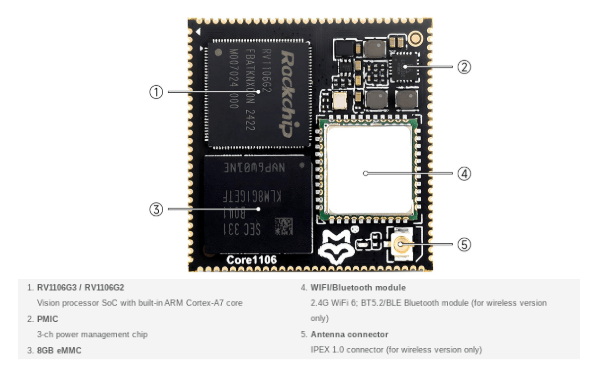
Core1106 Core Board peripherals
For video applications, the boards support H.264 and H.265 video encoding. The ISP can handle inputs up to 5 MP at 30 fps. Memory configurations differ between models, with the Pico Pi A and A W offering 256MB of DDR3L RAM, while the Pico Pi B and B W have 128MB. All variants include 8GB of eMMC storage and support additional storage through a MicroSD slot, although booting from the MicroSD is not supported.
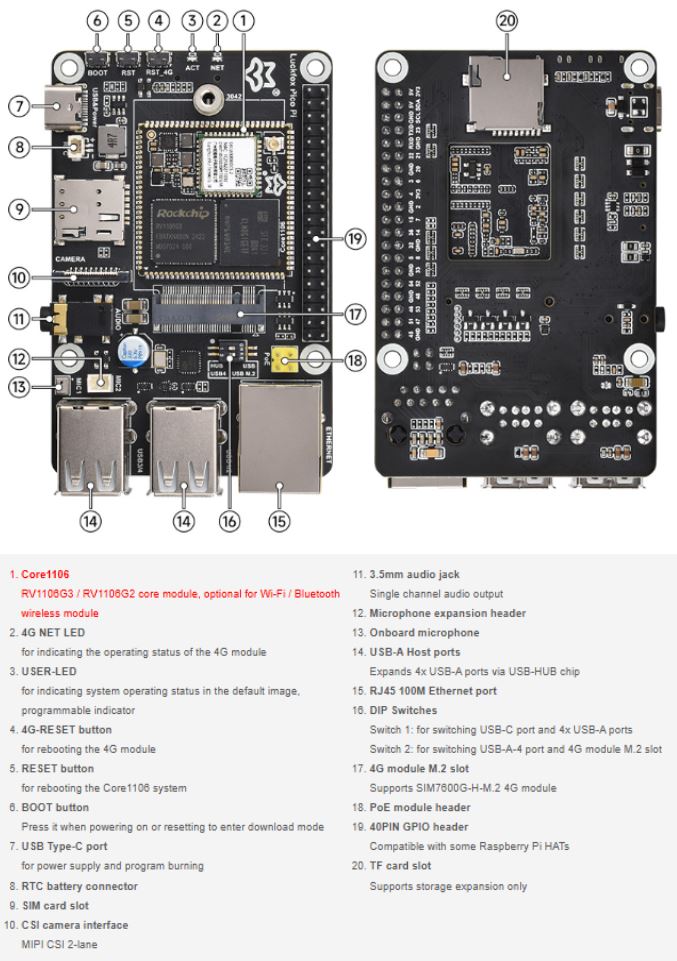
Luckfox Pico Pi Main Features
Connectivity options vary across the models. The Pico Pi A W and B W support 2.4GHz Wi-Fi 6 and Bluetooth 5.2/BLE. For wired connections, all models feature a 10/100M Ethernet controller with an embedded PHY. Additionally, an IEEE 802.3af PoE port is available for power-over-Ethernet support.
The boards include a surface-mount microphone, a microphone expansion port, a 3.5mm audio output jack, and a MIPI CSI 2-lane interface for camera connectivity.
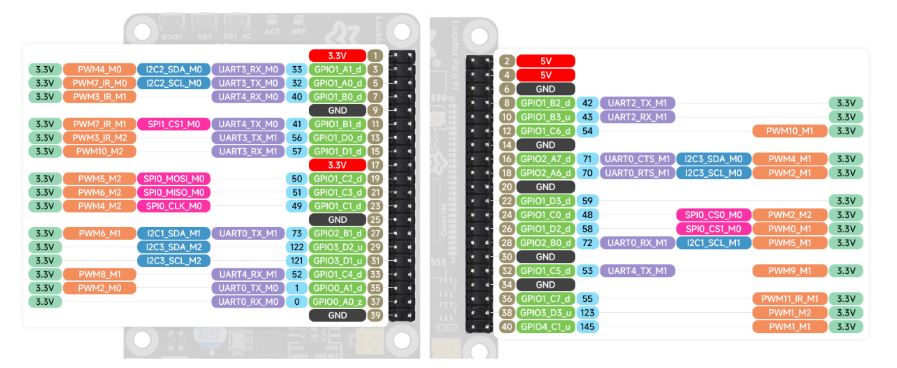
Luckfox Pico Pi Pinout
The boards support mobile network integration with a Nano SIM slot and an M.2 slot compatible with the SIM7600G-H-M.2 4G module. A DIP switch allows flexible switching between USB-C, four USB-A HOST ports, or the 4G module via the M.2 slot. GPIO compatibility follows the Raspberry Pi 40-pin layout for expanded functionality with peripherals like SPI, UART, and I2C.

Luckfox Pico Pi Models
For documentation, LuckFox provides dedicated Wiki pages with information to get started with the board as well as its SDK. The Luckfox Pico-SDK is primarily developed and tested on the Ubuntu LTS system, with a focus on supporting the Ubuntu 22.04 version.
Specifications listed for the Luckfox Pico Pi include:
- SoC:
- RV1106G3 (Pico Pi A, A W), RV1106G2 (Pico Pi B, B W)
- CPU:
- Cortex A7 @ 1.2GHz
- NPU:
- 1 TOPS, supports int4, int8, int16 (Pico Pi A, A W)
- 0.5 TOPS, supports int4, int8, int16 (Pico Pi B, B W)
- Memory & Storage:
- 256MB DDR3L (Pico Pi A, A W)
- 128MB DDR3L (Pico Pi B, B W)
- 8GB eMMC
- 1x MicroSD Slot (storage-only, no system boot support)
- Connectivity:
- 10/100M Ethernet controller with embedded PHY
- IEEE 802.3af PoE
- 2.4GHz Wi-Fi 6, Bluetooth 5.2/BLE (Pico Pi A W, B W)
- 1x Nano SIM Slot
- 1x M.2 Slot for 4G Module (Supports SIM7600G-H-M.2 4G Module)
- Camera:
- 1x MIPI CSI 2-lane
- Audio:
- 1x Surface-mount Microphone
- 1x MX1.25mm-2P Microphone Expansion Port
- 1x 3.5mm Audio Jack
- USB Ports:
- 1x USB Device Port
- 4x USB 2.0 HOST Ports (HUB Expansion)
- GPIO:
- 40-pin GPIO Expansion Header
- Other Features:
- DIP Switches
- 1x RTC Port (SH1.0-2P)
- Mechanical:
- 85 x 56mm
Further information
The Luckfox Pico Pi Model B starts at $21.99, excluding wireless or the 4G module, while the most expensive model is the Model A W with the 4G module, priced at $67.99.


Please comment here...