All News | Boards | Chips | Devices | Software | LinuxDevices.com Archive | About | Contact | Subscribe
Follow LinuxGizmos:
Twitter Facebook Pinterest RSS feed
*   get email updates   *

SpacemiT X60 RISC V Processor Enables AI and High Speed Storage in Bit Brick K1 Embedded Board

Feb 19, 2025 — by Giorgio Mendoza 745 views

The Bit-Brick K1 is a single-board computer designed for industrial and edge computing applications. It features the SpacemiT Key Stone K1, an ultra-low-power octa-core RISC-V system-on-chip with SpacemiT Daoyi AI acceleration. Built on the RISC-V 64GCVB architecture and RVA22 standard, the processor delivers 2.0TOPS of AI computing power using customized RISC-V instructions optimized for TensorFlow Lite, TensorFlow, and ONNX Runtime.

The SpacemiT X60 processor employs a dual-cluster octa-core design that balances performance and efficiency. Cluster 0 consists of four cores with dedicated AI acceleration, each equipped with a 32K L1 cache, 512K L2 cache, and 512KB TCM. Cluster 1 features an additional four cores, also with 32K L1 cache and 512K L2 cache, enabling multi-threaded processing.

— ADVERTISEMENT —


The processor supports 256-bit vector extensions, improving performance for AI inference, signal processing, and industrial workloads. The documentation states that its architecture incorporates granular power islands and multiple power states, reducing energy consumption while maintaining performance.
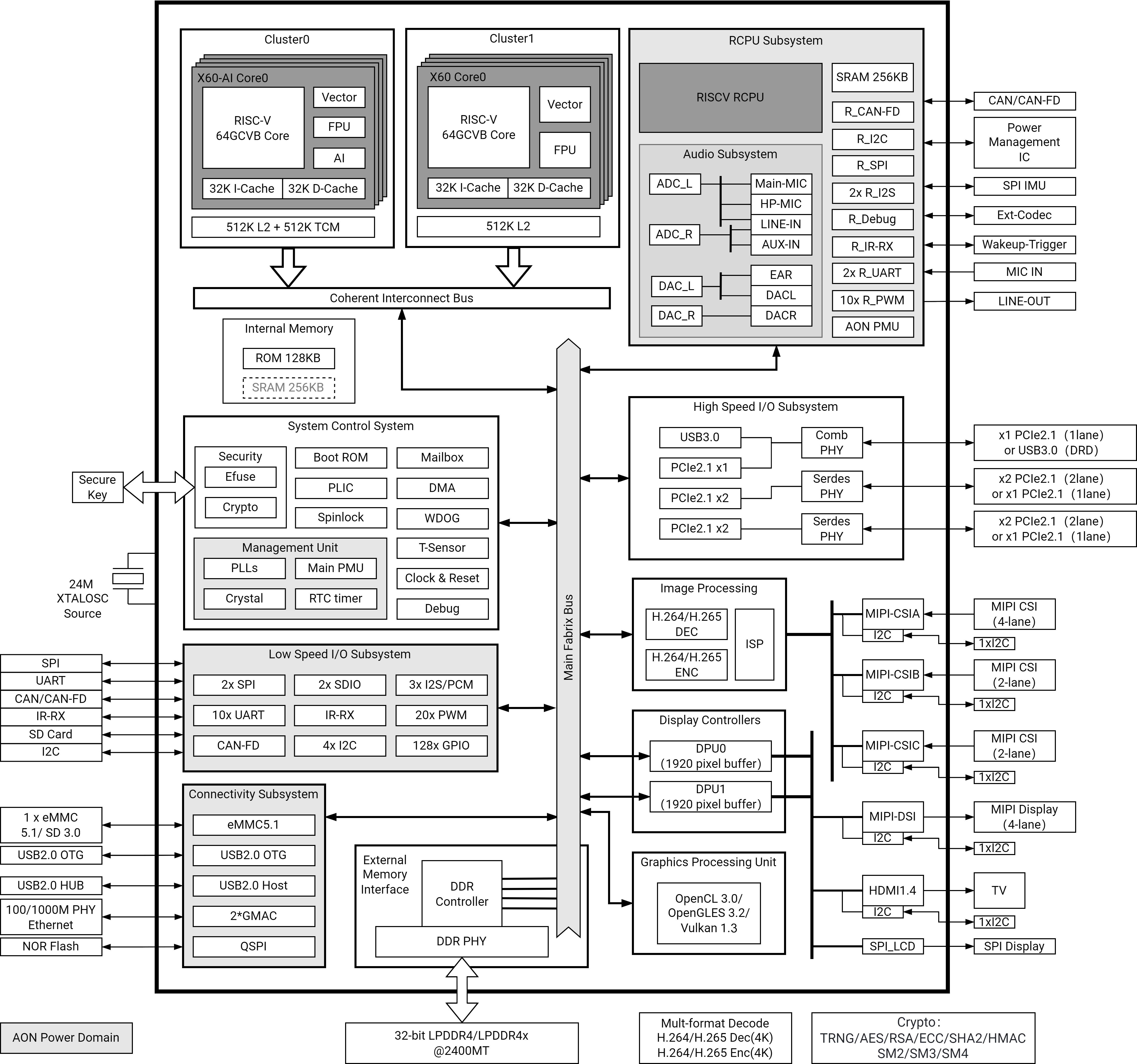

SpacemiT Key Stone K1 block diagram
(click image to enlarge)

The board integrates LPDDR4X memory, available in 4GB or 8GB configurations, enabling efficient multitasking and high-speed data processing. It features an IMG BXE-2-32 GPU running at 819MHz, supporting OpenCL 3.0, OpenGL ES 3.2, and Vulkan 1.3. Multimedia capabilities include 4K H.265 and H.264 video decoding and encoding useful for AI-driven vision applications and edge processing.

The Bit-Brick K1 offers USB 3.0, USB 2.0 Host, USB 2.0 OTG, and Gigabit Ethernet connectivity, supports HDMI 1.4 output at 1920×1080@60fps, and includes MIPI CSI for camera input and MIPI DSI for display output, enabling integration with external peripherals.

According to the documentation, the Bit-Brick K1 features PCIe 2.0 x2 for high-speed peripherals and storage. It includes three M.2 slots for expansion. SLOT 1 and SLOT 2 follow the M.2 Key-M standard, supporting 2280 NVMe SSDs for fast data access. SLOT 0 is a Key-E slot designed for wireless modules but does not support USB or PCIe connectivity due to hardware limitations.


Bit-Brick K1 bottom view
(click image to enlarge)

With 40 GPIOs, multiple UART, I2C, SPI, PWM, and CAN interfaces relevant for industrial automation, IoT networks, and embedded AI applications.

The Bit-Brick K1 documentation wiki provides resources on hardware, software, and development tools. It includes setup guides, Bianbu OS installation, Linux kernel configuration, and driver support. Additional sections cover camera integration, AI acceleration, and ROS 2 setup, helping developers optimize the board for robotics and machine learning projects.


Bit-Brick K1 top view
(click image to enlarge)

Specifications listed for the Bit-Brick K1 include:

  • Memory:
    • LPDDR4X SDRAM (4GB or 8GB)
  • Storage:
    • Supports SPI flash, eMMC 5.1, SDIO 3.0 SD card
    • Supports NVMe SSD via PCIe
  • Display:
    • 1x 4-lane MIPI DSI
    • 1x HDMI 1.4 (supports 1920×1080@60fps)
  • Camera:
    • 1x 4-lane MIPI CSI
  • Connectivity:
    • 1x Gigabit Ethernet
  • Multimedia:
    • IMG BXE-2-32 GPU @ 819MHz
    • Supports OpenCL 3.0, OpenGL ES 3.2, Vulkan 1.3
    • 4K H.265/H.264 video decoding and encoding
    • 1x Quad-lane MIPI DSI for display
  • I/O Interfaces:
    • 4x SPI, 7x I2C, 6x UART
    • 1x CAN, 12x PWM
    • 40x GPIO
  • USB:
    • 1x USB 3.0
    • 1x USB 2.0 Host
    • 1x USB 2.0 OTG
  • Operating Temperature:
    • -40°C to 85°C
  • Power Input:
    • 5V DC via USB-C
  • Dimensions:
    • 90.0 x 80.0 mm

Further information

The Bit-Brick K1 is available in two configurations on the Youyeetoo website. The basic kit includes only the SBC, while the development kit adds a power supply, a 32GB MicroSD card, a card reader, and a UART debug module. The basic kit costs $54.79 (4GB) or $68.52 (8GB), while the development kit is priced at $69.20 (4GB) or $80.87 (8GB).

(advertise here)


PLEASE COMMENT BELOW

Please comment here...