


SpacemiT MUSE Pi Pro is an octa-core RISC-V SBC with Armbian support
Jul 26, 2026 — by Giorgio Mendoza 936 views
The MUSE Pi Pro is an 85 × 56mm single-board computer built around SpacemiT’s M1 processor, combining eight 64-bit RISC-V cores with 2.0 TOPS of AI processing capability. The board provides up to 16GB of LPDDR4X memory, onboard eMMC storage, NVMe expansion, Gigabit Ethernet, Wi-Fi 6, and multiple camera and display interfaces.
The SpacemiT M1 processor handles general-purpose computing and AI inference workloads. The board is offered with LPDDR4X memory operating at 2400MT/s and up to 128GB of eMMC 5.1 storage.
— ADVERTISEMENT —
Storage expansion is provided through a microSD card slot supporting UHS-II and an M.2 Key-M connector for 2230-size NVMe drives. The M.2 slot uses a PCIe 2.0 ×2 interface and also supports PCIe-to-SATA adapters and other PCIe communication modules.
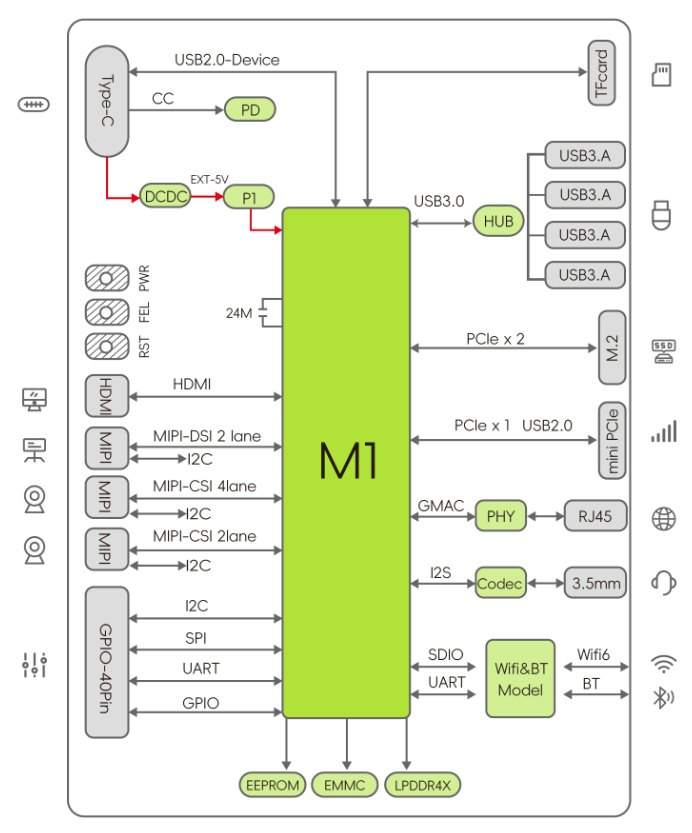
MUSE Pi Pro block diagram
A full-size mini-PCIe slot provides PCIe 2.0 ×1 and USB 2.0 connectivity for cellular, wireless, and networking modules. The board additionally integrates Wi-Fi 6 and Bluetooth 5.2, with two antenna connectors positioned along its upper edge.
Display output is available through an HDMI 1.4 connector supporting resolutions up to 1920 × 1080 at 60Hz. A 15-pin, two-lane MIPI-DSI connector provides an additional display interface with an I²C control channel and touchscreen support. When both interfaces are connected, the MIPI display is used as the primary display by default.
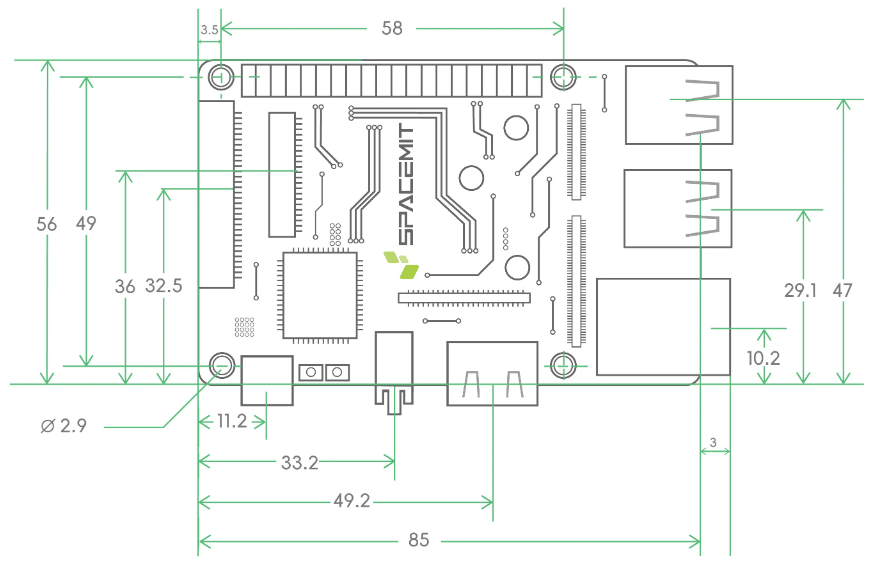
MUSE Pi Pro dimensions
For camera input, the MUSE Pi Pro includes one four-lane MIPI-CSI connector and one two-lane MIPI-CSI connector. The interfaces use 22-pin and 15-pin FFC connectors, respectively.
Wired connectivity consists of a Gigabit Ethernet port and four USB 3.0 Type-A host ports. A USB Type-C connector supports USB 2.0 device and OTG operation while also accepting USB Power Delivery input at 5V, 9V, or 12V and up to 3A.
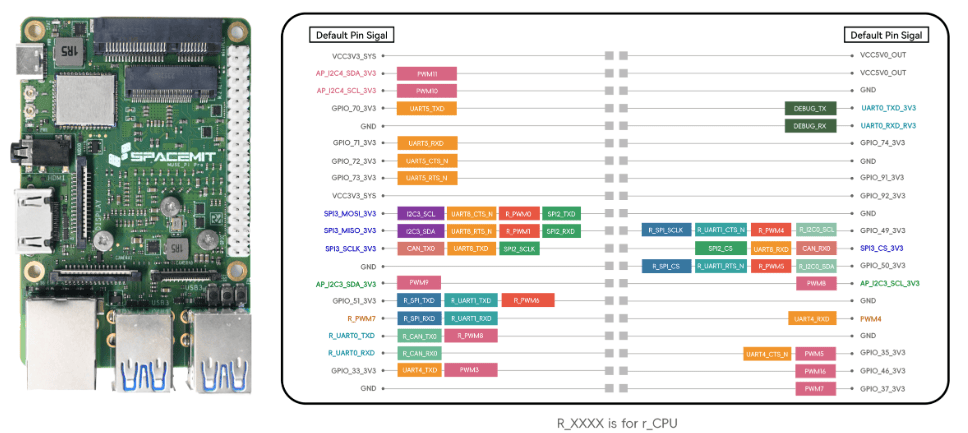
MUSE Pi Pro pinout
A 40-pin GPIO header exposes 3.3V GPIO and peripheral signals for UART, I²C, SPI, PWM, and other multiplexed functions. Two pins provide 5V output at up to 1A for fans or expansion hardware.
Other onboard features include a 3.5mm TRRS audio connector backed by an ES8326 codec, a UART debugging interface, a system-status LED, and power, reset, and firmware-download buttons. The status LED can report SPI flash, memory, kernel, and bootloader errors.
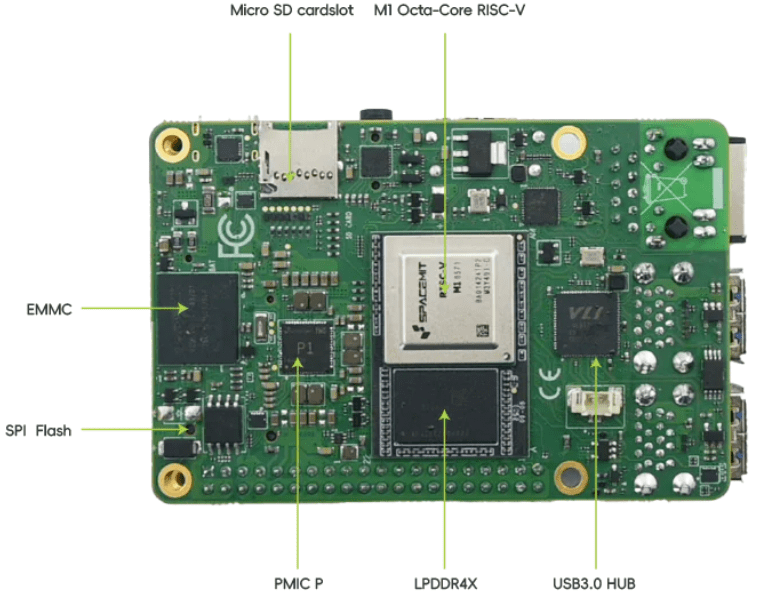
MUSE Pi Pro bottom view
The MUSE Pi Pro supports UEFI booting from eMMC, NVMe storage, USB drives, and microSD cards. Firmware can be installed through the USB Type-C port using SpacemiT’s Titan Flasher utility or the fastboot command.
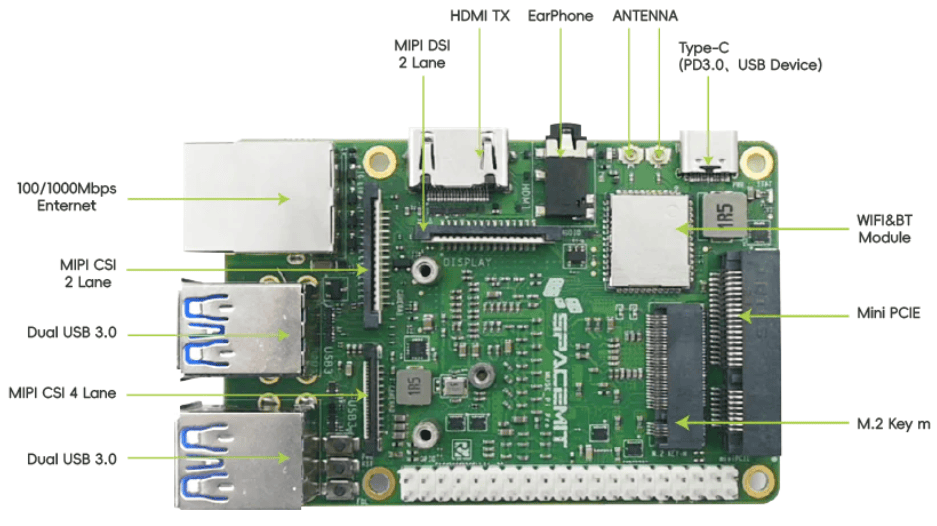
MUSE Pi Pro top view
Software support includes SpacemiT’s Bianbu Desktop Linux distribution, Ubuntu, Fedora, Deepin, openKylin, and Armbian.
SpacemiT maintains a wiki-based documentation section with a user guide, GPIO and interface pinouts, UEFI configuration instructions, firmware-flashing procedures, and hardware design resources.
Specifications listed for the MUSE Pi Pro include:
- Processor:
- SpacemiT M1 SoC
- 8× 64-bit RISC-V cores
- 2.0 TOPS AI processing capability
- SpacemiT M1 SoC
- Memory:
- Up to 16GB LPDDR4X
- Storage:
- Up to 128GB eMMC 5.1
- microSD card slot
- Expansion:
- 1× M.2 Key-M slot
- 1× full-size mini-PCIe slot
- Display:
- 1× HDMI 1.4
- 1× 2-lane MIPI DSI connector
- Camera:
- 1× 4-lane MIPI CSI connector
- 1× 2-lane MIPI CSI connector
- Networking:
- 1× Gigabit Ethernet port
- Wireless:
- Wi-Fi 6
- Bluetooth 5.2
- 2× antenna connectors
- I/O:
- 40-pin GPIO header
- TTL UART debug header
- USB:
- 4× USB 3.0 Type-A host ports
- 1× USB 2.0 Type-C device/OTG port
- Audio:
- 1× 3.5mm TRRS audio jack
- ES8326 audio codec
- Other Features:
- Power button
- Reset button
- Flash button
- Power:
- USB Power Delivery input
- 5V, 9V, or 12V at up to 3A
- Operating temperature:
- Consumer-grade: -20°C to 70°C
- Industrial-grade: -40°C to 85°C
- Mechanical:
- 85 × 56 mm
- FEMTO-ITX form factor
Further Information

Please comment here...