


Sipeed MaixCAM2 combines 4K imaging and edge AI in an open camera platform
Jan 27, 2026 — by Giorgio Mendoza 612 views The device is designed as an open system for rapid deployment of vision, audio, and AIoT applications, aimed at researchers, and developers requiring more capable on-device inference and improved image quality than typical DIY camera setups.
MaixCAM2 is built around an Axera AX630-series SoC with dual Arm Cortex-A53 cores running Linux, paired with a small RISC-V E907 core for real-time tasks. AI acceleration is provided by an onboard NPU rated at up to 12.8 TOPS INT4 or 3.2 TOPS INT8, supporting both convolutional and Transformer-based models.
— ADVERTISEMENT —
The camera is available in configurations with 1GB or 4GB of LPDDR4 memory. The 4GB variant supports larger local models, including vision-language models up to the 2B parameter class. Storage includes onboard 32GB eMMC, supplemented by a microSD card slot for expansion.

MaixCAM2 Peripherals & Pinout
MaixCAM2 supports up to an 8MP (4K) image sensor using a 4-lane MIPI CSI interface, with support for split dual CSI configurations. Video encoding is handled by hardware codecs supporting H.264, H.265, and MJPEG, with 4K@30fps encoding and 1080p@60fps decoding.
An onboard AI-ISP handles image processing tasks such as noise reduction and low-light enhancement, which Sipeed highlights in its documentation compared to Raspberry Pi–class camera modules.
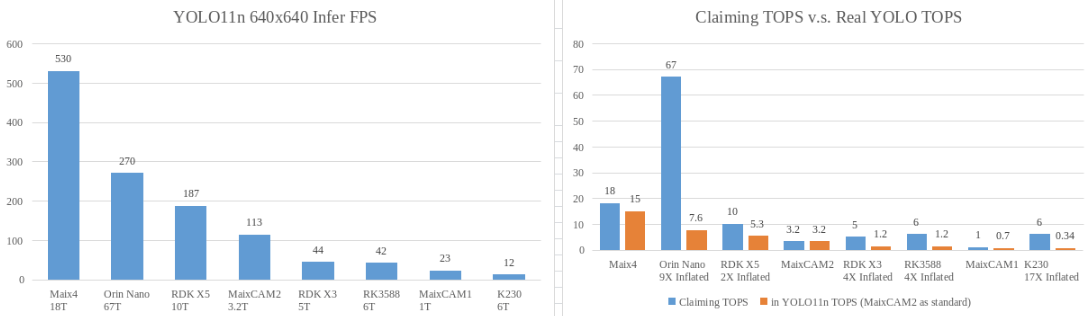
YOLO11n 640×640 inference results & claimed TOPS comparison
According to Sipeed’s documentation, YOLO11n at 640×640 resolution can exceed 110 fps, with lighter models achieving higher frame rates. The platform also supports vision-language and speech models, enabling offline LLM, VLM, ASR, and TTS workloads without cloud connectivity.

YOLO11n inference FPS & Qwen3-VL-2B efficiency results
A 2.4-inch IPS capacitive touchscreen with 640×480 resolution is integrated into the enclosure and connected over MIPI DSI. The display supports preview, UI interaction, and standalone operation without an external monitor.

MaixCAM2 Adapters
Audio features include dual onboard silicon microphones and a built-in power amplifier driving a 1W speaker. Wireless connectivity is provided via an onboard Wi-Fi 6 and Bluetooth 5.4 module, while wired networking is supported through a 6-pin FPC Ethernet interface using an external RJ45 adapter.
For expansion, MaixCAM2 exposes a 2.54mm PMOD-style interface with approximately 20 GPIOs, along with power rails and a separate 1.25mm 6-pin expansion connector. Standard peripherals such as I²C, SPI, UART, ADC, PWM, and watchdog timers are supported.
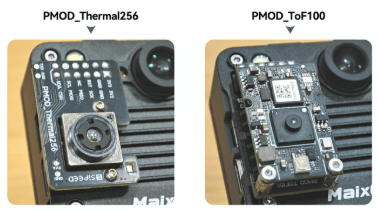
MaixCAM2 PMOD Interface
Additional onboard components include a six-axis IMU, a real-time clock with a rechargeable backup battery, and multiple user and status LEDs. Power is supplied via USB-C or a Li-ion battery, with integrated charge and discharge management on battery-equipped versions.
The enclosure measures roughly 65 × 49 × 20 mm and includes a standard 1/4-inch tripod mount.
MaixCAM2 is supported by Sipeed’s Maix software ecosystem, which includes MaixPy for Python-based development and MaixCDK for C++ workflows optimized for the platform’s hardware acceleration. The MaixVision IDE provides code execution, real-time image preview, and graphical tools intended to simplify development.
For non-developers, Sipeed provides a collection of prebuilt applications, with additional models and apps distributed through the MaixHub platform. The company notes that the platform supports both rapid prototyping and eventual productization.

Sipeed MaixCAM2
Further Information
The Kickstarter campaign includes multiple MaixCAM2 reward tiers differentiated by memory size, storage capacity, and camera resolution. Options start with 1GB LPDDR4 models paired with either a 2K or 4K camera and 32GB eMMC, with early-bird pricing starting in the high-$60 range.
Higher tiers add 64GB eMMC or increase memory to 4GB LPDDR4, again with a choice of 2K or 4K sensors. Pricing scales up to the mid-$130 range for the 4GB plus 4K configuration.

Please comment here...