


LILYGO Debuts ESP32-C5-Based T-Dongle C5 and T7-C5 Development Boards
Jan 29, 2026 — by Giorgio Mendoza 2,642 views LILYGO has introduced its first ESP32-C5-based development boards, geared toward different form factors and usage models: the USB stick-style T-Dongle C5 and the more conventional T7-C5 development board. Both platforms support dual-band Wi-Fi 6 alongside Bluetooth LE.
The T-Dongle C5 is a USB Type-A development board designed in a flash-drive form factor and housed in a transparent enclosure. Measuring approximately 58 × 18 × 9 mm, the board is based on the ESP32-C5HR8 microcontroller and supports 2.4 GHz and 5 GHz Wi-Fi 6 (802.11ax), with backward compatibility for 802.11 b/g/n networks.
— ADVERTISEMENT —
Bluetooth 5 is also supported, and wireless connectivity relies on an onboard ceramic antenna. Power is supplied directly over USB at 5 V and internally regulated to 3.3 V.
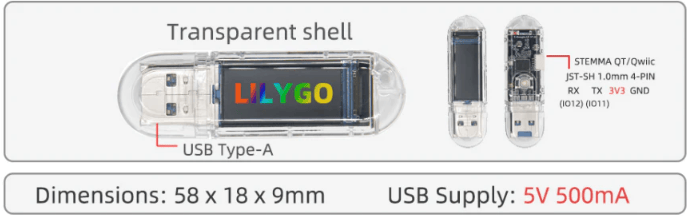
T-Dongle C5 Dimensions
The board includes 16 MB of onboard flash and 8 MB of PSRAM, along with a microSD card slot for removable storage. A 0.96-inch IPS LCD based on the ST7735 controller is integrated on the front side, offering an 80 × 160 pixel resolution, 65K colors, and a 4-wire SPI interface.
For basic expansion, the T-Dongle C5 provides a JST-SH 1.0 mm 4-pin connector compatible with STEMMA QT and Qwiic ecosystems, exposing UART signals and power for external peripherals. A single boot button is included for flashing and recovery, and the USB interface is used for both programming and data communication.
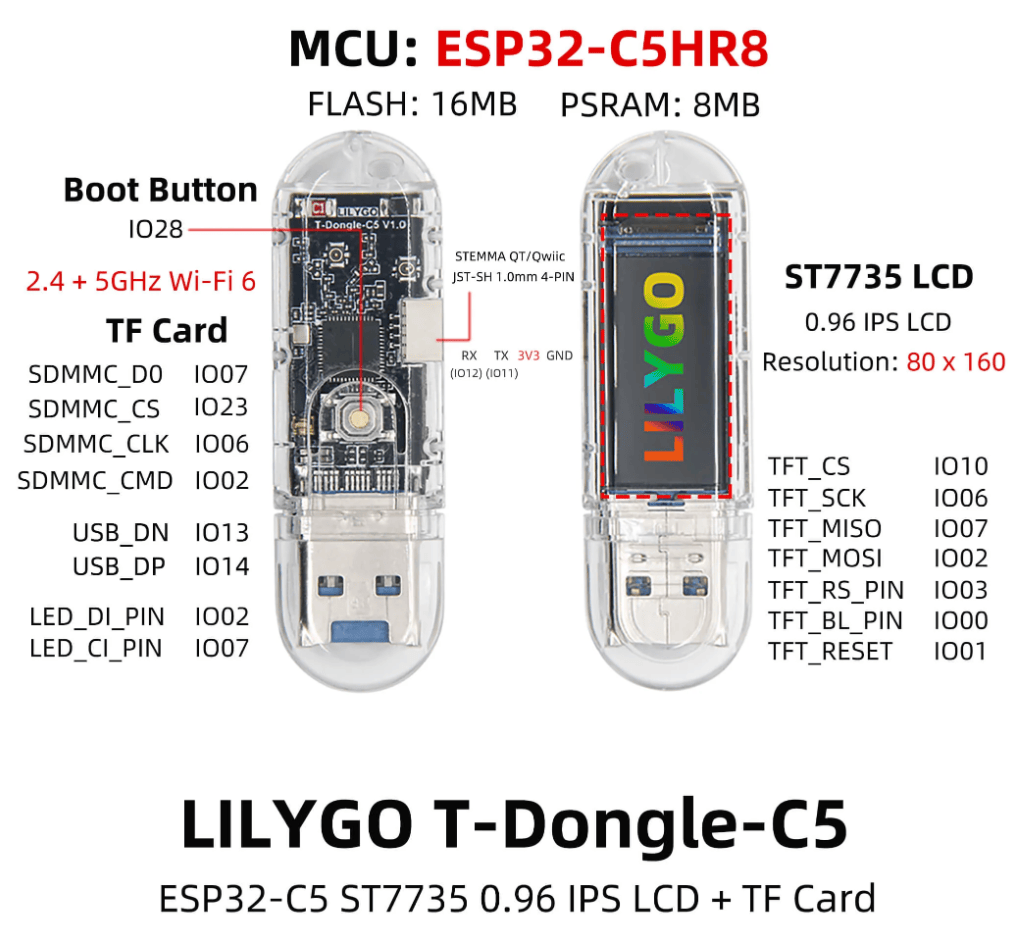
T-Dongle C5 Peripherals
Alongside the T-Dongle C5, LILYGO also offers the T7-C5, a more traditional development board built around the ESP32-C5-MINI-1 module. While it shares the same dual-band Wi-Fi 6 and Bluetooth LE 5 capabilities, the T7-C5 is oriented toward prototyping and embedded development rather than ultra-compact USB use.
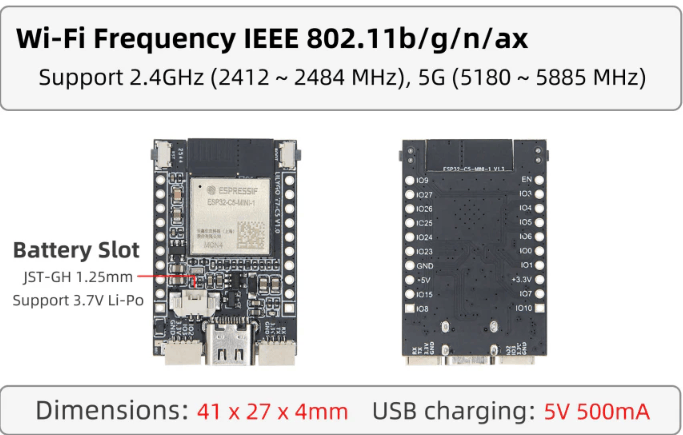
T7-C5 Dimensions
The ESP32-C5 platform used on the T7-C5 also supports IEEE 802.15.4, enabling Thread and Zigbee in addition to Wi-Fi and BLE. The board includes 4 MB of flash memory and exposes a wide range of GPIOs through dual pin headers, making it easier to connect sensors, displays, and other external hardware.
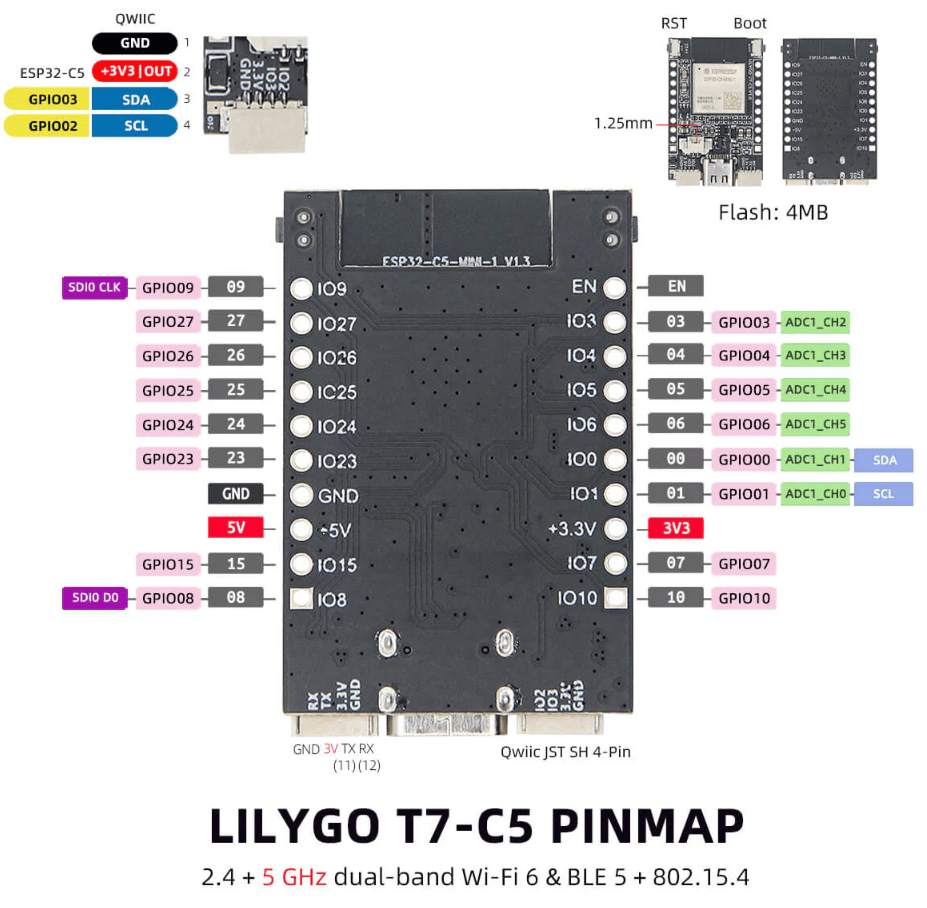
T7-C5 Pinout
Power options differ between the two boards. The T7-C5 includes a JST-GH 1.25 mm battery connector for single-cell 3.7 V Li-Po batteries, allowing battery-powered operation. USB is used for programming and charging, with a typical 5 V, 500 mA input.
Two Qwiic-compatible 4-pin connectors are provided for I²C peripherals, and dedicated BOOT and Reset buttons are included for development and debugging.
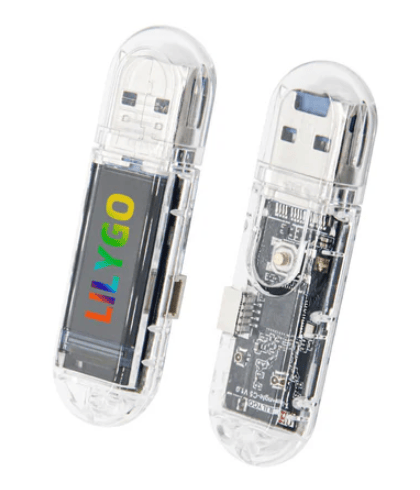
T-Dongle C5
Both the T-Dongle C5 and T7-C5 are supported by common ESP32 development environments, including the Arduino IDE and VS Code–based workflows using ESP-IDF.
Further Information
The USB stick–style T-Dongle C5, which integrates a color display, PSRAM, and MicroSD card slot, is listed at around $13.02, while the more traditional T7-C5 development board is available at a lower price of approximately $7.94.

Please comment here...