


Rockchip RK3668 Targets Edge AI with 44 TOPS NPU and PCIe 5.0
Oct 24, 2026 — by Giorgio Mendoza 1,891 views Rockchip’s upcoming RK3668 is a 6nm octa-core processor featuring six Arm Cortex-A725 cores, two Cortex-A520 cores, and a Mali-G2 Pro MC4 GPU. The SoC integrates a 44 TOPS NPU, LPDDR6 memory support, and high-speed interfaces including PCIe 5.0, SATA 3.1, and 10 Gigabit Ethernet, targeting edge AI, networking, industrial automation, and multimedia systems.
According to an application brief shared by Radxa, the RK3668 is positioned above the RK3588 in Rockchip’s processor roadmap, while the higher-end RK3688 remains planned as a future flagship. The new processor uses the Armv9.2 architecture, with six Cortex-A725 performance cores expected to reach 2.5GHz and two Cortex-A520 efficiency cores running at up to 2.2GHz.
— ADVERTISEMENT —
The CPU subsystem includes 4MB of L3 cache, 4MB of shared system-level cache, and 4MB of SRAM. It also supports SVE2 instructions and Arm security extensions, including Memory Tagging Extension and Pointer Authentication. Unlike some earlier Rockchip platforms, the RK3668’s CPU operates exclusively in 64-bit mode.
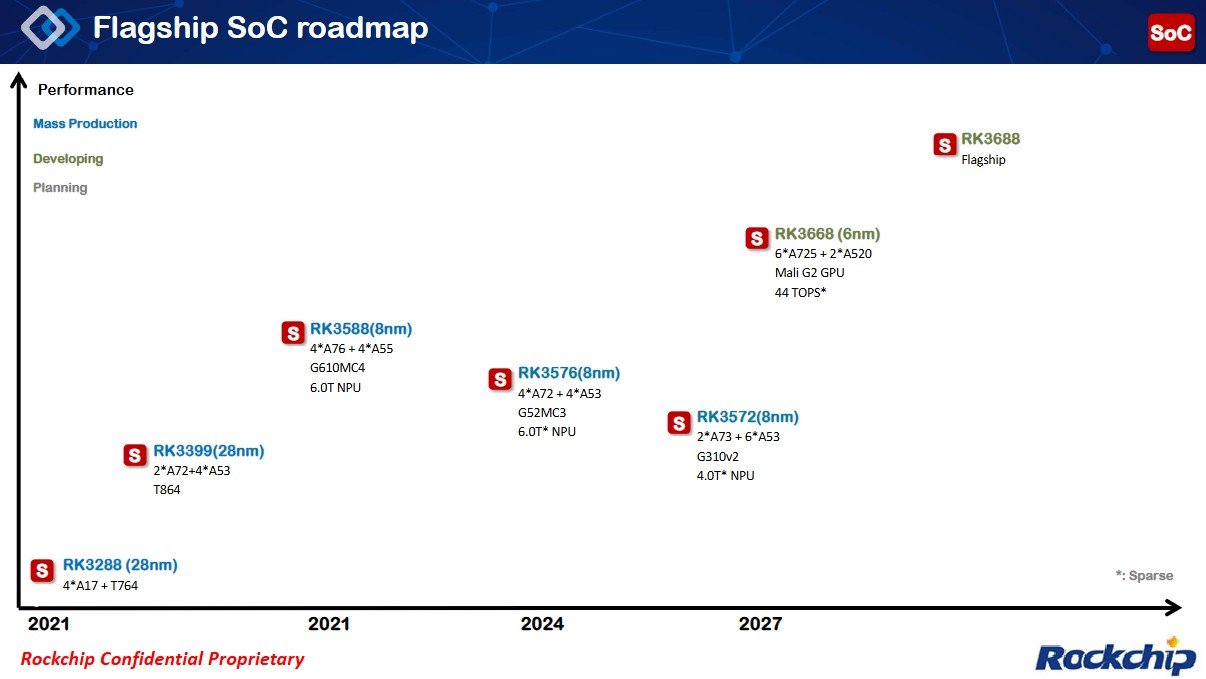
RK3668 SoC roadmap
Graphics processing is handled by an Arm Mali-G2 Pro MC4 GPU, with a projected operating frequency of 1.1GHz and approximately 1.23 TFLOPS of FP32 compute performance. The GPU also supports hardware-assisted virtualization for up to 16 virtual machines.
For machine learning workloads, Rockchip integrates its own NPU architecture, rated at 44 TOPS using sparse INT8 operations. The accelerator supports integer formats ranging from INT2 to INT16, along with FP4, FP6, FP8, and FP16 formats. Rockchip also lists support for convolutional neural networks, Transformer-based models, mixture-of-experts workloads, and speculative sampling.
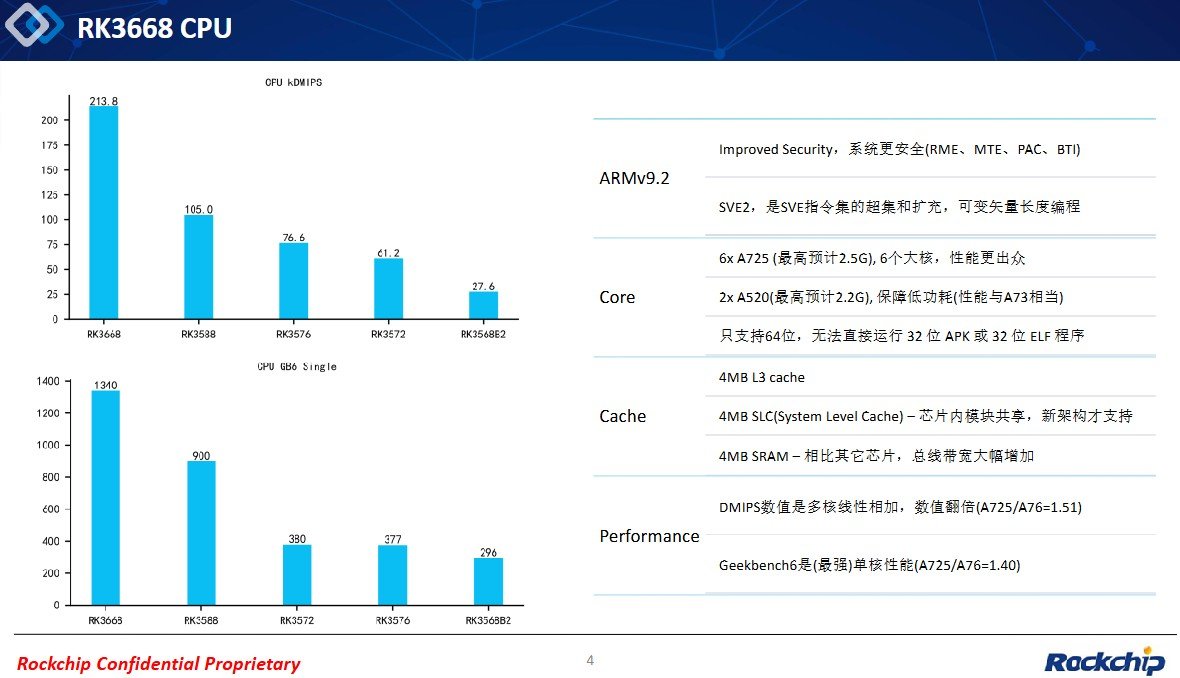
RK3668 CPU
The RK3668 supports LPDDR5/LPDDR5X-8533 through a 64-bit interface and LPDDR6-10667 through a 96-bit interface. Maximum theoretical memory bandwidth reaches 128GB/s with LPDDR6, although Rockchip estimates approximately 90GB/s of effective bandwidth. Memory addressing is supported up to 64GB.
High-speed expansion includes PCIe 5.0 and PCIe 3.0 connectivity, four SATA 3.1 controllers, two 10GbE interfaces, and two RGMII Ethernet interfaces. Storage options include UFS 4.0, eMMC 5.1, NVMe, and SD interfaces.
USB connectivity includes a USB 3.2 Gen 2 port with Type-C and DisplayPort support, dual USB 3.0 ports, and USB 2.0 interfaces. Some high-speed functions share configurable physical interfaces, so the final combination of available ports will depend on the hardware implementation.
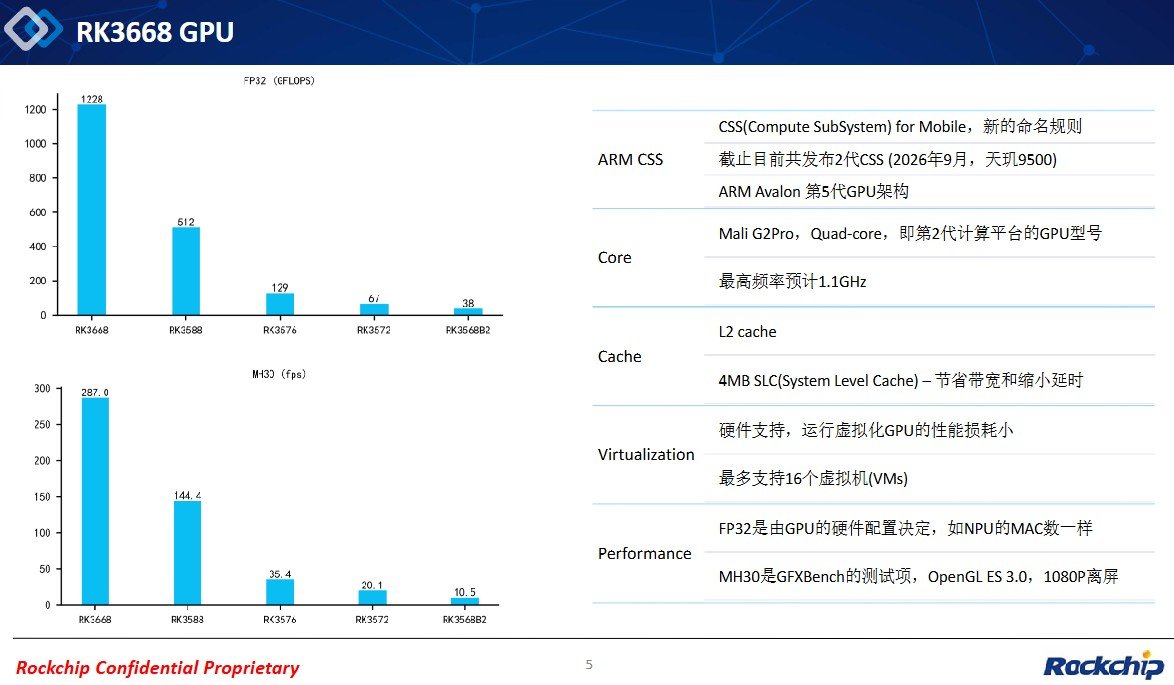
RK3668 GPU
For multimedia applications, the processor supports video decoding up to 8K at 120fps across formats including H.265, H.264, VP9, AV1, and AVS2. Video encoding reaches 8K at 60fps using H.264 or H.265, with support for 10-bit color and YUV 4:4:4.
Display capabilities include configurations supporting two 8K60 displays or six 4K60 displays, with HDMI 2.1, DisplayPort, eDP 1.4, and MIPI DSI interfaces. Camera processing is supported through multiple image signal processors, MIPI CSI-2 connectivity, HDR processing, fisheye correction, and stereo depth-processing features.

RK3668 NPU
Additional industrial capabilities include six CAN controllers, I2C, I3C, SPI, UART, and GPIO interfaces. A dedicated safety subsystem incorporates dual Cortex-M52 cores, error-detection mechanisms, built-in self-test, and secure boot functionality.
Rockchip identifies Android servers, interactive displays, network video recorders, NAS systems, robotics, programmable logic controllers, automotive cockpit systems, and industrial box PCs among the intended applications.
Further Information
The RK3668 remains in development, with engineering samples targeted for the first quarter of 2027. Pricing, production availability, and final system configurations have not yet been announced. Additional technical details are available on the SBCWiki website.

Why is there no info about the TDP goals for this design?