


RISC-V compute module brings ESP32-P4 to Raspberry Pi CM4/CM5 carriers
Nov 1, 2026 — by Giorgio Mendoza 1,967 views The SCINTIX P4 is a compact compute module developed by RELOC around Espressif’s ESP32-P4 microcontroller, using the 55 × 40mm form factor of Raspberry Pi CM4 and CM5 modules. It combines dual-core RISC-V processing with an ESP32-C6 wireless companion, Ethernet, and MIPI display and camera interfaces for embedded control and HMI applications.
Unlike conventional Raspberry Pi Compute Modules, the SCINTIX P4 runs bare-metal or RTOS firmware rather than Linux. Its mechanical design and dual board-to-board connectors allow it to operate with compatible CM4/CM5 carrier boards, although supported peripherals depend on the carrier and its wiring.
— ADVERTISEMENT —
The module uses Espressif’s ESP32-P4NRW32X, which integrates two 32-bit RISC-V cores operating at up to 400MHz with AI instruction extensions and a single-precision floating-point unit. A separate low-power RISC-V core running at up to 40MHz handles additional control and low-power tasks.
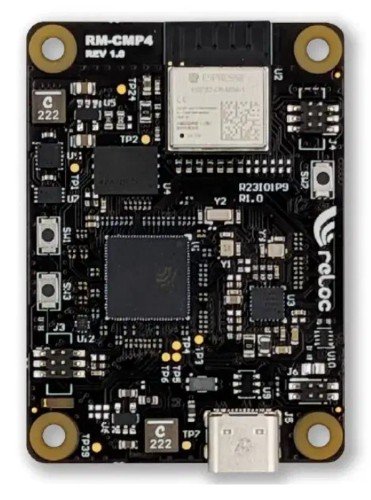
SCINTIX P4 top view
The microcontroller also includes a 2D Pixel Processing Accelerator, H.264 and JPEG hardware codecs, 768KB of high-performance L2 memory, 32KB of low-power SRAM, and 8KB of tightly coupled memory. External memory consists of 32MB PSRAM and 32MB NOR flash.
Wireless connectivity is provided by an ESP32-C6 companion microcontroller, which supports 2.4GHz Wi-Fi 6, Bluetooth 5 LE, and IEEE 802.15.4 for Thread and Zigbee applications. The ESP32-C6 communicates with the main ESP32-P4 through a four-bit SDIO interface and UART.
For wired networking, RELOC includes a Microchip KSZ8091RNACA 10/100Mbps Ethernet PHY, allowing the module to use compatible Ethernet connections exposed by CM4/CM5 carrier boards.
Display and camera connectivity includes two-lane MIPI-DSI and MIPI-CSI interfaces routed through the compute module connectors. USB connectivity consists of an onboard USB Type-C connector for power and programming, alongside USB 2.0 OTG signals routed to the carrier board.
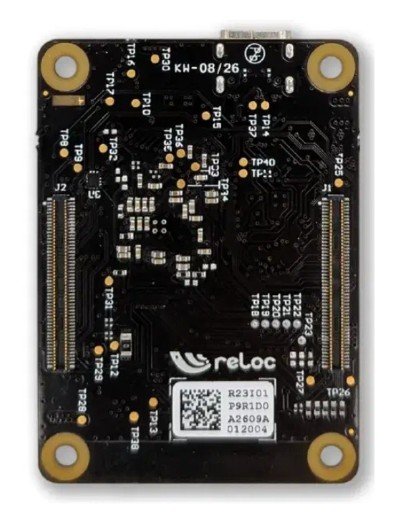
SCINTIX P4 bottom view
The SCINTIX P4 uses two Hirose DF40C-100DP board-to-board connectors and follows the Raspberry Pi Compute Module mechanical footprint. This allows developers to reuse supported carrier boards for prototyping or build custom carriers around the module.
RELOC has documented compatibility with the official Raspberry Pi CM4 and CM5 IO Boards, along with several third-party carrier boards, including the CM4 to Pi 4B Adapter, CM4-DUAL-ETH-MINI, and selected Waveshare CM4/CM5 boards.
According to RELOC’s compatibility table, the official Raspberry Pi CM4 IO Board has been tested with power, USB device and host functions, Ethernet, microSD, display, and GPIO. Camera support has been checked against the schematic. The CM5 IO Board has also undergone testing, although USB host operation requires additional consideration.
Not all Raspberry Pi carrier interfaces are supported. Features such as HDMI and PCIe, which are commonly used with Linux-based Compute Modules, are not provided by the ESP32-P4 in the same way.
The SCINTIX P4 routes 40 GPIO signals through its CM4/CM5 board-to-board connectors, with 23 ESP32-P4 GPIO signals accessible through the carrier’s 40-pin expansion header. Some signals are shared with wireless control, fan operation, and display or camera functions. RELOC also notes that the standard Raspberry Pi I2C header positions 3 and 5 are not connected, requiring developers to use alternative ESP32-P4 GPIO assignments for I2C communication.
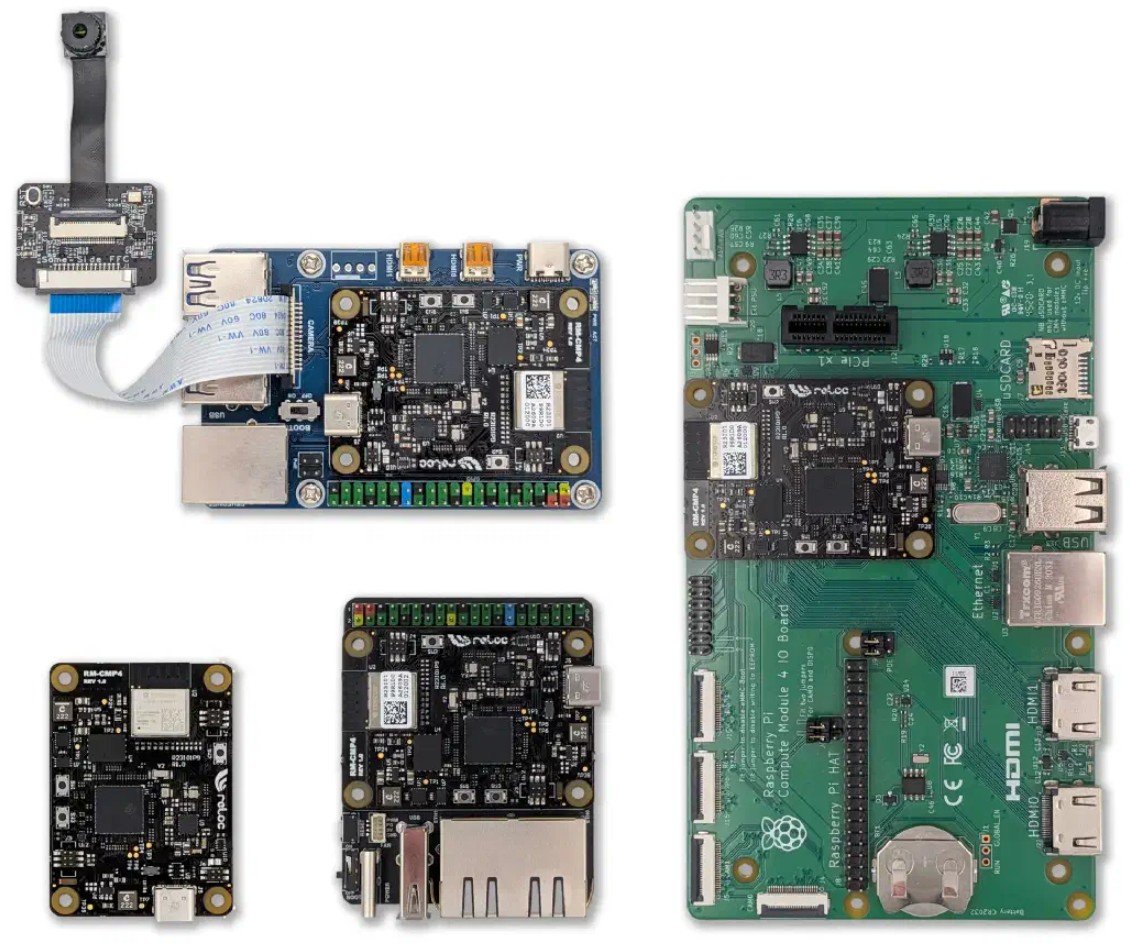
SCINTIX P4 on CM4/CM5 carrier boards
The SCINTIX P4 measures 55 × 40 × 5mm, increasing to approximately 8mm in height when the programming connectors are included. The module weighs 8.2g and has a specified operating temperature range of -20°C to +70°C.
Power is supplied through a 5V input on the compute module connectors or through the onboard USB Type-C port. The module can also operate independently of a carrier board for firmware programming and basic development.
Software development is based on Espressif’s ESP-IDF framework, with additional support for Arduino and PlatformIO. RELOC has published instructions using ESP-IDF 6.0.1, along with examples for USB programming, Ethernet, and Wi-Fi connectivity. The available Ethernet example uses iperf to test network communication on a Raspberry Pi CM4 IO Board.
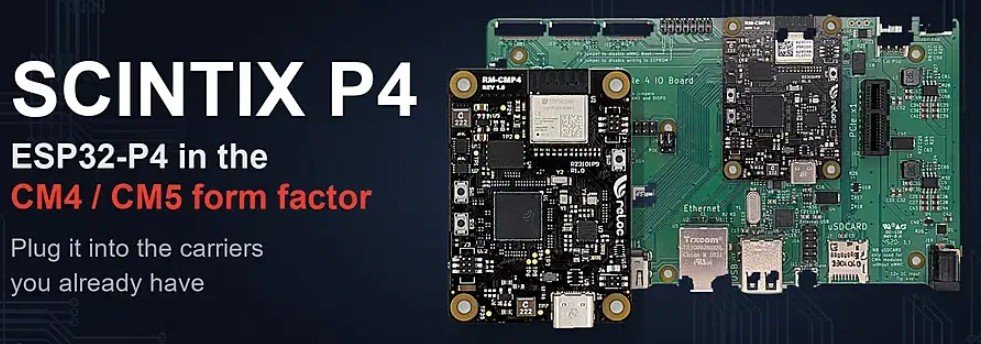
SCINTIX P4 compute module
In the documented test configuration, RELOC reports approximately 73Mbps uplink and 79Mbps downlink over UDP using the onboard 100Mbps Ethernet interface.
Additional demonstrations include an ESP-Brookesia-based graphical interface and an AI agent application using the ESP32-C6 for wireless connectivity.
A public GitHub repository contains firmware examples, wireless firmware, and development documentation. RELOC also plans to provide further hardware design resources, including schematics, a bill of materials, pinout diagrams, mechanical models, and KiCad-compatible libraries.
Further Information
The SCINTIX P4 is currently in the pre-launch stage on Crowd Supply, with no crowdfunding price or confirmed shipping date announced. Additional documentation and development examples are available through RELOC’s product page and the technical guide published on Espressif’s Developer Portal.

Please comment here...