


Raspberry Pi PoE+ Injector Leverages Power-Over-Ethernet for Remote Deployments
Mar 27, 2025 — by Giorgio Mendoza 809 views This month, Raspberry Pi launched a device capable of powering its single-board computers over Power-over-Ethernet. The Raspberry Pi PoE+ Injector enables both power and data to be transmitted through a single Ethernet cable, simplifying network infrastructure for projects deployed in remote or difficult-to-access locations.
Compatible with devices conforming to IEEE 802.3af and 802.3at standards, including all generations of Raspberry Pi PoE HATs, the PoE+ Injector supports network pass-through at speeds up to 1000 Mbps. Developed in collaboration with Microchip, this injector serves as a midspan device, inserting power into the Ethernet connection without altering data transmission. This makes it a practical solution for extending PoE capability to non-PoE switches.
— ADVERTISEMENT —
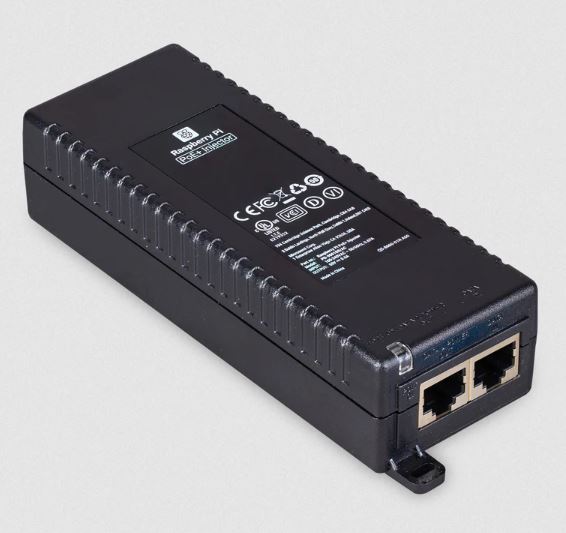
Raspberry Pi PoE+ Injector
With an output power of 30W, the Raspberry Pi PoE+ Injector can handle the demands of various applications, from industrial automation to remote sensors. The device accepts an input voltage range of 100 to 240 V AC and delivers a nominal output voltage of 55 V DC. Power is supplied through pins 4/5 (+) and 7/8 (-) on the Ethernet cable, ensuring compatibility with a wide range of PoE devices.
Physically, the injector measures 159 mm in length, 51.8 mm in width, and 33.5 mm in height. It features shielded RJ-45 connectors that support EIA 568A and 568B standards for reliable data transmission. An IEC C13 mains power input is present, though a mains lead is not included. The device operates within a temperature range of -10°C to 50°C, with a maximum humidity of 90% non-condensing.
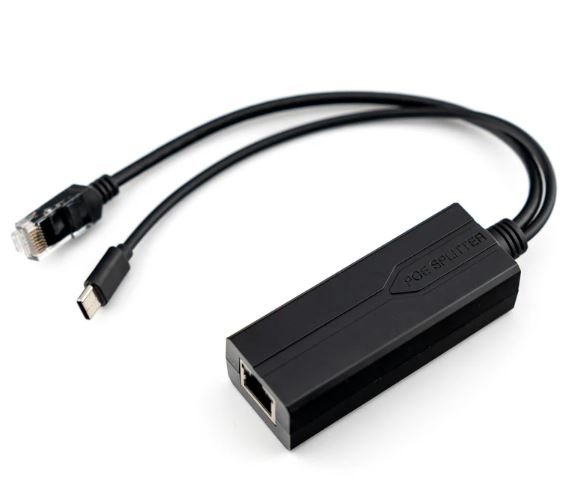
USB-C PoE Splitter
For users without a PoE HAT, Pimoroni offers a USB-C splitter to facilitate PoE-powered setups. Plugging in a PoE-enabled Ethernet cable allows the splitter to output 5V power from its USB-C connector and gigabit data from the Ethernet connector.
The USB-C connector can supply up to 3.5A to the Raspberry Pi 5, providing sufficient power for most setups, even when using peripherals like the 7″ touchscreen, the official monitor, or the NVMe Base, as stated by Pimoroni.
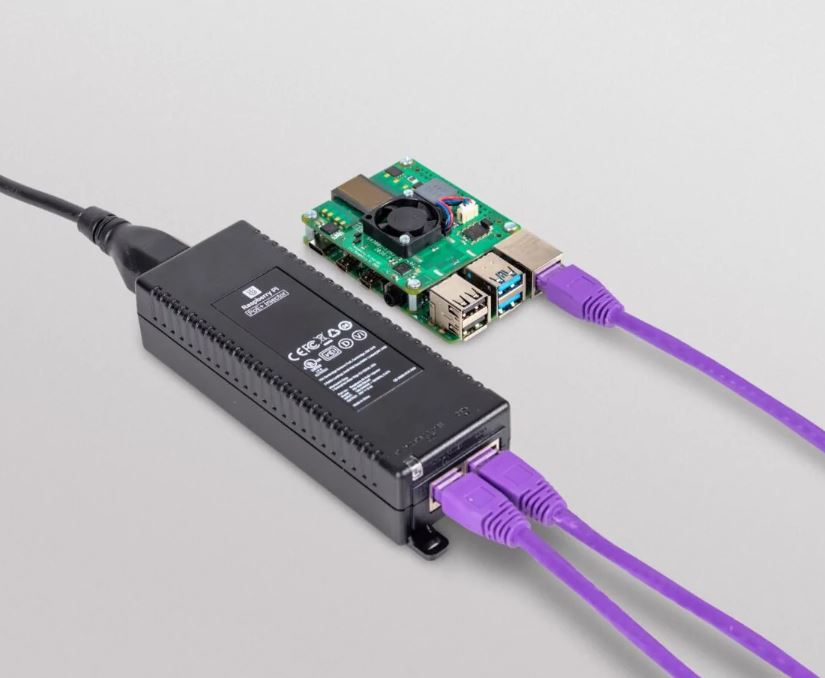
Raspberry Pi PoE+ Injector + RPi
While the Raspberry Pi 5 includes a 4-pin PoE power connector, the official Raspberry Pi PoE+ HAT+ designed for it is not yet available. According to Raspberry Pi, the HAT+ is in the final stages of development and aims to offer a compact and efficient power delivery solution.
Further information
The Raspberry Pi PoE+ Injector is priced at $24.94 on Pimoroni’s website, $25.00 at CanaKit, and $33.95 at PiShop.US. The USB-C PoE Splitter is available for $10.22 from Pimoroni.
The Raspberry Pi PoE+ Injector has a mean time between failures (MTBF) of 200,000 hours at 25°C and is expected to remain in production until at least January 2034.

Please comment here...