


Radxa previews Qualcomm-based CM-Q64 and VMARC-Q9075 compute modules
Jul 28, 2026 — by Giorgio Mendoza 1,025 views
Radxa has published specifications for two upcoming compute modules based on Qualcomm Dragonwing processors. The compact CM-Q64 combines 12 TOPS of AI performance with multi-camera support, while the larger VMARC-Q9075 uses the SMARC form factor and scales to 200 sparse TOPS for industrial AI, robotics, and machine-vision systems.
The Radxa CM-Q64 measures 55 × 40mm and is built around the Qualcomm Dragonwing QCS6490. The 6nm processor integrates an eight-core Kryo 670 CPU consisting of one Kryo Gold Prime core running at up to 2.7GHz, three Kryo Gold cores at 2.4GHz, and four Kryo Silver cores at 1.9GHz.
— ADVERTISEMENT —
Graphics are handled by an Adreno 643 GPU clocked at up to 812MHz, with support for OpenGL ES 3.2, OpenCL 2.0, Vulkan 1.x, and DirectX 12. The accompanying Hexagon 770 AI engine provides 12 TOPS of dense compute through dual HVX vector processors, Hexagon CP 2.0, and a tensor accelerator.

CM-Q64 block diagram
Memory configurations extend to 16GB of LPDDR5 with a 32-bit interface and transfer rates of up to 5500MT/s. Storage options include optional onboard eMMC 5.1 or UFS 3.1, while SDIO 3.0 supports microSD expansion. A PCIe Gen3 ×2 interface can also be used for NVMe storage or other PCIe peripherals.
The module includes a Qualcomm Spectra 570L triple image signal processor and exposes two two-lane MIPI-CSI interfaces together with one four-lane MIPI-CSI interface. Radxa states that up to four camera inputs are supported, depending on lane allocation and software support.
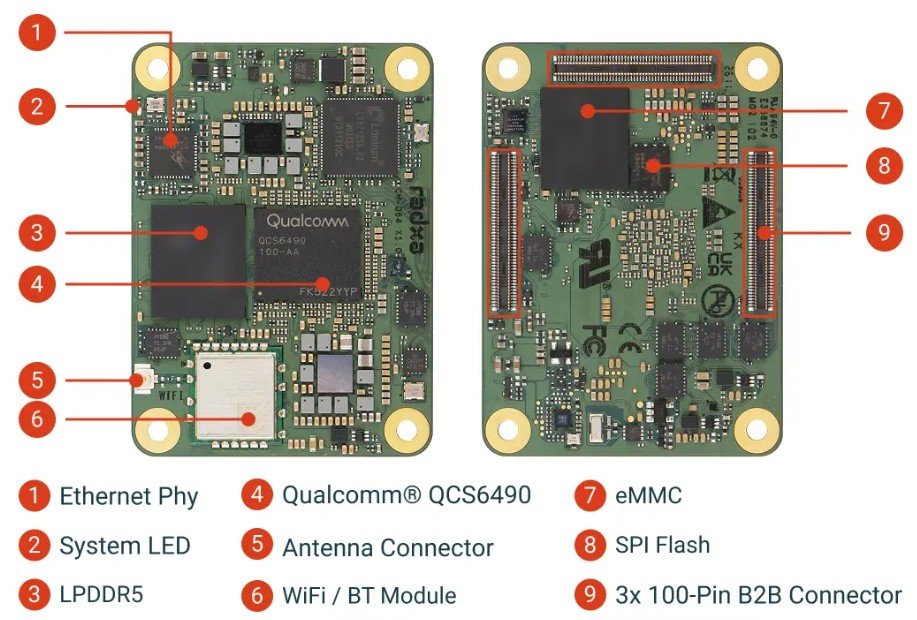
CM-Q64 features
Video processing includes decoding of one 4K60 stream, two 4K30 streams, or four 1080p60 streams using H.264, H.265, or VP9. Encoding supports one 4K30 stream or four 1080p30 streams, along with HDR10 and HDR10+ playback.
Display interfaces consist of HDMI 2.0 and DisplayPort 1.4 at up to 4K60, plus a four-lane MIPI-DSI interface. The DisplayPort output is routed through USB-C using DP Alt Mode, and the platform supports up to two independent displays.
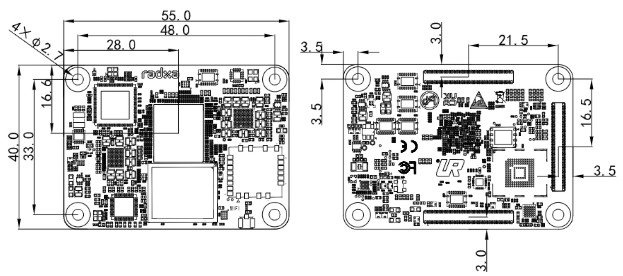
CM-Q64 dimensions
Networking options include an onboard Ethernet controller configurable for either Gigabit Ethernet or 2.5GbE. An optional FCU760K wireless module provides Wi-Fi 6 and Bluetooth 5.4. Additional interfaces routed through three 100-pin board-to-board connectors include USB 3.2 Gen 1, USB 2.0, UART, I2C, SPI, PWM, GPIO, SoundWire, and audio connections.
The CM-Q64 operates from a 5V DC input and is specified for temperatures from -20°C to 85°C. The product page also lists compatibility with several carrier boards, including the Raspberry Pi CM5 IO Board, Radxa Taco, Seeed Studio CM5 MINIMA, and Waveshare Mini Base Board.
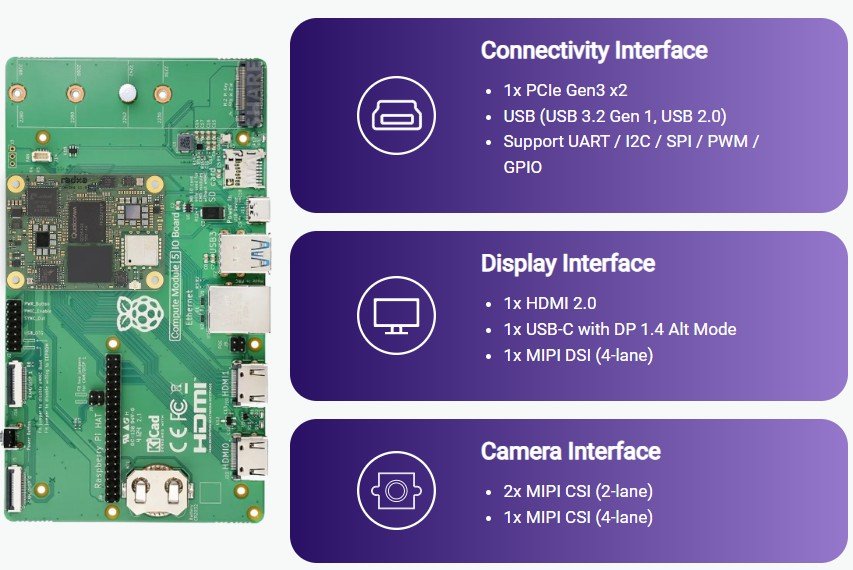
CM-Q64 + Raspberry CM5 IO Board
The larger VMARC-Q9075 is an 82 × 80mm SMARC compute module based on the Qualcomm Dragonwing IQ-9075. It targets higher-end edge AI, industrial automation, robotics, autonomous mobile robots, and machine-vision systems.
The IQ-9075 combines an eight-core Kryo Gen 6 CPU running at up to 2.36GHz with an Adreno 663 GPU. Radxa rates the GPU at 1.2 TFLOPS of FP32 performance and lists support for Vulkan 1.2, OpenGL ES 3.2, OpenCL 2.0 FP, and Adreno NN Direct.
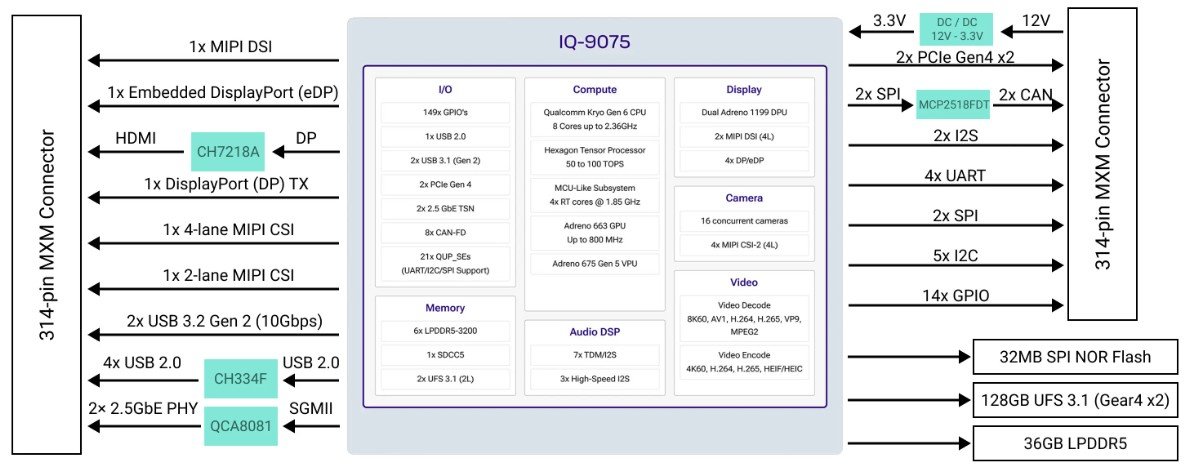
VMARC-Q9075 block diagram
AI workloads are handled by a Hexagon Tensor Processor equipped with four HVX vector units and two HMX matrix accelerators. Radxa specifies performance of up to 200 sparse TOPS at INT8 and lists compatibility with frameworks including TensorFlow, PyTorch, ONNX, Paddle, Caffe, and DarkNet.
The IQ-9075 also incorporates a four-core Arm Cortex-R52 microcontroller subsystem running at up to 1.85GHz. This separate processing domain can handle real-time control tasks alongside Linux workloads running on the Kryo CPU cluster.
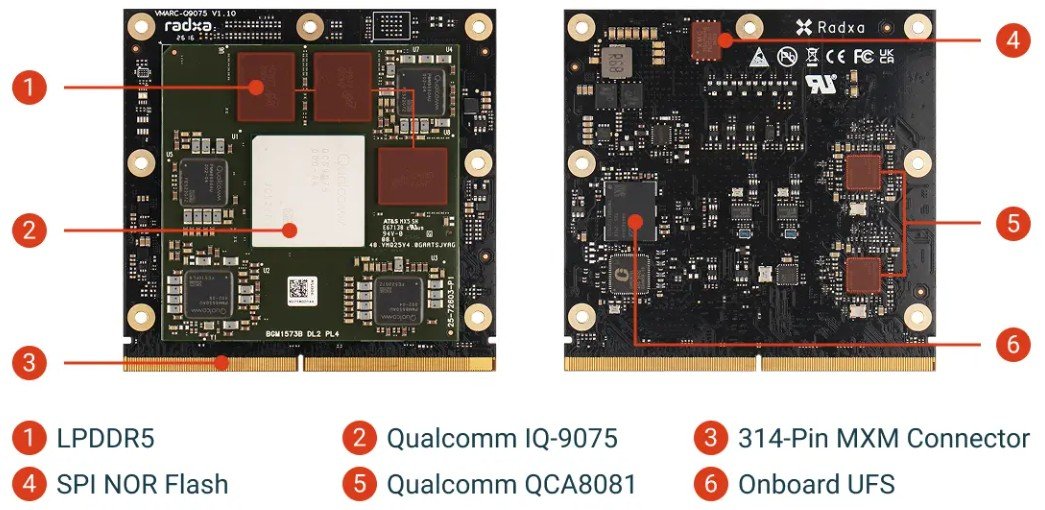
VMARC-Q9075 features
The module is equipped with 36GB of LPDDR5 memory connected through a 96-bit interface and operating at up to 6400MT/s. Onboard storage consists of 128GB of UFS 3.1 using a Gear4 ×2 interface, accompanied by 32MB of SPI NOR flash for boot and firmware storage.
Its Adreno VPU 765 supports AV1, HEVC, H.264, H.265, VP9, and MPEG-2 decoding. Processing capabilities extend to one 8K60 stream, two 8K30 streams, four 4K60 streams, or 32 1080p30 streams. Video encoding supports up to two 4K60 streams, four 4K30 streams, or sixteen 1080p30 streams using H.264, H.265, HEIF, or HEIC.
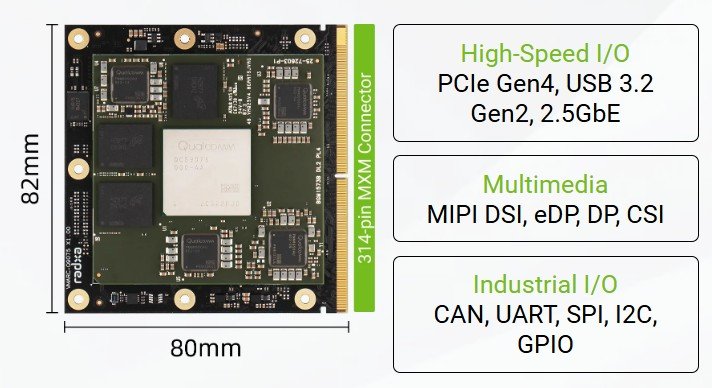
VMARC-Q9075 dimensions
Display connections include four-lane MIPI-DSI, embedded DisplayPort, DisplayPort 1.4, and HDMI generated from DisplayPort signals. Output resolution is specified at up to 4K60.
Camera connectivity consists of one four-lane and one two-lane MIPI-CSI interface. Although Radxa’s IQ-9075 block diagram references support for up to 16 concurrent cameras, the module itself exposes these two CSI interfaces through its edge connector.
High-speed expansion includes two PCIe Gen4 ×2 interfaces, two USB 3.2 Gen 2 connections operating at up to 10Gbps, and four USB 2.0 interfaces. Networking is provided through two 2.5GbE PHYs using Qualcomm QCA8081 controllers.

Radxa C201 VMARC IO Board
Industrial interfaces routed through the 314-pin MXM 3.0 connector include two CAN channels, two I2S interfaces, four UARTs, two SPI buses, five I2C buses, and GPIO. The module accepts a 12V supply and includes onboard conversion to 3.3V.
The product page also shows a compatible carrier board called the Radxa C201 VMARC IO Board, which provides multiple USB ports, two Ethernet ports, display outputs, and additional I/O connectors.
Regarding software, Radxa lists Qualcomm Linux, Ubuntu, and Windows for the CM-Q64, while the VMARC-Q9075 supports Ubuntu, Yocto, and ROS/ROS 2.
Further Information

Please comment here...