


Radxa C201 exposes dual 2.5GbE, NVMe and serial I/O for VMARC-Q9075
Aug 30, 2026 — by Giorgio Mendoza 351 views
Radxa has recently published additional hardware details for the C201, a 120 × 120mm carrier board designed for its compute module based on Qualcomm’s Dragonwing IQ-9075 platform. The board provides access to the module’s high-speed interfaces through dual 2.5GbE, NVMe storage, camera support, as well as RS-232, RS-485, and CAN bus connectivity.
The C201 is designed around Radxa’s VMARC-Q9075 compute module covered last month, which connects to the carrier board through a 314-pin MXM 3.0 connector. The module is based on Qualcomm’s Dragonwing IQ-9075 processor and integrates an eight-core Kryo Gen 6 CPU running at up to 2.36GHz, an Adreno 663 GPU, and a Hexagon AI accelerator rated for up to 200 sparse TOPS of INT8 performance.
— ADVERTISEMENT —
It also includes 36GB of LPDDR5 memory, 128GB of UFS 3.1 storage, and a separate four-core Arm Cortex-R52 subsystem for real-time control workloads.
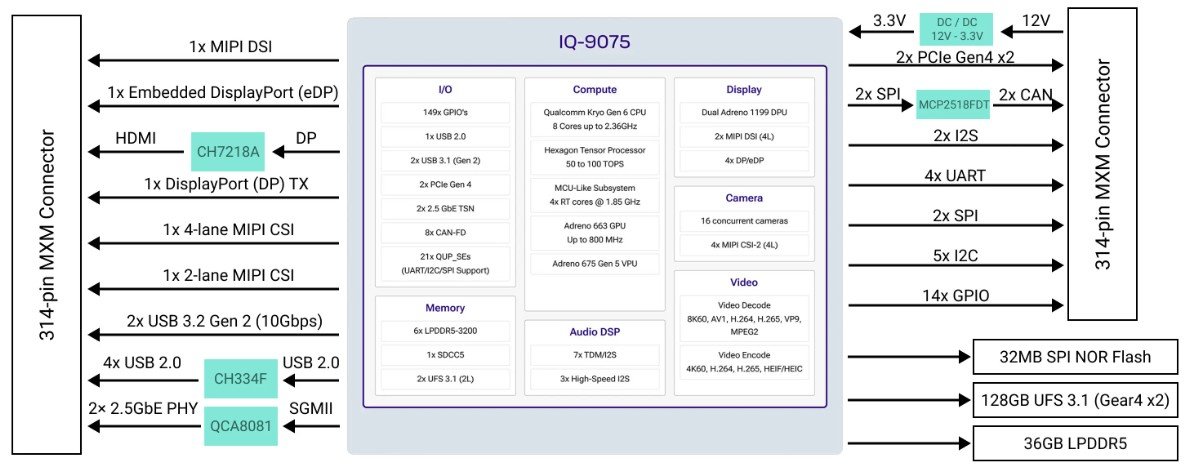
VMARC-Q9075 block diagram
Storage expansion on the carrier board is provided through an M.2 M-Key 2280 slot intended for NVMe SSDs. The board also includes an M.2 E-Key 2230 slot for Wi-Fi and Bluetooth modules, together with an M.2 B-Key 3042 slot and Nano-SIM socket for cellular connectivity.
Networking consists of two RJ45 Ethernet ports supporting up to 2.5GbE. These complement the wireless and cellular expansion options and allow the board to support multiple network connections.
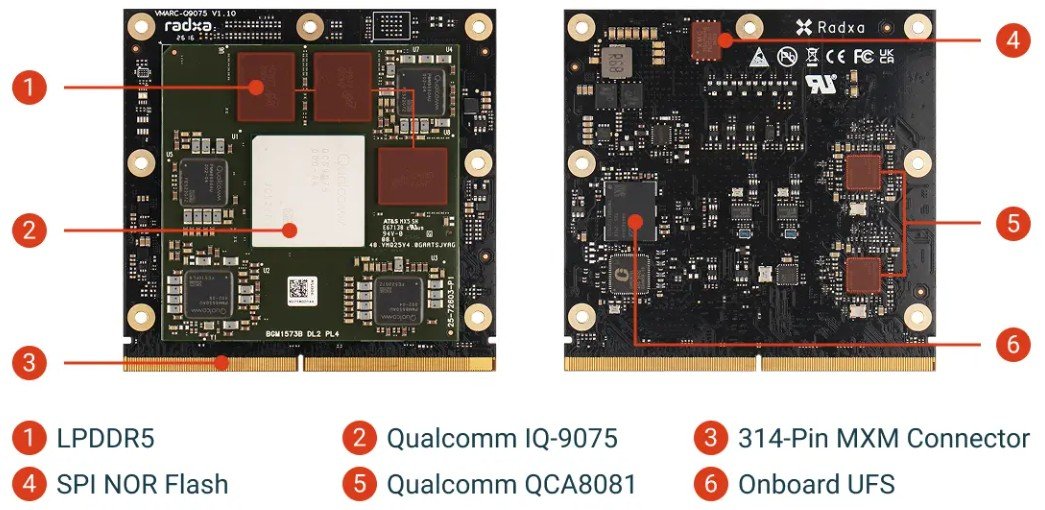
VMARC-Q9075 features
The C201 exposes several display interfaces, including HDMI, DisplayPort, embedded DisplayPort, and a four-lane MIPI-DSI connector. Camera support consists of one 31-pin MIPI-CSI interface with up to four lanes and a second 15-pin MIPI-CSI connector supporting up to two lanes.
USB connectivity includes four USB 3.2 Type-A ports operating at up to 10Gbps, along with a separate USB 3.2 header. Three additional USB 2.0 headers are provided for internal peripherals, while a USB Type-C connection is reserved for debugging.
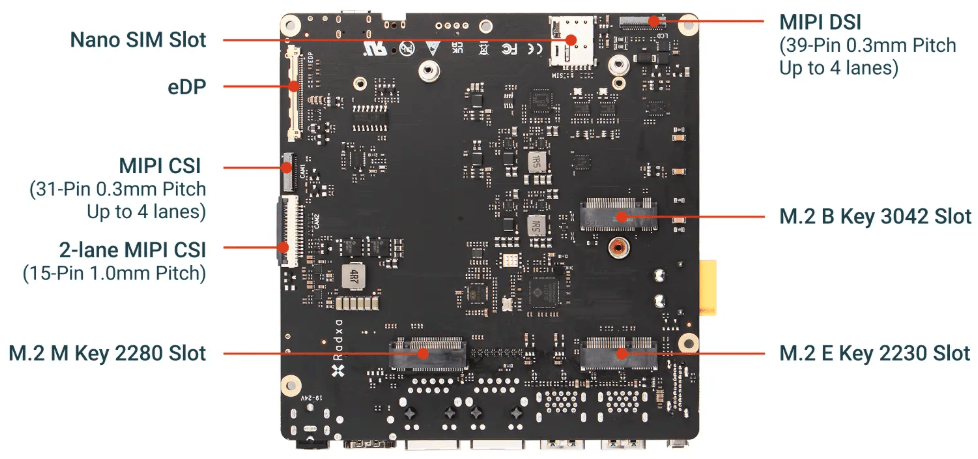
C201 VMARC IO Board bottom view
Industrial and embedded interfaces are available through dedicated connectors and a 40-pin GPIO header. The header carries offers UART, SPI, I2C, and general-purpose I/O, while separate connections are provided for RS-232 and RS-485.
Radxa’s interface diagram labels three CAN connectors; however, the published specifications list four CAN bus connectors, which also appears consistent with the image below.
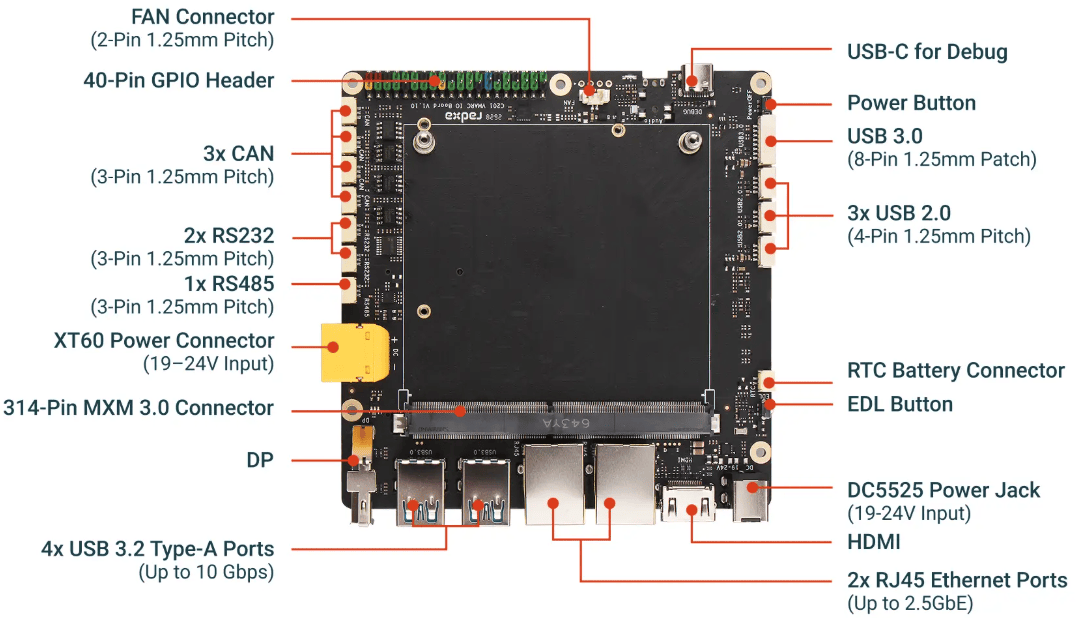
C201 VMARC IO Board top view
Regarding software, Radxa previously listed Ubuntu, Yocto, and ROS/ROS 2 support for the VMARC-Q9075, positioning the C201 as a development platform for robotics, edge AI, machine vision, and industrial control applications.
Specifications listed for the Radxa C201:
- Storage:
- 1× M.2 M-Key 2280 slot
- NVMe SSD support
- Networking:
- 2× RJ45 Ethernet ports
- Up to 2.5GbE
- 1× M.2 E-Key 2230 slot for Wi-Fi/Bluetooth
- 1× M.2 B-Key 3042 slot for 4G/5G cellular modules
- 1× Nano-SIM slot
- Display:
- 1× HDMI
- 1× DisplayPort
- 1× eDP
- 1× MIPI DSI, up to 4 lanes
- Camera:
- 1× 31-pin MIPI CSI, up to 4 lanes
- 1× 15-pin MIPI CSI, up to 2 lanes
- USB:
- 4× USB 3.2 Type-A, up to 10Gbps
- 1× USB 3.2 header, up to 10Gbps
- 3× USB 2.0 headers
- 1× USB Type-C debug port
- I/O:
- 1× 40-pin GPIO header
- 2× RS-232
- 1× RS-485
- 4× CAN connectors
- 1× 2-pin fan connector
- 1× RTC battery connector
- 1× Power button
- 1× EDL button
- Power:
- DC5525 barrel jack
- XT60 connector
- 19–24V input
- Mechanical:
- 120 × 120mm
- 314-pin MXM 3.0 connector
Further Information

Please comment here...