


QuadRF uses Raspberry Pi 5 for 4×4 MIMO SDR, RF visualization, and scalable phased-array support
Jun 23, 2026 — by Giorgio Mendoza 642 views
Crowd Supply recently featured QuadRF, a 4×4 MIMO software-defined radio platform designed for spatial RF visualization, beamforming, and phased-array experimentation. The platform includes four coherent transmit/receive channels, swappable dual-polarization antennas, an integrated Raspberry Pi 5, and a browser-based interface for viewing nearby wireless activity.
QuadRF uses four coherent antennas to measure differences in signal arrival time and generate a live RF overlay on a phone, tablet, or laptop. Scale RF says the interface can display nearby sources such as Wi-Fi devices, drones, beacons, wireless cameras, and lab transmitters as color-coded RF signals over a camera view. The platform operates from 4.9GHz to 6.0GHz and supports up to 40MHz of instantaneous bandwidth per antenna.
— ADVERTISEMENT —
For mobile use, the kit can be paired with a smartphone mount and handle. Users can align the phone camera with the QuadRF tile and access the AR stream through a web interface. The platform also allows selected RF sources to be routed to SDR applications, GNU Radio flowgraphs, video decoders, communication modems, or custom software running on the onboard Raspberry Pi 5.

QuadRF mobile setup
The hardware includes 4 RX and 4 TX full-duplex digital signal chains, up to 1W transmit power per antenna, and four swappable antennas supporting RHCP and LHCP polarization. A Lattice ECP5 FPGA handles distributed DSP and beamforming tasks, while Analog Devices MAX2850 and MAX2851 mixers are used for upconversion and downconversion.
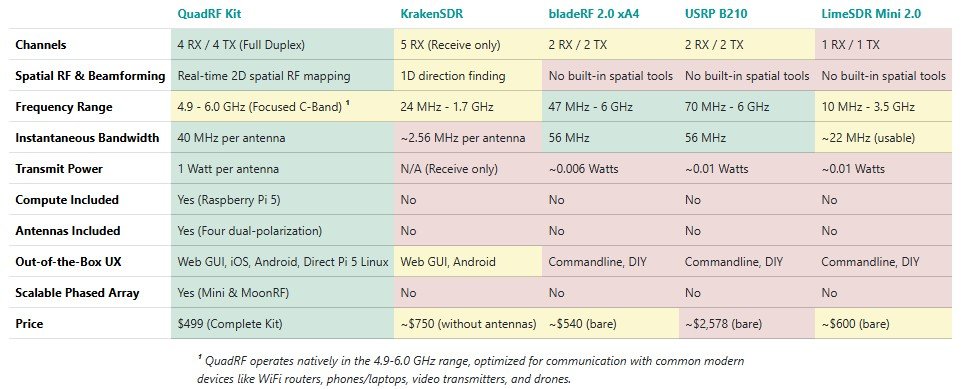
QuadRF kit comparison table
A 5.6Gbit/s MIPI data path connects the RF FPGA to the Raspberry Pi 5 host. QuadRF can process data locally or forward I/Q sample streams over Gigabit Ethernet, USB 3.0, or Wi-Fi through SoapySDR or ZeroMQ. The system is also described as compatible with GNU Radio, SDRangel, SDR#, and related SDR tools.

QuadRF GUI demo
QuadRF can also be used as a module for larger phased arrays. The company describes open interconnect structures for scaling beyond a single four-antenna tile, including larger 72-element and 240-element array concepts. Potential applications include Earth-Moon-Earth communication, radio astronomy experiments, mesh networking, satellite communication, and mobile RF platforms.
Connectivity options include USB 3.0, Gigabit Ethernet, Wi-Fi, HDMI, and direct keyboard access. An optional mobile expansion pack adds a battery-powered setup using 21700 lithium cells, with an estimated 5 to 6 hours of receive-only use or 3 to 4 hours under full transmit load.
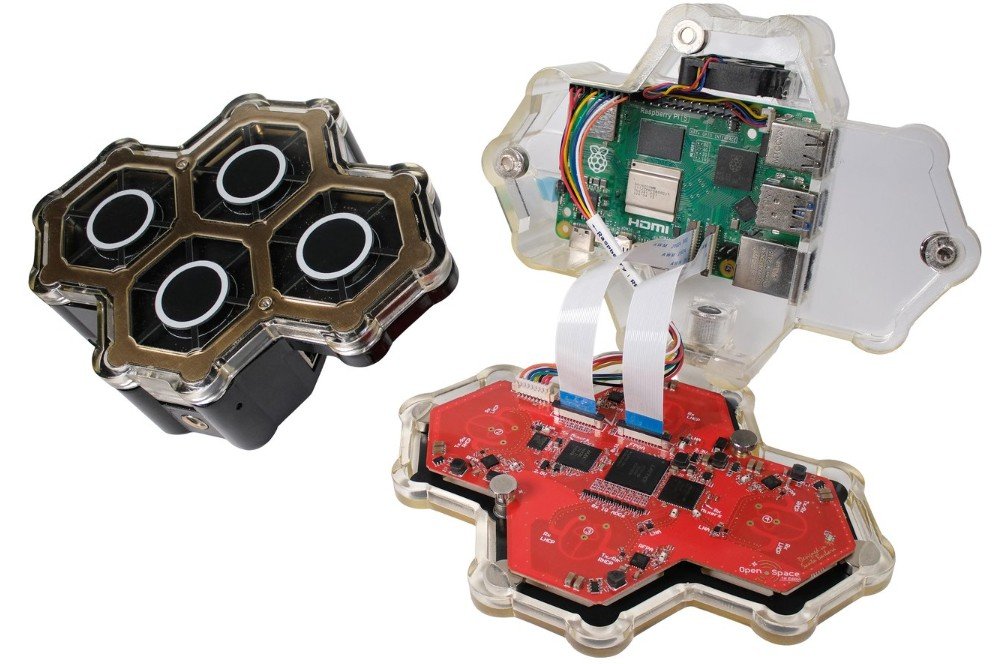
QuadRF kit
The QuadRF Kit includes the QuadRF tile, magnetic enclosure with clear front panel, four dual-polarization antennas, Raspberry Pi 5, cooling fan, tripod/mobile handle with smartphone mount, 27W USB-C power supply, cables, connectors, and a preloaded microSD card containing drivers, libraries, calibration utilities, web interfaces, and example applications.
Scale RF states the software stack is open source under GPLv2/GPLv3. The antenna and mechanical ecosystem files are planned under CC BY-SA 4.0, while the production RF core and official factory DSP bitstreams remain proprietary.
Further Information
The QuadRF campaign is live on Crowd Supply, with the main kit priced at $499, the Mobile Expansion Pack at $149, and the Six-Pack at $594. The main kit and mobile pack are expected to ship on September 30, 2026, while the Six-Pack is listed for January 14, 2027.

Please comment here...