


Quad-motor control board with Cortex-M33 and TinyEngine AI
Oct 25, 2026 — by Giorgio Mendoza 1,542 views BeagleBoard.org has introduced the BeagleConnect QuadESC, an open-source four-channel brushless DC motor-control board for robotics, drones, and embedded applications. It integrates four three-phase power stages and the BeagleConnect Torque module, featuring a 200 MHz Arm Cortex-M33 processor, dedicated math acceleration, and a TinyEngine neural-network accelerator.
The BeagleConnect QuadESC measures 60 × 48 mm and integrates motor-driving circuitry, current and voltage sensing, power regulation, and communication interfaces on a single PCB. Its architecture supports independent control of four brushless motors, with dedicated PWM timing resources for each channel and synchronized analog measurements for field-oriented control applications.
— ADVERTISEMENT —

AM13E230x block diagram
The BeagleConnect QuadESC uses the BeagleConnect Torque system-on-module, based on Texas Instruments’ AM13E23019 microcontroller. The processor integrates a 200 MHz Arm Cortex-M33 core with floating-point support, 512 KB of flash memory, and 128 KB of SRAM.
It also features a trigonometric math unit for accelerating motor-control calculations and a TinyEngine neural-network accelerator that can support application-specific inference tasks, such as fault detection and condition monitoring.
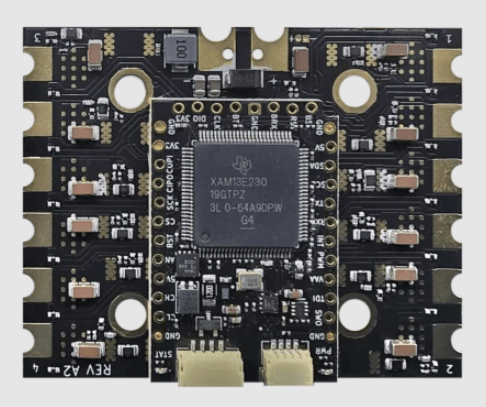
BeagleConnect QuadESC
The board assigns a dedicated motor-control PWM module to each of its four channels, allowing independent adjustment of PWM periods and phase offsets.
Each channel also routes its three phase-current signals across the microcontroller’s three 12-bit ADCs for synchronized acquisition, supporting field-oriented control algorithms. The converters are shared across all four motors, requiring firmware to coordinate sampling with PWM switching events.
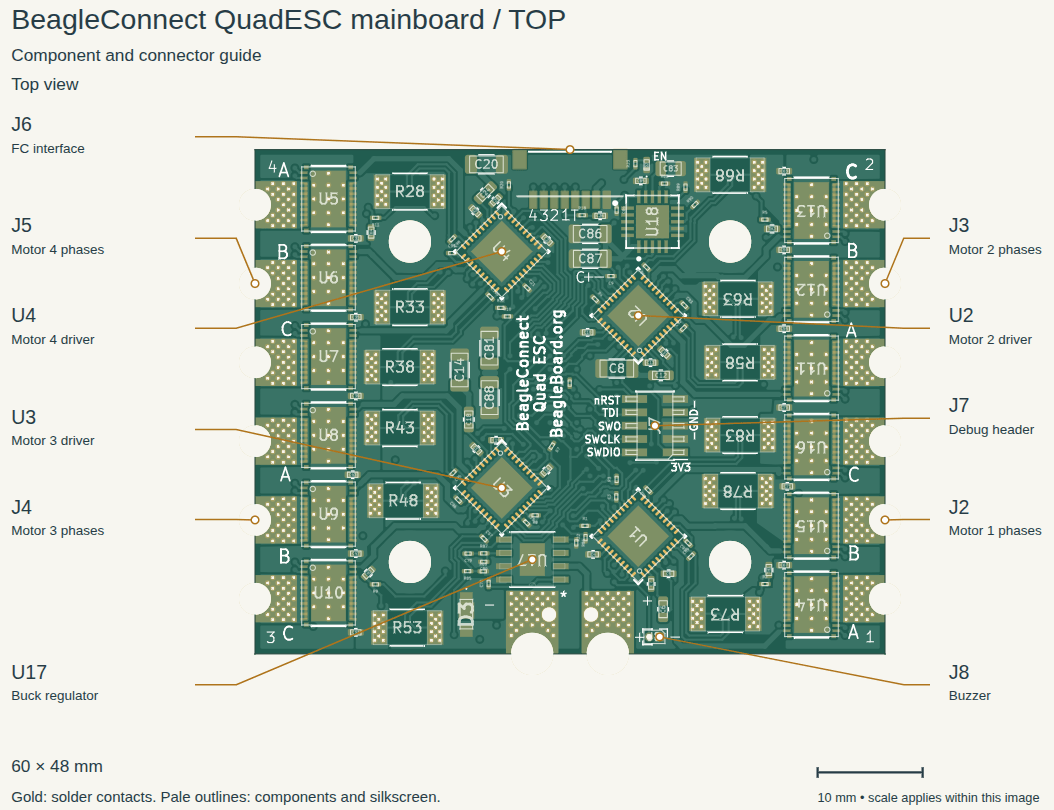
BeagleConnect QuadESC top view
Each motor channel uses a Texas Instruments DRV8323SRTAR three-phase gate driver with integrated current-sense amplifiers, SPI configuration, and fault reporting. Each gate driver controls three TI CSD88599Q5DC half-bridge devices, for a total of twelve across the four motor channels. The gate drivers communicate over a shared SPI bus with individual chip-select and fault-reporting signals, while two common enable signals control all four power stages.
For monitoring and feedback, the QuadESC provides 29 analog signals, including twelve phase-current measurements, twelve phase-voltage measurements, four board-temperature sensors, and battery-voltage monitoring. The current-sensing circuitry uses low-side shunts, requiring measurements to be synchronized with suitable PWM switching intervals. The feedback architecture also supports voltage measurements and thermal monitoring for applications that implement the corresponding control and protection functions.
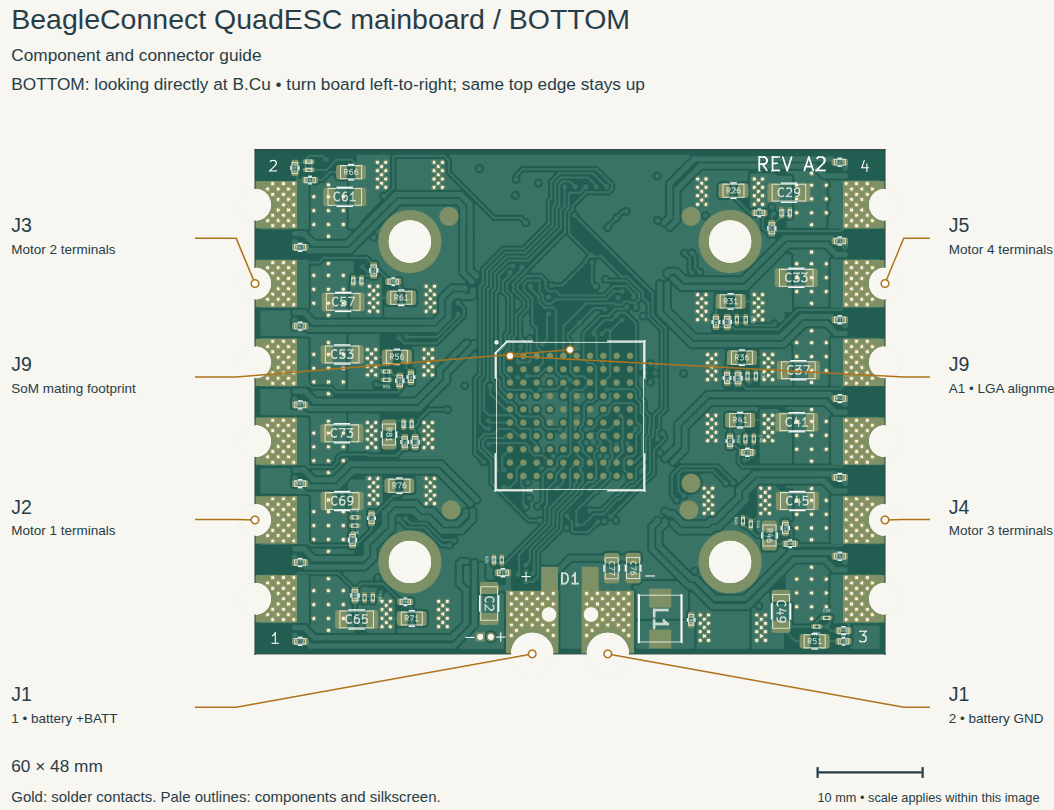
BeagleConnect QuadESC bottom view
Power is supplied through dedicated battery terminals supporting the intended 3S to 6S battery range of 9 V to 25.2 V. A TPS54360B buck regulator generates the supply for the BeagleConnect Torque module, while a TPS7A4701 regulator provides the analog supply rail used by the sensing circuitry. Battery-voltage monitoring is implemented through a resistor-divider network connected to one of the microcontroller’s ADC inputs.
The power-stage design targets 40 A continuous and 70 A burst current per motor, although these figures have not been established as validated operating ratings. Actual current capacity depends on cooling, ambient temperature, and load duration, while the burst duration remains unspecified. The hardware documentation also identifies a 32 V design maximum, which is not a recommended operating supply voltage.

BeagleConnect QuadESC power sensing architecture
For external connectivity, an eight-pin flight-controller interface provides four DShot command signal routes, telemetry, current reporting, battery voltage, and ground. CAN communication is supported through the TCAN844 transceiver integrated into the BeagleConnect Torque module. Additional connections include an ARM/JTAG debug header with SWD support, a two-pin buzzer interface, and three solder terminals for each motor’s phases.
Although the hardware provides resources for closed-loop motor control, the board requires application firmware to operate the motors. The installed controller includes Texas Instruments’ ROM bootstrap loader, while functions such as field-oriented control, DShot command decoding, telemetry, and AI-based diagnostics must be implemented in software. Programming and debugging documentation includes support for TI XDS110 tools.
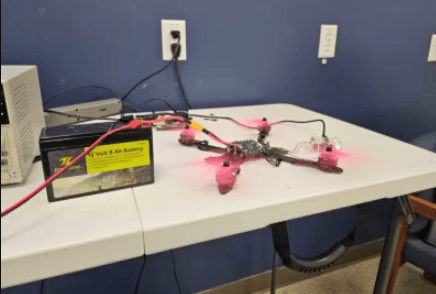
BeagleConnect QuadESC demo
BeagleConnect QuadESC is accompanied by open-source KiCad design files, schematics, firmware development resources, and technical documentation covering its power stages, sensing architecture, motor-control resources, and external connections. Separate documentation is also available for the BeagleConnect Torque module, including its programming interfaces, power management, and communication peripherals.
Further Information
Pricing and commercial availability have not yet been announced. Additional information is available on the BeagleBoard.org product page, with technical documentation published through the BeagleConnect QuadESC project website and hardware design files hosted on GitHub.

Please comment here...