


Pocket-sized Linux AI box runs on 256-TOPS Axera chip
Nov 4, 2026 — by Giorgio Mendoza 904 views
Sipeed has recently shared additional details about the MaixStation, a Linux AI workstation powered by Axera’s AX8860P processor, which combines a 16-core Arm CPU with an NPU rated at 256 TOPS FP4. The system supports up to 128GB of LPDDR5X memory, 273GB/s memory bandwidth, 10G SFP+ networking, and PCIe 5.0 expansion for local AI inference and development.
The AX8860P integrates 16 Arm Cortex-A55 cores and a dedicated AI accelerator, with Sipeed specifying 256 TOPS of dense FP4 performance. The processor uses a 256-bit LPDDR5X-8533 memory interface and supports up to 128GB of unified memory. It also incorporates video-processing hardware and PCIe 5.0 connectivity.
— ADVERTISEMENT —
The MaixStation is built around the Maix-V compute module, a 78 × 78mm board carrying the AX8860P and its associated memory. The module uses an LPCAMM2 connector and is shared across the MaixStation, MaixStation Pro, and MaixBlade product families.
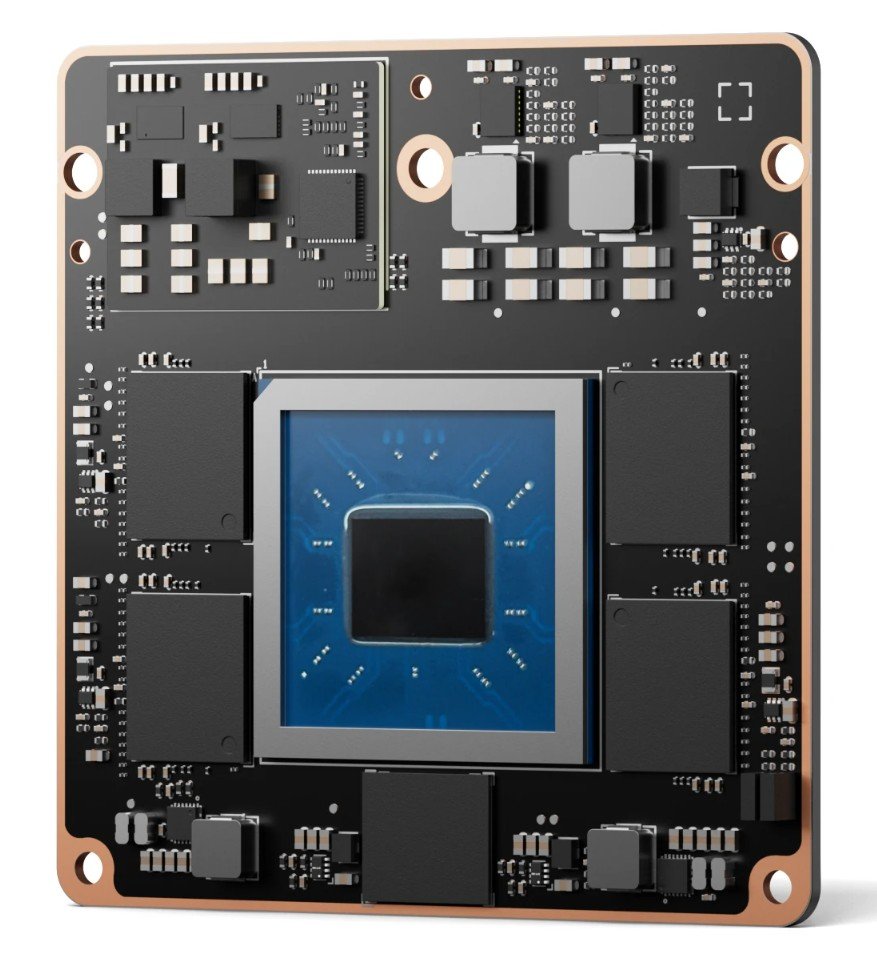
Maix-V compute module top view
Sipeed plans to offer the standard MaixStation in 32GB and 128GB memory configurations. According to the company, the 32GB version can accommodate dense language models with approximately 27 billion parameters, while the 128GB configuration supports larger mixture-of-experts models with up to 125 billion parameters, depending on model architecture and precision.
The manufacturer has also published preliminary inference benchmarks comparing the 128GB MaixStation with NVIDIA’s DGX Spark. Using Qwen3.8-27B at FP4 precision, Sipeed reports 1,400 tokens per second for prompt prefill and 15 tokens per second for decoding, compared with 1,300 and 13 tokens per second, respectively, for the DGX Spark.
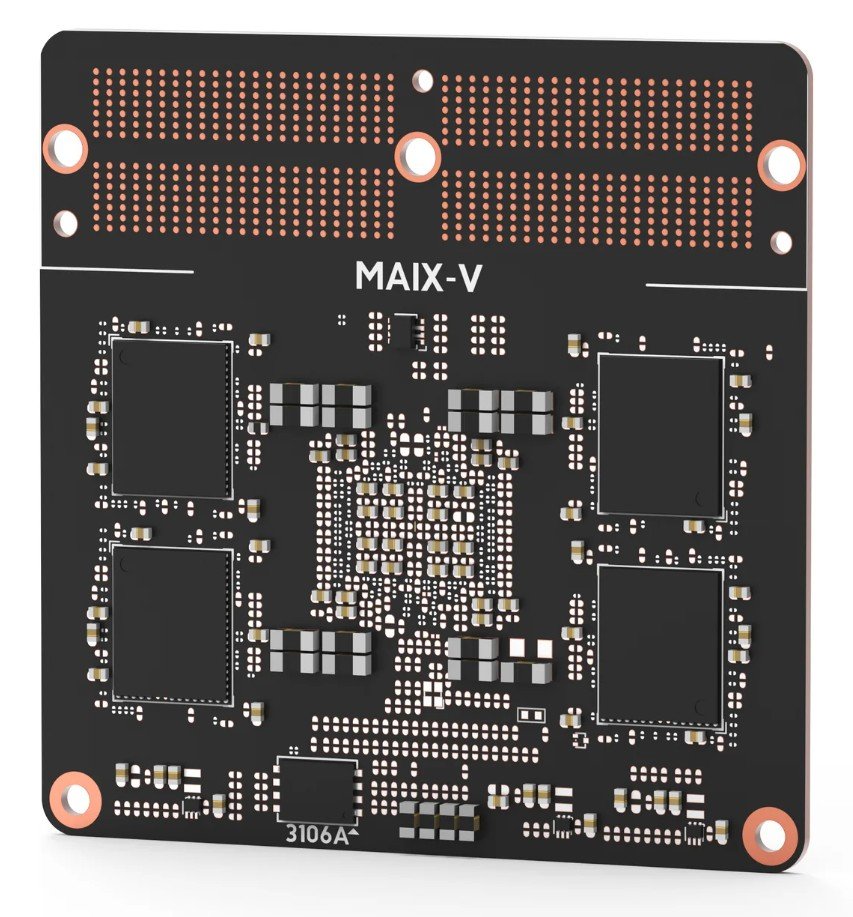
Maix-V compute module rear view
For the Qwen3.6-35B-A3B mixture-of-experts model, Sipeed reports 6,300 tokens per second for prefill and 80 tokens per second for decoding on MaixStation, compared with 5,600 and 80 tokens per second on DGX Spark.
Both systems were tested with multi-token prediction disabled, according to the company. These figures are preliminary manufacturer-reported results and have not been independently verified.

Sipeed-reported MaixStation vs DGX Spark pricing and benchmarks
The MaixStation measures 110 × 110 × 30mm, with an enclosure volume of approximately 363cm³. The enclosure includes a power button, USB Type-C power input, USB 3.0 connectivity, a 10G SFP+ interface, and a physical mode switch.
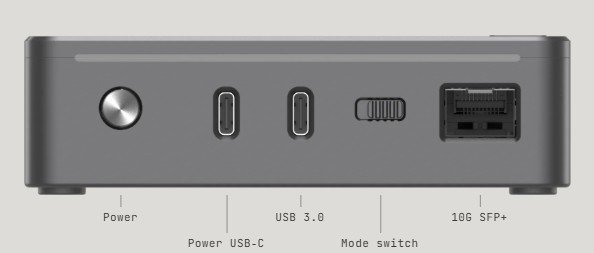

MaixStation front and rear views
The mode switch allows the system to operate through a direct USB connection to a host computer or serve inference workloads over a 10Gbps network connection. Sipeed also provides a small status display on the enclosure for monitoring device information.
Power is supplied through USB-C Power Delivery, with Sipeed specifying approximately 40W consumption under a typical workload. The company states that the system can operate from a compatible 65W USB-C power bank.
For software, MaixStation is expected to ship with Debian 13 and Linux kernel 6.18. Sipeed lists support for inference frameworks including vLLM, SGLang, PyTorch, llama.cpp, and Ollama, alongside agent-oriented tools such as OpenClaw and n8n.
The vLLM and SGLang implementations use a hardware-acceleration backend with kernels written in Axera’s AXDSL programming language. Sipeed plans to release the AXDSL kernels and associated development tools as open source, while also working toward broader availability of the AX8860 software development kit.
The system is expected to include preloaded language models, a browser-based interface, and OpenAI- and Anthropic-compatible APIs for local inference services.

MaixBlade PCIe accelerator card with four AX8860P processors
Beyond the standalone workstation, Sipeed is developing additional configurations based on the same AX8860P architecture. Two MaixStation systems can be connected using an MCIO 8i interface with PCIe 5.0 ×8 connectivity, allowing a combined memory capacity of 256GB.
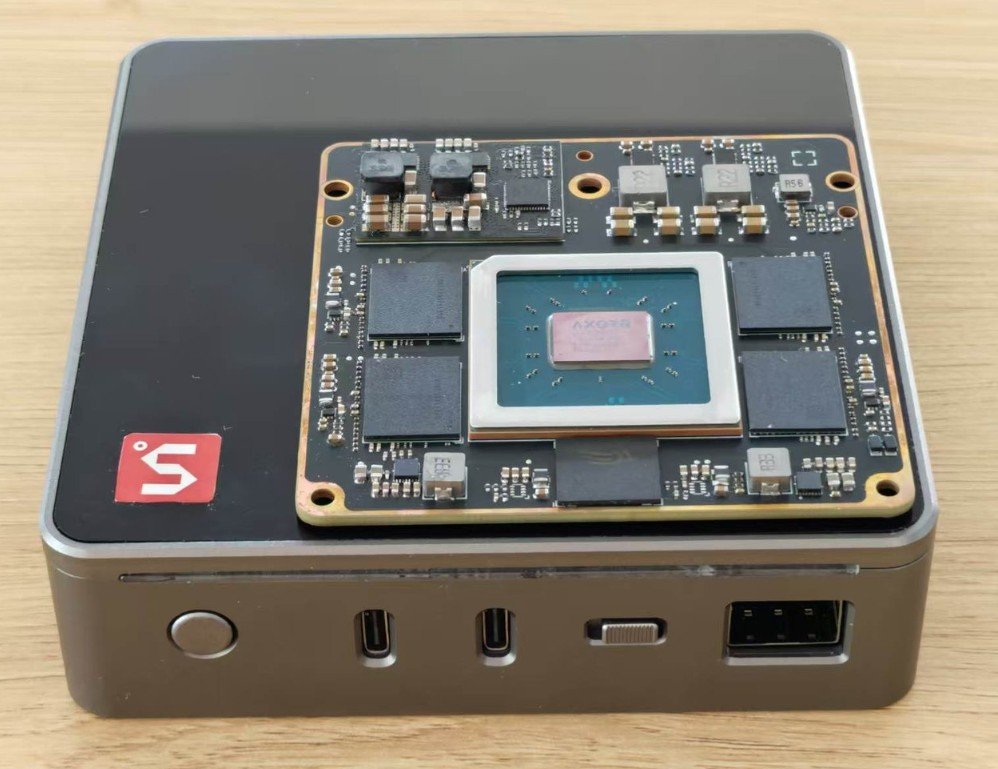
MaixStation and Maix-V compute module
The company also describes a 512GB MaixStation Pro and the MaixBlade, a PCIe accelerator card integrating four AX8860P processors. Multiple MaixBlade cards are proposed for larger configurations with 1TB or 2TB of aggregate memory. These expanded configurations remain part of Sipeed’s planned product lineup.
Specifications listed for the MaixStation include:
- Processor:
- Axera AX8860P
- 16x Arm Cortex-A55 cores
- NPU rated at 256 TOPS FP4
- Memory:
- 32GB or 128GB LPDDR5X
- 256-bit LPDDR5X-8533 interface
- Up to 273GB/s bandwidth
- Storage:
- M.2 2280 interface for NVMe SSD
- Networking:
- 1x 10G SFP+
- I/O and Expansion:
- USB Type-C for power
- USB 3.0 device connectivity
- MCIO 8i, PCIe 5.0 ×8 for multi-node expansion
- USB/network mode switch
- Software:
- Debian 13, Linux 6.18
- vLLM, SGLang, PyTorch, llama.cpp, Ollama
- OpenAI- and Anthropic-compatible APIs
- Power:
- USB-C Power Delivery
- Approximately 40W typical consumption
- 65W USB-C power source
- Mechanical:
- 110 × 110 × 30mm
- 363cm³ enclosure
- Maix-V compute module: 78 × 78mm
Further Information
The MaixStation is scheduled for a Kickstarter launch toward the end of 2026. Sipeed has indicated preliminary pricing below $2,000 for the 32GB configuration and starting below $4,000 for the 128GB model, although final crowdfunding prices and shipping dates have not been confirmed.
The company is also preparing a $30 reservation program offering a $100 rebate on eligible Kickstarter pledges after delivery, subject to its reservation terms.

Please comment here...