All News | Boards | Chips | Devices | Software | LinuxDevices.com Archive | About | Contact | Subscribe
Follow LinuxGizmos:
Twitter Facebook Pinterest RSS feed
*   get email updates   *

Open Home Foundation Marks Second Year with Structural Changes and Home Assistant 2025.4 Update

May 4, 2025 — by Giorgio Mendoza 274 views

April 2025 marked the start of the Open Home Foundation’s second year. Since its launch at the State of the Open Home 2024 event, the Foundation has grown rapidly, gaining broad community and industry support. Last month’s 2025 event highlighted key milestones from its first year and outlined plans for continued development.

Over the past year, the Foundation advanced its mission by supporting open-source projects such as Home Assistant, ESPHome, Zigpy, and Wyoming. It also assumed responsibility for the Works With Home Assistant program, expanding its certified vendor list to include companies like Aqara, Reolink, and Eve.

— ADVERTISEMENT —


The organization gained visibility through its role in the Z-Wave Alliance, participation in GitHub Universe, and the release of its first hardware product, the Home Assistant Voice Preview Edition. It also achieved Matter certification for its Matter Server.
OHF Growth
(click image to enlarge)

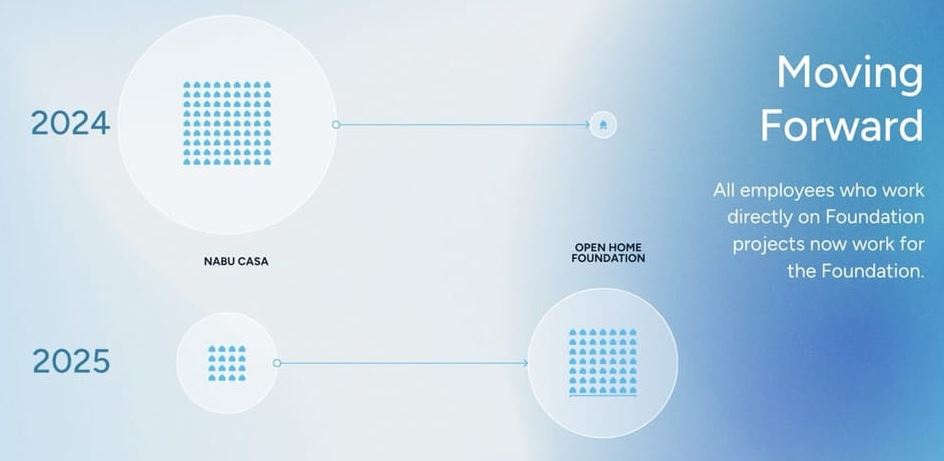
A major structural shift involved transferring 39 full-time developers from Nabu Casa to the Foundation. This clarified roles between the Foundation, which now leads core development, and Nabu Casa, which focuses on hardware and cloud services. Staff are organized into two teams: Home Assistant and Ecosystems, with the latter managing ESPHome, Piper, Zigpy, and other related efforts.

The Foundation also secured tax-exempt status in Switzerland and received a $25,000 donation from Espressif. It added two important community projects to its portfolio: Music Assistant and the Home Assistant Community Store.

Looking ahead, the Ecosystems team has begun development of a Device Database. This initiative aims to consolidate fragmented device knowledge from across the community, improving compatibility and automation capabilities across the Open Home ecosystem.

OHF Supporters
(click image to enlarge)

In parallel with the Foundation’s organizational growth, Home Assistant has continued to evolve. The April 2025.4 release introduces a range of new features and improvements across dashboards, voice interaction, integrations, templates, and energy management.

An experimental Areas dashboard has been introduced. It automatically generates a layout based on user-defined areas, providing a more intuitive and clean interface for monitoring and control. This new dashboard emphasizes usability by grouping entities by type and providing temperature/humidity status per area. Customization options are available, and users can still opt to manage dashboards manually.

Additionally, a new Clock card has been added, allowing users to include a configurable time display on their dashboards, particularly useful for wall-mounted or shared screens.

Voice Assistant Updates

Voice interaction has been enhanced with support for continued conversations using LLMs, enabling natural back-and-forth dialogue without repeating a wake word. ESPHome-based assistants can now initiate conversations based on triggers, such as detecting an open door or a user arriving home.

The Voice Wizard has also been redesigned to guide users through language and feature selection based on device capabilities.

Voice Wizard
(click image to enlarge)

Cloud-Based Onboarding

Users of Home Assistant Cloud can now restore backups during initial setup. This streamlines migration to new hardware and provides quicker recovery in case of system failure.

Home Assistant Cloud
(click image to enlarge)

Integrations and Improvements

New integrations include Bosch Alarm, Remote Calendar, and Pterodactyl server panel, among others. Enhancements to existing integrations such as SmartThings, Roborock, Reolink, Home Connect, and OpenAI have expanded functionality. Several integrations achieved higher ratings in the Home Assistant integration quality scale, with Azure Storage and Fronius reaching platinum level.

Templates and Energy Management

The template engine now supports advanced functions like combine, difference, intersect, and union, improving flexibility in automations and data processing.

Energy Management Device Hierarchy
(click image to enlarge)

Energy management now supports device hierarchies, allowing users to define parent-child relationships between monitored devices. This helps eliminate double-counting and provides more accurate energy tracking.

Further Information

For more details, visit the official Home Assistant blog and review the full April 2025.4 release notes.

(advertise here)


PLEASE COMMENT BELOW

Please comment here...