


ODROID-H5 is a low-power x86 SBC with 10GbE and four M.2 slots
May 19, 2026 — by Giorgio Mendoza 3,961 views
Hardkernel has introduced the ODROID-H5, a new x86 single-board computer based on Intel’s Core i3-N300 processor. The board updates the ODROID H-series with onboard 10GbE networking, four M.2 expansion slots, DDR5 memory support, and a revised HSIO configuration intended for storage, networking, and accelerator expansion.
The new model succeeds the ODROID-H4 family and shifts the platform toward home labs, network storage, virtualization, and low-power server deployments.
— ADVERTISEMENT —
The system is built around the Intel Core i3-N300 (Alder Lake-N) processor featuring eight Gracemont cores and eight threads operating at up to 3.8GHz. Hardkernel positions the N300 as a lower-power alternative to the N305 used on the H4 Ultra, reducing TDP from 15W to 7W while maintaining the same core count.
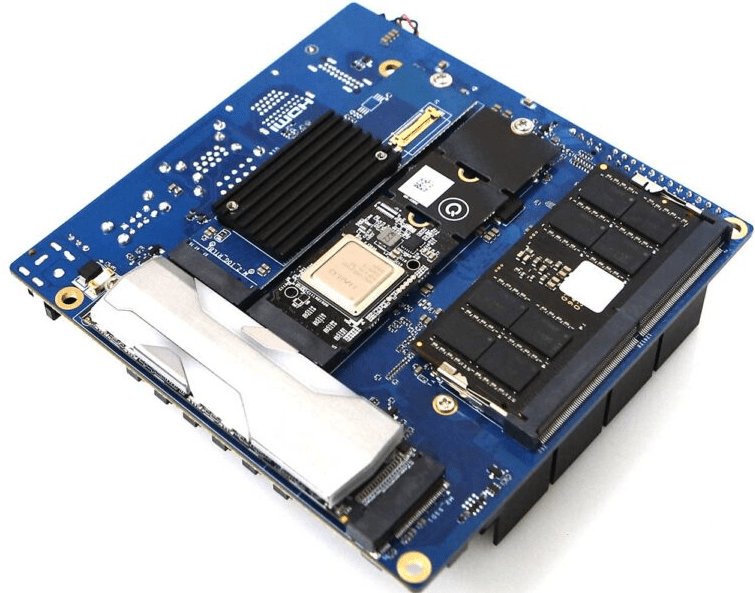
ODROID-H5 bottom view
For memory, the board provides a single DDR5 SO-DIMM slot supporting up to 64GB at 4800MT/s together with an onboard eMMC socket for boot storage.
Expansion is handled through four M.2 interfaces consisting of three PCIe Gen3 x2 slots and one PCIe Gen3 x1 slot supporting NVMe SSDs, networking adapters, Wi-Fi modules, AI accelerators, and SATA expansion cards. Board images also show the four M.2-2280 positions arranged directly on the PCB without requiring splitter cards.
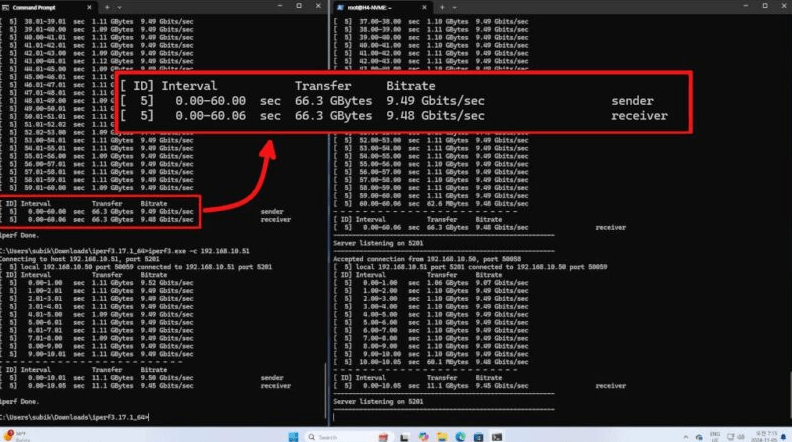
ODROID-H5 networking benchmarks
Networking is provided by a Realtek RTL8127 controller supporting up to 10GbE. Hardkernel reports that iperf3 testing reached approximately 9.49Gbit/s over a 60-second run transferring roughly 66.3GB, while an 18-hour stress test showed no connectivity or thermal issues.
| ODROID-H4 | ODROID-H4 Ultra | ODROID-H5 | |
|---|---|---|---|
| CPU | Intel Processor N97 | Intel Core i3-N305 | Intel Processor N300 |
| Architecture | Alder Lake-N / Gracemont | Alder Lake-N / Gracemont | Alder Lake-N / Gracemont |
| Cores / Threads | 4C / 4T | 8C / 8T | 8C / 8T |
| TDP | 12W | 15W | 7W |
| Single-thread boost | 3.6GHz | 3.8GHz | 3.8GHz |
| Multi-thread frequency | 2.9GHz | 2.6GHz | 2.3GHz |
| Memory | DDR5-4800, up to 64GB | DDR5-4800, up to 64GB | DDR5-4800, up to 64GB |
| Intel UHD EUs | 24 | 32 | 32 |
| PCIe / Storage | 1× M.2 PCIe Gen3 x4 | 1× M.2 PCIe Gen3 x4 | 3× M.2 PCIe Gen3 x2 1× M.2 PCIe Gen3 x1 |
| USB 2.0 | 2 ports | 2 ports | 3 ports |
| USB 3.0 | 2 ports | 2 ports | 1 port |
| Networking | 1× 2.5GbE | 2× 2.5GbE | 1× 10GbE |
| SATA III | None | 4 ports | Optional via M.2 card |
| Video output | 1× HDMI + 2× DP | 1× HDMI + 2× DP | 1× HDMI + 2× DP |
| Dual BIOS | No | Yes | Yes |
| Form factor | 120 × 120 mm | 120 × 120 mm | 120 × 120 mm |
Display output is provided through one HDMI 2.0 connector and two DisplayPort 1.2 outputs supporting up to three simultaneous 4K displays at 60Hz. The integrated Intel UHD graphics engine includes 32 execution units operating up to 1.25GHz.
Additional hardware includes dual BIOS support, RTC backup battery support, onboard power and reset switches, and a standard 12V PWM fan header with tachometer feedback compatible with PC cooling fans. Hardkernel recommends 92mm PWM fans for sustained workloads and Unlimited Performance mode operation.
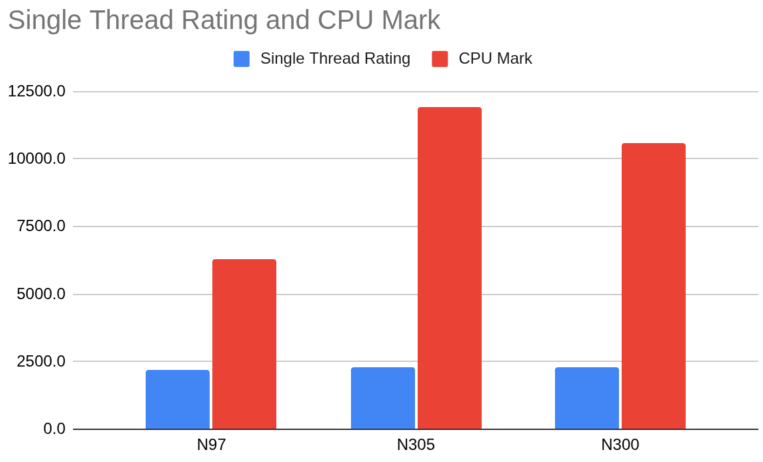
ODROID-H series CPU benchmark
Hardkernel also published benchmark comparisons between the N97, N305, and N300 processors. According to the company, the N300 reaches a PassMark CPU score of 10,578.8, compared to 11,939.2 for the N305 and 6,281.8 for the N97, while single-thread performance remains similar between the N300 and N305.
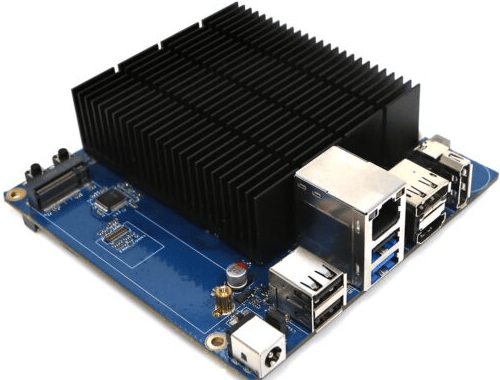
ODROID-H5
The company attributes the lower multi-thread score to the N300’s reduced sustained all-core frequency of 2.3GHz versus 2.6GHz on the N305 while lowering TDP from 15W to 7W.
Additional Phoronix-based testing covering compression, cryptography, rendering, Python workloads, video encoding, and Vulkan compute reportedly showed real-world performance differences below 5% between the N300 and N305.
Specifications listed for the ODROID-H5:
- Processor:
- Intel Processor N300 octa-core processor
- 8× Gracemont CPU cores
- Up to 3.8GHz turbo frequency
- Intel UHD Graphics with 32 execution units
- Memory:
- 1× DDR5 SO-DIMM slot
- Single-channel memory support
- Up to 64GB DDR5-4800
- Storage:
- 1× bootable eMMC connector
- 3× M.2 PCIe Gen3 x2 slots (NGFF-2280)
- 1× M.2 PCIe Gen3 x1 slot (NGFF-2280)
- Networking:
- 1× 10GbE RJ45 port
- Realtek RTL8127 controller
- 10/100/1000/2500/5000/10000 Mbps support
- Wake-on-LAN support
- Video:
- 1× HDMI 2.0 (up to 4K@60Hz)
- 2× DisplayPort 1.2 (up to 4K@60Hz)
- Triple-display output support
- Audio:
- Digital audio via HDMI & DisplayPort
- No analog audio output
- Expansion / I/O:
- 24-pin expansion header
- UART interface (TXD/RXD/RTS/CTS)
- 2× I2C interfaces
- HDMI-CEC support
- External power button support
- 3.3V I/O signaling
- USB:
- 1× USB 3.0
- 3× USB 2.0
- Other Features:
- Passive heatsink
- BIOS backup battery
- Power & reset buttons
- System status LEDs
- 12V PWM fan header with tachometer support
- Optional active cooling support
- Power:
- 11V to 20V DC input
- Recommended 15V / 4A power supply
- ≈3.3W headless idle
- ≈4.5W desktop idle
- ≈25W CPU + GPU load
- Mechanical:
- 120 × 120 × 44 mm
- ~ 320g including heatsink
Further Information
The ODROID-H5 is available from Hardkernel for $260, with optional accessories including a 10GbE M.2 adapter, 6-port SATA expansion card, Mini-ITX kit, Wi-Fi modules, and Weather Board 2 sensor module.

For me, there is one but decisive minus – RJ45 instead of SFP+. It is supposed to be a fast, energy-efficient NAS, so probably somewhere close to the ‘server room’, and most of the switches have SFP+ (e.g. 8x 2.5G + 2x SFP+). Pity…