


NVIDIA JetPack 7.2 expands support for NemoClaw, Yocto Project, and AGX Orin 32GB Super Mode
Jun 19, 2026 — by Giorgio Mendoza 358 views NVIDIA has announced JetPack 7.2 for Jetson edge AI platforms, adding new deployment tools for agentic AI workloads, official Yocto Project support, and performance updates for Jetson Orin and Jetson Thor systems. The release is aimed at robotics, industrial automation, vision AI, and other edge applications that rely on local AI processing.
One of the main additions is one-command deployment support for NVIDIA NemoClaw on Jetson. NemoClaw is described as an open-source stack that adds privacy and security controls to OpenClaw. With JetPack 7.2, Jetson devices include the dependencies and software stack needed to deploy NemoClaw-based workflows without additional manual setup.
— ADVERTISEMENT —
This support is intended for agentic physical AI applications across robotics, industrial automation, vision agents, and edge AI systems. On a Jetson device running JetPack 7.2, NemoClaw can be installed using a single command provided in NVIDIA’s documentation.
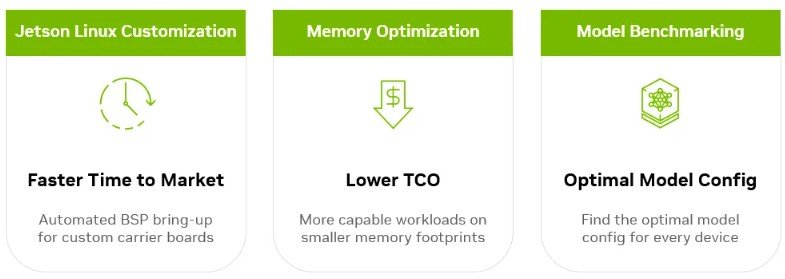
Jetson agent skills power agentic development
JetPack 7.2 also introduces NVIDIA agent skills for Jetson. These skills are repeatable, agent-executable instructions that define which tools to call, what outputs to generate, and how results should be validated. They are intended to automate Jetson software development tasks that would otherwise require manual configuration.
The release includes skills for Jetson Linux customization, memory optimization, and model benchmarking. The Jetson Linux customization skills are aimed at building and configuring BSPs for custom carrier boards, including I/O configuration, clock settings, fan control, and power profiles. Memory optimization skills can be used to tune memory usage across the stack, while model benchmarking skills are intended to help identify efficient model configurations for a given device and workload.
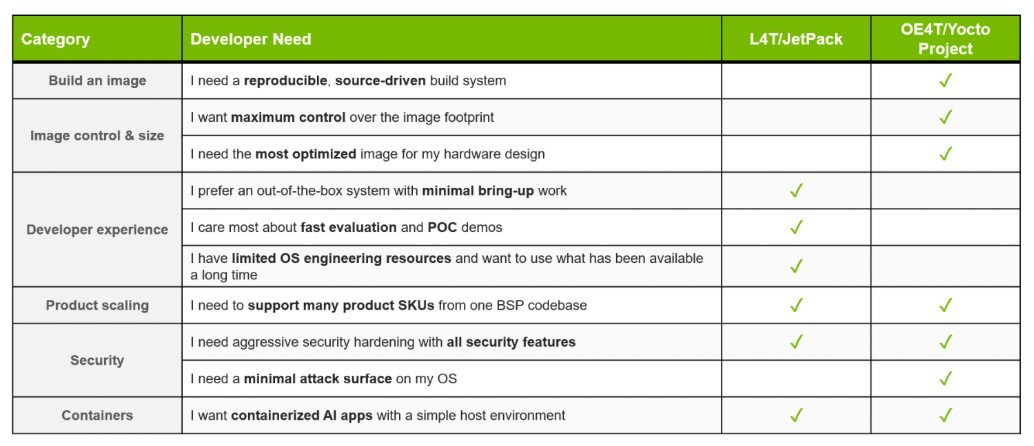
Developer decision guide for L4T/JetPack and OE4T/Yocto Project
NVIDIA is also adding official Yocto Project support for Jetson starting with JetPack 7.2. The Yocto Project is an open-source Linux Foundation project used to build custom Linux distributions for embedded systems. The release provides validated recipes and reference images for Jetson developer kits, along with technical documentation and support through NVIDIA developer forums.
This support builds on the long-running meta-tegra and OE4T community work, which previously provided Yocto support for Jetson platforms. During a June 15 livestream, NVIDIA described the change as a shift from community-only support to direct involvement in the codebase, validation process, and developer support path. The company is now contributing recipes, running CI/CD and software quality validation, and training engineering and support teams to handle Yocto-related Jetson issues.

Jetson AGX Orin module comparison for JetPack 7.2
The livestream also outlined the distinction between JetPack and Yocto for Jetson developers. JetPack remains the more direct option for evaluation, development kits, and teams that want an out-of-the-box Ubuntu-based environment. Yocto is positioned as a production-oriented option for teams that need reproducible builds, smaller system images, tighter software control, customized BSPs, and a reduced attack surface.
JetPack 7.2 also extends the newer Jetson software stack to the Jetson Orin family. The release brings the Ubuntu 24.04, Linux kernel 6.8, and CUDA Toolkit 13.0-based stack introduced with Jetson Thor to Jetson Orin, creating a more unified software foundation across the Jetson portfolio.
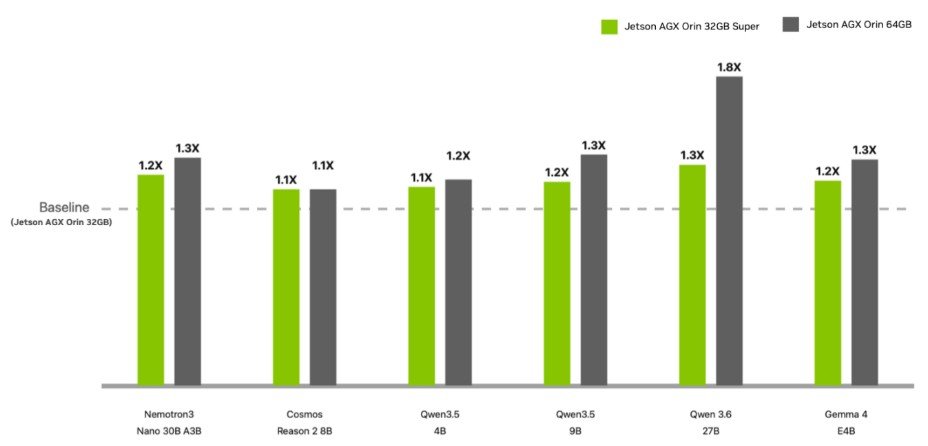
Model performance comparison on Jetson AGX Orin modules
For Jetson Thor, JetPack 7.2 introduces support for NVIDIA Multi-Instance GPU. MIG allows the integrated Blackwell GPU to be partitioned into two isolated GPU instances with dedicated compute, cache, and memory bandwidth.
NVIDIA says this can help run multiple AI workloads concurrently with more predictable performance, which is relevant for robotics and other mixed-criticality systems where perception, planning, control, and generative AI workloads may share the same SoC.
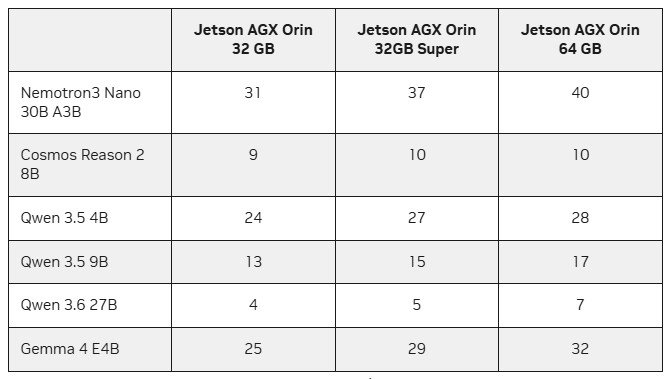
Generative AI model performance in tokens/sec on Jetson AGX Orin modules
The release supports two MIG partitions on Jetson Thor. One partition is intended for AI, graphics, inference, rendering, visualization, and general CUDA workloads, while the second isolated compute partition can be used for robotics, control, perception, or safety-related workloads.
NVIDIA indicates applications, containers, and services can be assigned to specific MIG partitions using CUDA Runtime controls and NVIDIA Container Toolkit integration.
NVIDIA & Yocto project
JetPack 7.2 also introduces a new Super Mode for the Jetson AGX Orin 32GB module. According to NVIDIA, the mode increases GPU frequency from 930MHz to 1.3GHz and enables higher power configurations up to 60W. This raises AI performance from 200 TOPS to 241 TOPS, representing an increase of more than 20 percent over the standard AGX Orin 32GB configuration.
NVIDIA notes the AGX Orin 32GB Super Mode allows the module to approach higher-end AGX Orin performance while reducing module cost compared with the Jetson AGX Orin 64GB. The company states that the update is intended for generative AI, robotics, and edge AI deployments where memory, performance, and cost remain important design constraints.
Further Information
More details are available from NVIDIA’s JetPack 7.2 announcement, Jetson software documentation, and livestream on Yocto Project support for Jetson.

Please comment here...