


Mudi 7 travel router runs 5G NR alongside tri-band Wi-Fi 7
Feb 4, 2026 — by Giorgio Mendoza 1,190 views GL.iNet has opened pre-orders for the Mudi 7 (GL-E5800), a portable travel router that combines 5G NR cellular connectivity with tri-band Wi-Fi 7 in a compact, battery-powered design. The device integrates high-speed wireless networking, dual SIM support, and a touchscreen interface for local configuration.
The Mudi 7 is built around Qualcomm’s Dragonwing MBB Gen 3 (X72) platform and supports 3GPP Release 17 5G NR operation in both standalone and non-standalone modes. Peak cellular download speeds are rated at up to 4.67 Gbps on supported sub-6 GHz networks, with regional variants covering different 5G and LTE frequency bands for North America and Europe.
— ADVERTISEMENT —
On the local network side, the router supports tri-band Wi-Fi 7 (802.11be), delivering up to 688 Mbps on 2.4 GHz, 2,882 Mbps on 5 GHz, and 5,765 Mbps on the 6 GHz band. Wired connectivity includes a single 2.5 GbE LAN/WAN port, allowing the Mudi 7 to function as either a portable gateway or a wired uplink for high-speed connections.
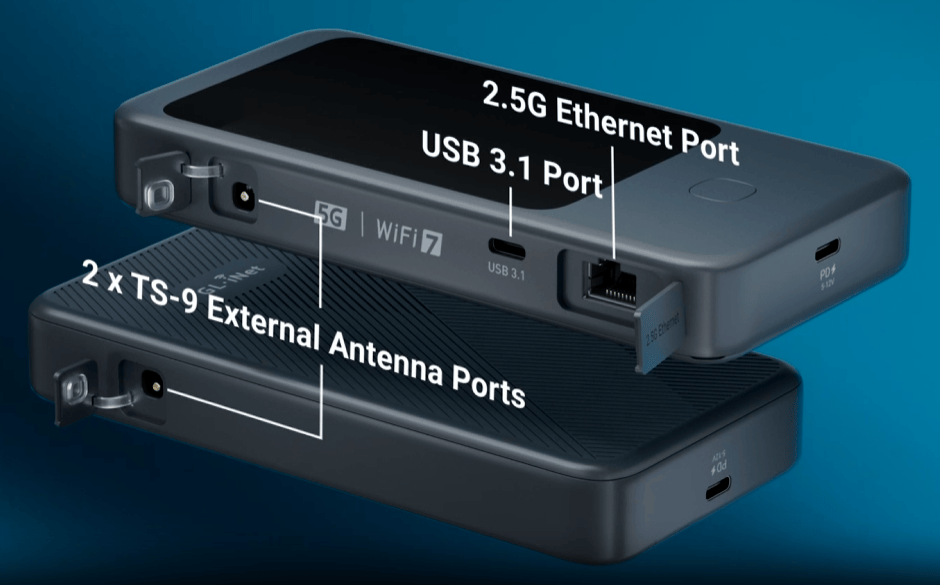
Mudi 7 peripherals
Unlike many travel routers, the Mudi 7 integrates a 2.8″ color touchscreen on the front panel. The display allows users to monitor connection status, switch networks, enable or disable VPNs, generate Wi-Fi QR codes, and manage repeater settings without accessing a separate web interface or mobile app.
For cellular connectivity, the device includes dual nano-SIM slots with dual-SIM dual-standby support, along with an onboard eSIM. Two TS-9 external antenna connectors are also provided for use with optional external antennas.

Mudi 7 SIM card slots
Power is supplied by an internal 5,380 mAh battery rated for up to 13.5 hours of operation. Charging and expansion are handled through two USB-C ports, one dedicated to power and one supporting USB 3.1 at up to 10 Gbps for tethering and OTG use. The router supports USB-PD fast charging at up to 30 W.

Mudi 7 other features
VPN functionality is a core feature, with hardware-accelerated performance reaching up to 700 Mbps using OpenVPN-DCO and around 600 Mbps with WireGuard.
The Mudi 7 ships with OpenWrt pre-installed, enabling advanced routing, firewalling, and customization for users familiar with embedded Linux networking platforms.
Specifications listed for the Mudi 7 (GL-E5800) include:
- Display:
- 2.8″ color LCD touchscreen
- Wireless Connectivity:
- 5G NR Sub-6 GHz (NSA and SA operation)
- Tri-band Wi-Fi 7 (802.11a/b/g/n/ac/ax/be)
- Up to 688 Mbps (2.4 GHz)
- Up to 2882 Mbps (5 GHz)
- Up to 5764 Mbps (6 GHz)
- Bluetooth (integrated with Wi-Fi platform)
- Cellular:
- Dual nano-SIM slots
- Built-in eSIM support
- Dual-SIM dual-standby operation
- Wired Networking:
- 1× 2.5 GbE WAN/LAN Ethernet port (10/100/1000/2500 Mbps)
- USB:
- 1× USB Type-C (power input/output only)
- 1× USB Type-C (USB 3.1 Gen 2, up to 10 Gbps; power input/output, USB tethering, USB OTG)
- Antenna Interfaces:
- 2× TS-9 external antenna connectors
- 8× internal antennas
- 6× cellular
- 2× Wi-Fi (2.4 GHz / 5 GHz / 6 GHz)
- Other Features:
- Power button
- Reset button
- Battery:
- Built-in 5380 mAh lithium battery (20.72 Wh)
- Power:
- USB-C PD/PPS input, 5–12 V
- Maximum input power: 30 W
- Typical power consumption: <30 W
- OS:
- OpenWrt pre-installed
- Operating Temperature:
- 0 °C to 40 °C (32 °F to 104 °F)
- Mechanical:
- 157 × 75 × 22.8 mm
- 300 g
Further Information
Pre-orders for the Mudi 7 are open through GL.iNet’s online store, with pricing starting at $279 for early-bird units and rising to $319 for standard pre-order tiers.

You state “The Mudi 7 ships with OpenWrt pre-installed”. Which is not entirely correct. It ships with GL.iNet software which is based on OpenWrt and contains proprietary and not open source GL.iNet code.
The WireGuard figure (~600 Mbps) is plausible on the X72 platform, though real-world throughput will vary depending on which 5G bands are actually available in your region. The touchscreen handles the basics well, but if you prefer to monitor battery, SIM state, active tunnel, and throughput from your iPhone or Mac without opening a browser tab — there’s a native app for GL.iNet routers called “Glint Router Monitor” on the App Store. No cloud middleman, works over Tailscale when the router is off-LAN.