


IAR webinar to examine static and runtime analysis for AI-assisted embedded development
Aug 24, 2026 — by Giorgio Mendoza 145 views
IAR will host a September 15 webinar focused on the use of AI-generated code in regulated embedded development, with discussion covering static analysis, runtime checking, and CI/CD workflows used to support software verification and compliance activities.
AI coding assistants can generate functions, test skeletons, and other source code relatively quickly, but IAR notes that this output does not inherently provide the evidence required in regulated environments such as automotive, medical, and industrial systems. Relevant standards and guidelines include ISO 26262, IEC 62304, IEC 61508, MISRA C/C++, CERT C/C++, and CWE.
— ADVERTISEMENT —
The webinar, titled “Guarantee Quality in AI-Assisted Workflows,” will examine the gap between generating code and producing the verification and traceability evidence expected in safety-critical development.
According to IAR, AI-assisted development can shift part of the engineer’s role from writing code toward reviewing and validating generated implementations. In this workflow, developers remain responsible for determining whether generated code matches system requirements, follows applicable coding rules, and behaves correctly under expected operating conditions.
One area covered during the session will be static analysis. IAR notes that its C-STAT tool can check source code against MISRA C, MISRA C++, CERT C, and CWE rules during development. These checks are intended to identify issues such as implicit conversions, potentially unsafe language constructs, and other violations before code reaches later verification stages.

C-STAT analysis report with MISRA C:2012 and CERT C checks
The webinar will also discuss dynamic analysis using IAR C-RUN. According to the company, C-RUN instruments an application during a debug session and can identify issues that depend on runtime behavior rather than source structure alone.
IAR lists memory leaks, out-of-bounds accesses, integer overflow, heap errors, and unhandled switch cases among the types of problems C-RUN can detect. The company positions runtime checking as a complement to static analysis, particularly for defects that may only appear under specific execution conditions.
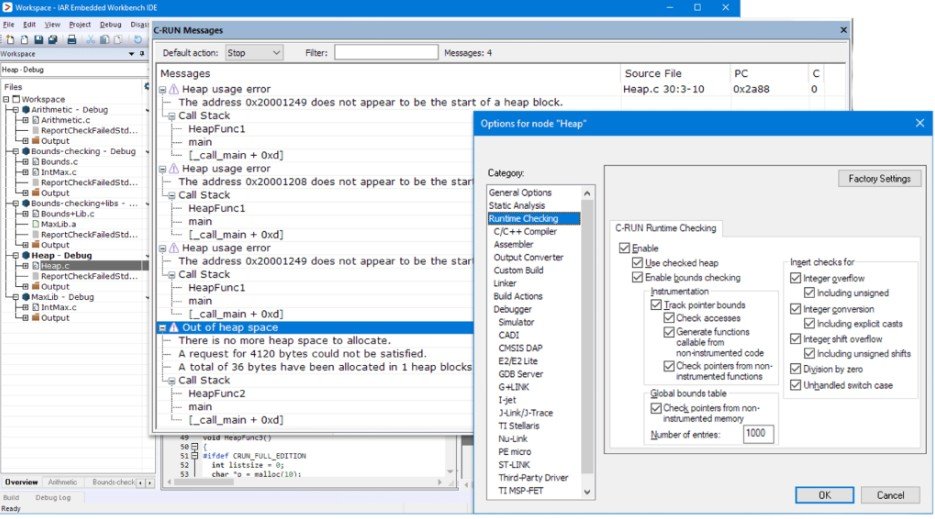
C-RUN runtime analysis showing heap errors and bounds violations
Another topic will be the integration of these checks into continuous integration and continuous delivery workflows. IAR argues that as AI tools increase the amount of code developers can produce, manually triggering verification steps becomes increasingly difficult to scale.
IAR Build Tools provides command-line versions of the compiler, linker, and related development tools for use in automated build environments. The company notes that these tools can be incorporated into systems such as Jenkins, GitHub Actions, and Azure DevOps, allowing builds and analysis checks to run automatically as part of the development pipeline.
C-STAT can also operate in headless environments, allowing coding-rule violations and other analysis results to appear in automated build output. According to IAR, this approach can help verification evidence accumulate throughout a project instead of being assembled primarily near a certification or release milestone.

IAR logo
The broader issue addressed by the webinar is that increasing code-generation speed does not necessarily reduce the verification effort required for regulated embedded software. IAR notes that review, testing, coverage measurement, traceability, and certification activities remain necessary regardless of whether code is written manually or generated with AI assistance.
The session will therefore focus less on AI code generation itself and more on the development process surrounding generated code, including where automated analysis can be applied and where engineering judgment is still required.
Topics listed for the webinar include static analysis for identifying MISRA C, CERT C, and CWE violations, dynamic analysis for detecting runtime defects, and the use of CI/CD automation to generate verification evidence for development processes associated with ISO 26262, IEC 62304, and IEC 61508.
Further Information

Please comment here...