


GPD BOX mini PC features Intel Panther Lake and Arc B390 graphics
Jun 14, 2026 — by Giorgio Mendoza 796 views
GPD has launched an Indiegogo campaign for the GPD BOX, a compact mini PC based on Intel’s upcoming Core Ultra Series 3 “Panther Lake” processors. The system is available with either a Core Ultra X7 358H or Core Ultra 7 356H processor, up to 64GB of LPDDR5x-8533 memory, dual M.2 storage, dual 2.5GbE, USB4 v2.0, and a built-in 160W GaN power supply.
The two processor options differ mainly in graphics and expansion. The Core Ultra X7 358H version includes Intel Arc B390 graphics with 1536 shader units and is listed with up to 180 TOPS of total INT8 AI performance. The Core Ultra 7 356H version uses a smaller integrated GPU with 512 shader units and is listed with up to 100 TOPS, but it adds an MCIO 8i port for PCIe 5.0 x8 expansion.
— ADVERTISEMENT —
According to GPD’s comparison table, both processors have 16 CPU cores and are built on Intel’s 18A process. The 358H model reaches up to 4.8GHz and is positioned as the stronger standalone option, while the 356H model reaches up to 4.7GHz and is aimed at users who want direct PCIe expansion for external GPUs or other high-bandwidth devices.
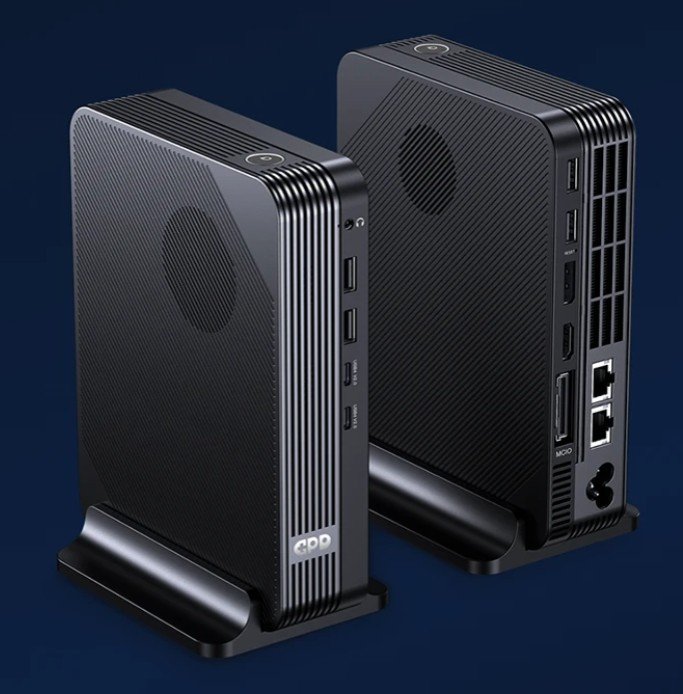
GPD BOX
The MCIO 8i port is available only on the Core Ultra 7 356H model. GPD describes it as a PCIe 5.0 x8 interface with up to 512Gbps bidirectional bandwidth. The company shows examples including external GPU docks, enterprise NVMe storage, multi-bay storage enclosures, video capture cards, and other PCIe-based expansion hardware.
The Core Ultra X7 358H version does not include MCIO 8i, but it can still connect to external GPU docks through USB4 v2.0.
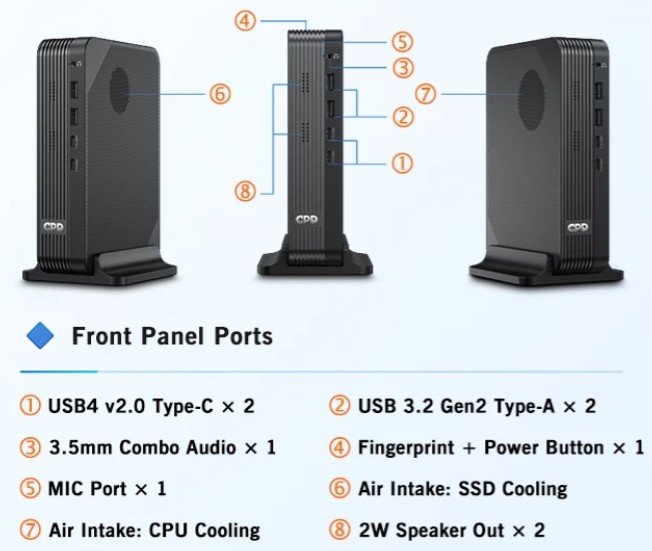
GPD BOX front peripherals
For external connectivity, the GPD BOX includes two USB4 v2.0 Type-C ports rated at 80Gbps, four USB 3.2 Gen2 Type-A ports, DisplayPort 2.1 UHBR20, HDMI 2.1 FRL, two 2.5GbE RJ45 ports, WiFi 6E, Bluetooth 5.3, a 3.5 mm combo audio jack, a microphone port, and two 2W speaker outputs.
GPD says the system can drive up to four displays using a combination of DisplayPort, HDMI, and USB4.
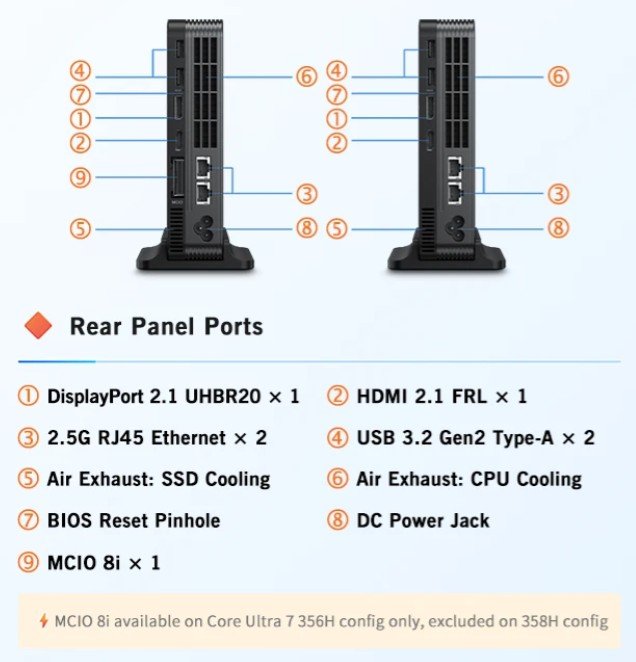
GPD BOX rear peripherals
Storage is handled by two M.2 slots. The primary slot supports PCIe Gen5 x4 NVMe SSDs, while the secondary slot supports PCIe Gen4 x2 NVMe storage.
GPD advertises sequential speeds of up to 15,000MB/s read and 14,000MB/s write with suitable PCIe Gen5 drives, although actual performance will depend on the SSD and cooling conditions.
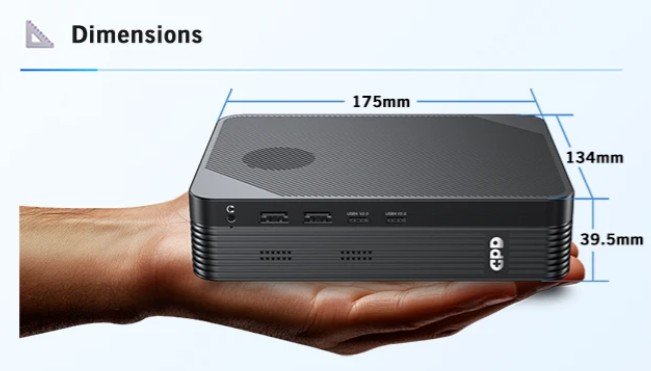
GPD BOX front dimensions
Security features include a discrete dTPM 2.0 chip and a fingerprint reader built into the power button. GPD also lists support for Windows Hello and BitLocker-related use cases.
The enclosure measures 175 × 134 × 39.5 mm and weighs about 940 grams. Cooling is provided by a dual-fan layout with separate airflow paths for the CPU and SSD. The system has an adjustable 15W to 80W TDP range in BIOS, while the integrated 160W GaN power supply removes the need for an external power brick.
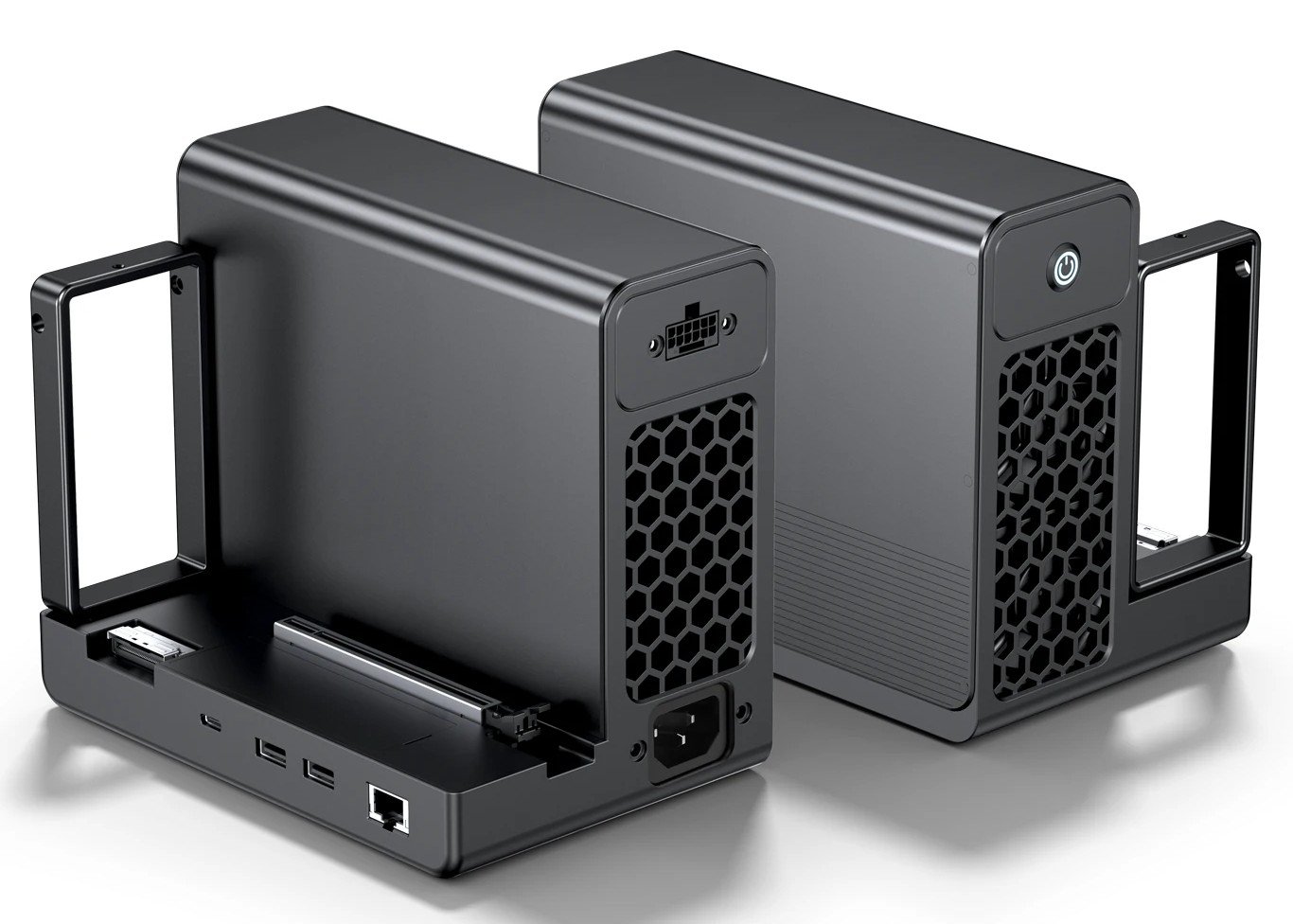
GPD G2 eGPU dock
GPD is also offering the GPD G2 eGPU dock alongside the mini PC. The dock includes an 800W Gold-rated server-grade power supply and is intended to pair with the MCIO-equipped Core Ultra 7 356H model.
The company says the dock supports full-size PCIe graphics cards and claims only around a 2% performance loss with an RTX 4090, but this figure should be treated as a company-provided benchmark until independent testing is available.
Further Information
Current Indiegogo pledge options list the GPD BOX 356H with 32GB of soldered memory and 1TB of storage at HK$11,377 (~US$1,452). The 358H version with the same memory and storage configuration is listed at HK$12,020 (~US$1,534).
Bundle options with the GPD G2 dock start at HK$14,394 (~US$1,837) for the 356H model and HK$15,036 (~US$1,919) for the 358H model. Estimated delivery is listed for August 2026.

Please comment here...