


Geniatech Enables Local LLM Inference with RK1828 and Hailo-10 M.2 AI Accelerators
Oct 13, 2026 — by Giorgio Mendoza 2,153 views Geniatech has listed two M.2 AI accelerator cards targeting local inference workloads on embedded systems and edge devices. The AIM-M-R28 uses Rockchip’s RK1828 processor with 20 TOPS of computing performance, while the AIM-M-H10 is based on Hailo’s Hailo-10 architecture, delivering up to 40 TOPS for generative AI and computer vision applications.
Both cards use the M.2 2280 form factor and connect to compatible host systems through PCIe, providing dedicated processing and memory resources for AI inference without relying entirely on the host CPU.
— ADVERTISEMENT —
The AIM-M-R28 integrates Rockchip’s RK1828 AI coprocessor, featuring a 20 TOPS INT8 NPU and 5GB of 3D-stacked in-package DRAM. Its memory architecture places DRAM alongside the processing hardware, reducing reliance on external memory bandwidth for inference workloads.

RK1820/RK1828 block diagram
The accelerator uses an M.2 2280 M-Key interface with PCIe 2.1 x1 connectivity. Supported host processors include the Rockchip RK3568, RK3576, and RK3588, while Linux and Android are listed as compatible operating systems. Geniatech specifies a 20W TDP and an operating temperature range of -25°C to 85°C.
Supported workloads include computer vision, audio processing, time-series prediction, and local inference with 3B to 7B parameter language models. Geniatech claims generation speeds exceeding 100 tokens per second, although specific benchmark configurations are not provided.
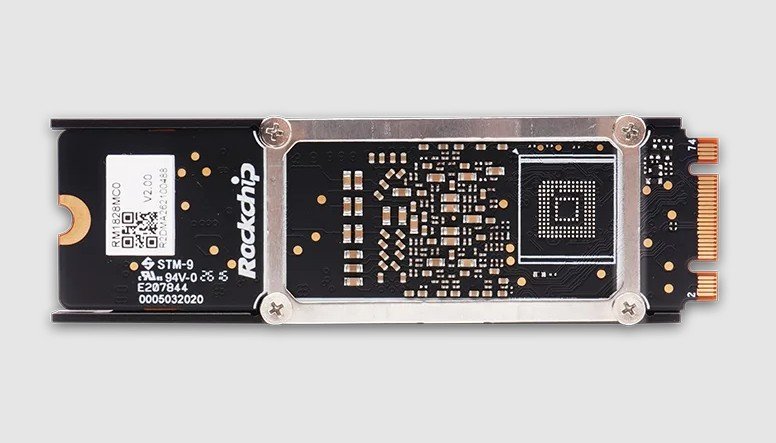
AIM-M-R28 top view
The RK1828 was also featured in a previously covered Forlinx M.2 accelerator, which demonstrated multi-card PCIe configurations for running larger language models. Geniatech’s implementation similarly uses Rockchip’s RKNN software ecosystem, with support for models developed using frameworks such as TensorFlow, PyTorch, and ONNX.
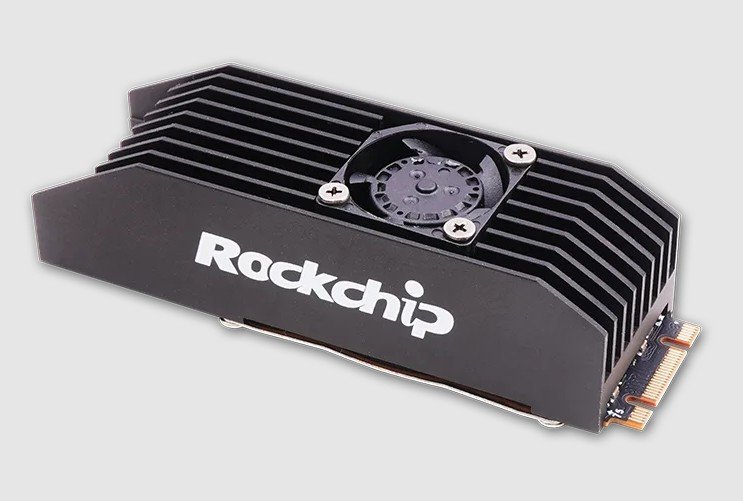
AIM-M-R28 with active cooling
The second accelerator, AIM-M-H10, uses the Hailo-10 processor and provides up to 40 TOPS of AI computing performance. It includes up to 16GB of LPDDR4/4X memory for executing generative AI models locally, including LLMs, VLMs, and diffusion models.

AIM-M-H10 bottom view
The 22 × 80 mm card uses an M.2 M-Key interface with PCIe connectivity and is designed for integration with embedded computing platforms based on NXP, NVIDIA, Qualcomm, and AMD Xilinx processors. Geniatech lists typical power consumption of 12W, an operating temperature range of 0°C to 70°C, and compatibility with Linux and Windows.
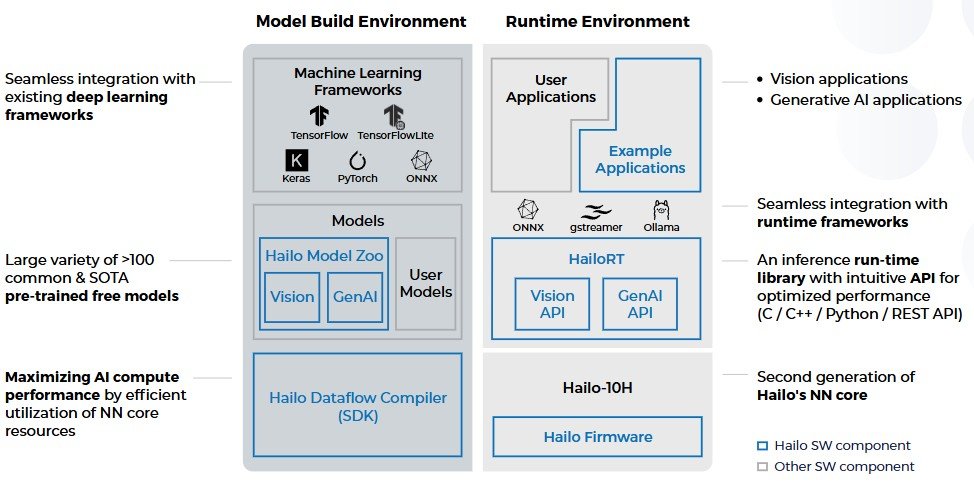
Hailo-10H AI software stack
The Hailo-10 architecture supports convolutional neural networks, Transformers, and Vision Transformers. Its software ecosystem includes the Hailo Dataflow Compiler and Model Zoo, with support for model development using TensorFlow, PyTorch, ONNX, and other frameworks.

AIM-M-H10 top view
The Hailo-10H processor was previously featured in the ASUS UGen300 USB AI Accelerator, which integrates 8GB of LPDDR4 memory and uses USB-C connectivity. Geniatech’s AIM-M-H10 instead targets internal M.2 expansion, with a larger maximum memory configuration and a PCIe host interface.
Further Information
Additional information is available on Geniatech’s AIM-M-R28 and AIM-M-H10 product pages. Both accelerators are listed for sales inquiries, although public pricing and availability details have not been disclosed.

Please comment here...