


Forlinx OK153-S SBC Combines Cortex-A7 and RISC-V Cores for Real-Time I/O Interfaces
Oct 14, 2025 — by Giorgio Mendoza 927 views
The OK153-S SBC from Forlinx Embedded is a compact industrial platform based on the Allwinner T153 processor. It supports Linux 5.10 and offers up to 1 GB of DDR3 RAM and 8 GB of eMMC storage. Key interfaces include triple Gigabit Ethernet, dual CAN-FD, and a Local Bus for PSRAM or FPGA expansion.
The Allwinner T153 integrates a quad-core Arm Cortex-A7 running at 1.6 GHz and a XuanTie E907 RISC-V core at 600 MHz. Additional features include secure boot, a hardware encryption engine, and multimedia output via RGB, LVDS, and MIPI DSI interfaces.
— ADVERTISEMENT —
Measuring 44 × 35 mm, the FET153-S SoM connects through a 185-pin edge using an LGA interface. It includes 256 MB to 1 GB of DDR3 RAM, along with 256 MB or 512 MB of NAND Flash and up to 8 GB of eMMC storage.
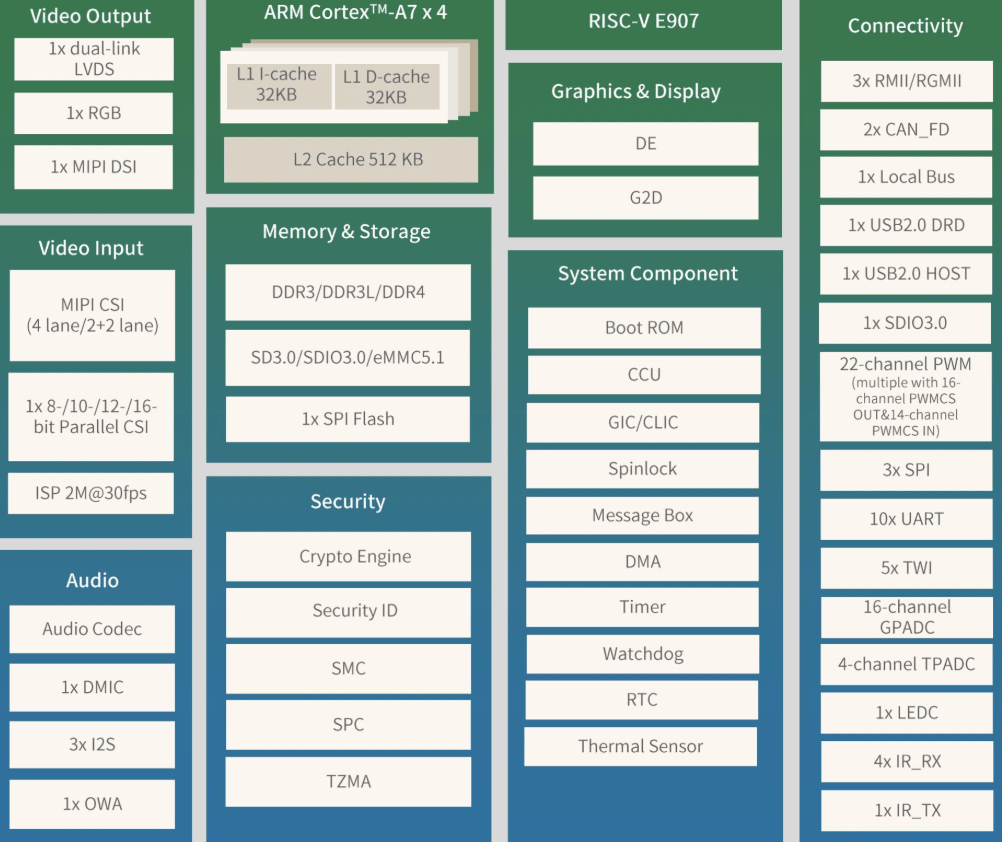
T153 Block Diagram
Hardware interfaces include three Gigabit Ethernet ports, two CAN-FD channels, and a Local Bus supporting 8-, 16-, or 32-bit operation up to 100 MHz. Additional I/O includes 10 UARTs, 5 I²C-compatible TWI buses, 4 SPI ports, and 24 analog input channels.
USB 2.0 host and OTG modes are supported, along with 3 I²S interfaces and camera inputs via parallel CSI or MIPI CSI, backed by an integrated ISP.

FET153-S Dimensions
The accompanying OK153-S carrier board provides standard connectors for evaluation and development. These include RJ-45 Ethernet, USB Type-C, three USB 2.0 host ports, dual RS-485 interfaces, and CAN-FD with protection circuitry.
Additional connectivity features include onboard Wi-Fi and Bluetooth via a 6221A-SRC module, a Mini PCIe slot for 4G modules, and support for RGB, LVDS, and MIPI DSI displays. The board also includes audio outputs, GPIO test points, RTC backup, and infrared I/O.
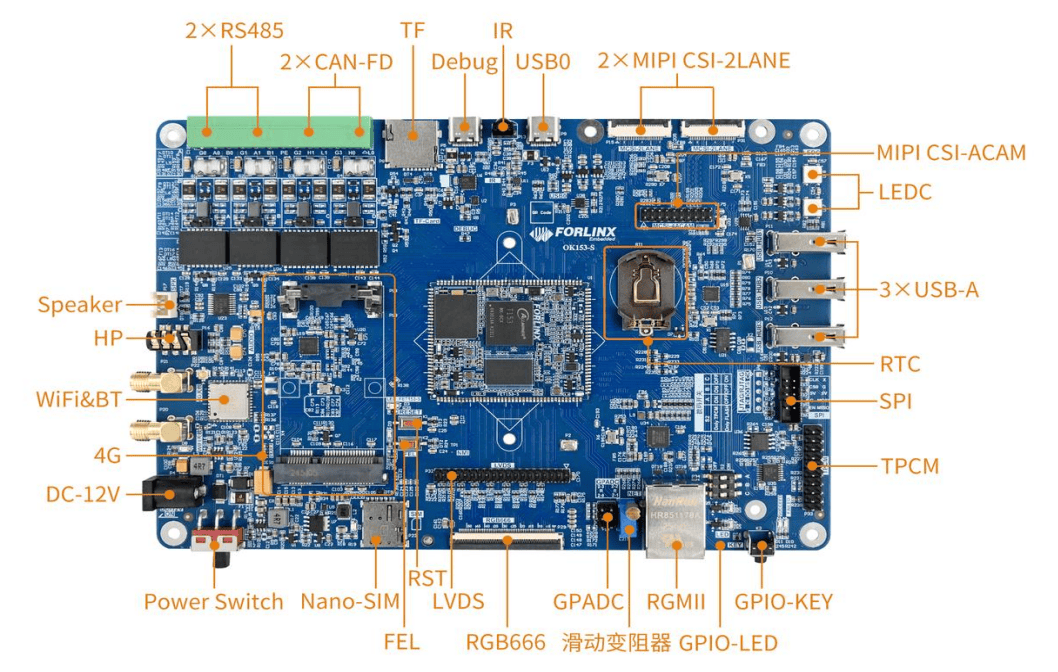
OK153-S Top View
Forlinx states that they will provide support based on Linux kernel 5.10, along with documentation and development resources such as schematics, hardware manuals, and related materials.
Specifications listed for the OK153-S Carrier Board & FET153-S SoM include:
- Memory/Storage:
- 256 MB / 512 MB / 1 GB DDR3 RAM
- 256 MB / 512 MB NAND Flash
- Up to 8 GB eMMC
- SDIO for SD card interface
- Display:
- 1× RGB LCD (up to 1920×1080 @ 60 Hz)
- 1× MIPI DSI (4-lane, up to 1920×1200 @ 60 Hz)
- 1× LVDS (dual-link up to 1920×1080 @ 60 Hz; single-link up to 1366×768)
- Camera:
- 2x MIPI CSI (2-lane each)
- Parallel CSI (up to 4-ch 720P@30fps or 2-ch 1080P@30fps)
- Connectivity:
- 1× Gigabit Ethernet (RJ-45)
- 2× CAN-FD interfaces
- 2× RS-485 with auto TX/RX control
- Wi-Fi + Bluetooth 5.0 (via 6221A-SRC module, 2.4G/5G dual-band)
- Mini PCIe slot for 4G modules (e.g. Quectel EC20)
- I/O Interfaces:
- 10× UART, 5× TWI (I²C compatible)
- 4× SPI (one multiplexed with JTAG/RJTAG), 3× I²S (up to 384 kHz)
- 1× DMIC (up to 48 kHz), 24× GPADC (12-bit, up to 1 MHz)
- 1× TPADC (4-wire resistive touch)
- 30× PWM/PWMCS (PWM: up to 100 MHz, PWMCS: up to 4 MHz)
- 140× GPIOs
- Audio:
- 1× 3.5 mm 4-segment headphone jack (HP + MIC)
- 1× Mono speaker output
- 1× LINEOUT (differential)
- 1× OWAIN/OUT (single-wire audio)
- Audio via I²S and onboard codec
- USB:
- 1× USB 2.0 Type-C (OTG)
- 3× USB 2.0 Host ports (via hub)
- USB2.0 DRD & Host ports supported by SoM
- Infrared:
- 1× IR TX
- 4× IR RX (64×8-bit buffer, 1 MHz sample rate)
- Other Features:
- LEDC for smart LED control (800 kbit/s max)
- 3× onboard buttons (Reset, Programming, GPIO)
- RTC battery (CR2032)
- SPI multiplexed with JTAG and RJTAG (2.54mm pin header)
- TYPE-C Debug port (CPUX & RISC-V serial export)
- Power:
- 5V DC input
- Mechanical:
- 44× 35 mm (SoM)
- 185-pin Edge + LGA (0.4 mm / 0.47 mm pitch)
Further Information
Product pages for the OK153-S SBC and the FET153-S SoM are available on the Forlinx website. Pricing information has not been disclosed.

Please comment here...