


Forlinx Embedded introduces FET1126Bx-S industrial SoM for edge AI and vision
Jan 4, 2026 — by Giorgio Mendoza 239 views Forlinx’s FET1126Bx-S is described as a compact industrial system-on-module designed for low-power edge AI and embedded vision applications. The 40 mm × 40 mm module targets systems such as intelligent video analysis, smart infrastructure, and industrial monitoring, where local inference and long-term availability are required.
The FET1126Bx-S is based on the Rockchip RV1126 B or RV1126BJ processor, integrating four Arm Cortex-A53 CPU cores. Datasheet information indicates that commercial variants operate at up to 1.6 GHz, while industrial-grade versions are clocked at up to 1.3 GHz. An on-chip NPU provides up to 3 TOPS of INT8 performance, enabling AI inference workloads to run locally without reliance on cloud connectivity.
— ADVERTISEMENT —
Memory configurations include 1 GB, 2 GB, or 4 GB of LPDDR4. Storage is provided via on-module eMMC, with commercial versions paired with 64 GB eMMC, while industrial variants are available with 8 GB, 16 GB, or 32 GB options depending on configuration.
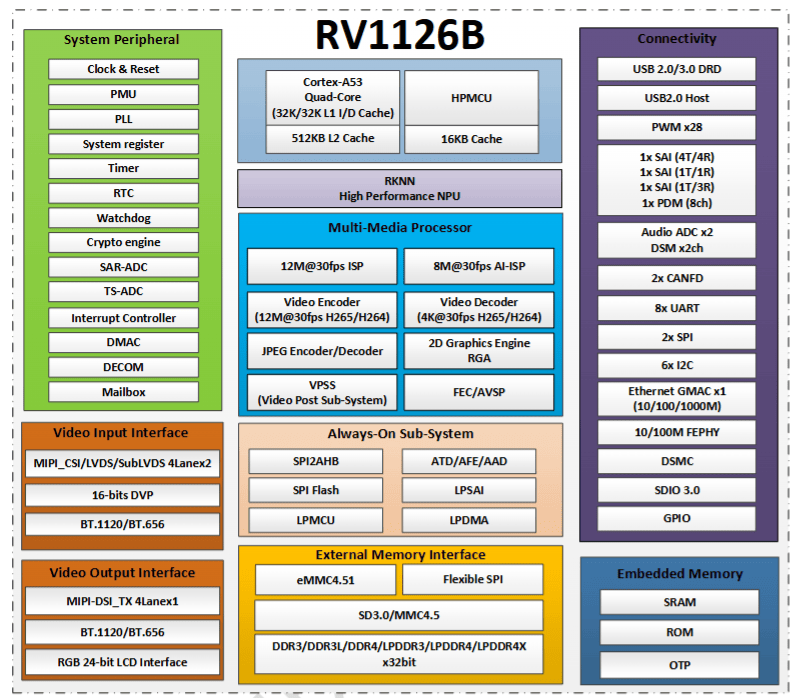
RV1126B Block Diagram
According to Forlinx, the module is designed primarily for vision-centric workloads. It supports hardware decoding of H.264 and H.265 video streams up to 4K resolution, along with hardware encoding for H.264, H.265, and JPEG. The integrated ISP and AI-ISP provide support for features such as HDR, noise reduction, fisheye correction, and image enhancement.
Camera connectivity includes support for up to two MIPI-CSI interfaces using MIPI D-PHY v1.2, as well as a parallel DVP interface compatible with BT.601, BT.656, and BT.1120 standards.
Display output is limited to a single channel and can be routed through MIPI-DSI, BT.656/BT.1120, or a 24-bit RGB interface, with a maximum supported resolution of 1920 × 1080 at 60 fps.
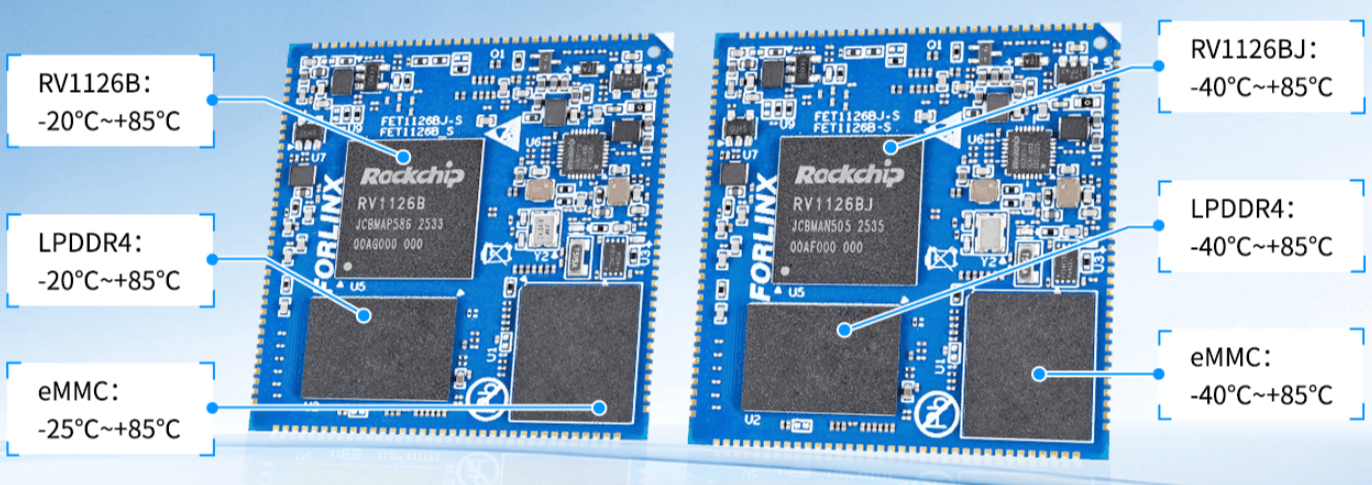
FET1126Bx-S Features
Despite its small footprint, the FET1126Bx-S exposes all functional processor pins through a combination of stamp-hole and LGA connections, totaling 237 pins.
Available interfaces include Gigabit Ethernet via RGMII, an integrated 100 Mbps Ethernet PHY option, USB 2.0 and USB 3.0 dual-role support, multiple UARTs, CAN, SPI, I²C, PWM, ADC channels, audio interfaces, and general-purpose GPIOs..
SL1680 OPTIMA Eval Kit Block Diagram
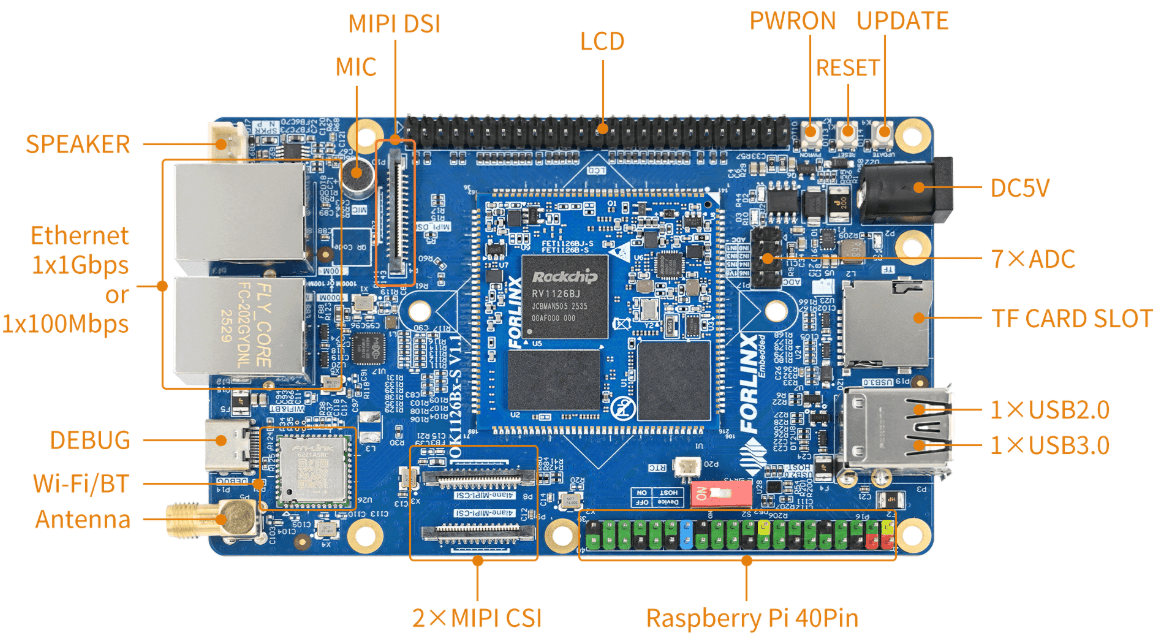
For development and evaluation, Forlinx provides the OK1126Bx-S carrier board. The board exposes interfaces such as Ethernet, USB, dual MIPI-CSI connectors, display outputs, audio, and a Raspberry Pi–compatible 40-pin header, allowing developers to evaluate AI and vision workloads without designing custom hardware at an early stage.
On the software side, the FET1126Bx-S supports Linux 6.1, with flashing via USB OTG or MicroSD card. Forlinx notes that its software package includes kernel source code, drivers, development tools, sample applications, and AI algorithm examples. The platform also supports Rockchip’s RKNN toolchain for deploying models from frameworks such as TensorFlow and PyTorch.
Specifications listed for the FET1126Bx-S include:
- Memory
- Up to 4GB LPDDR4
- Storage
- 8GB / 16GB / 32GB / 64GB eMMC (configuration dependent)
- Camera:
- Up to 2× MIPI-CSI (4-lane, up to 2.5Gbps per lane)
- DVP parallel camera input (BT.601 / BT.656 / BT.1120, up to 150 MHz)
- Display:
- Single display output
- MIPI-DSI (4-lane, 1.5Gbps per lane)
- 24-bit RGB
- BT.656 / BT.1120
- Up to 1920×1080 @ 60fps
- Connectivity:
- Gigabit Ethernet (via RGMII)
- Integrated 100Mbps Ethernet PHY
- SDIO 3.0
- I/O Interfaces:
- Up to 8× UART
- Up to 2× SPI (master/slave)
- Up to 5× I²C (7-bit / 10-bit addressing)
- Up to 27× PWM
- Up to 24× ADC (13-bit, 2 MSPS)
- CAN 2.0 A/B (up to 2 channels)
Audio interfaces (SAI, audio ADC)
- USB:
- 1× USB 2.0 Host
- 1× USB 2.0 / USB 3.0 DRD
- Power:
- 5 V DC input
- Low-power design optimized for edge AI workloads
- Operating Temperature:
- −20 °C to +85 °C (Commercial grade)
- −40 °C to +85 °C (Industrial grade)
- Mechanical:
- 40.0 × 40.0 mm SoM
- Stamp-hole + LGA connection (237 pins total)
Further Information
The product page does not list pricing information for the FET1126Bx-S series, though it indicates that engineering samples are available, with multiple commercial and industrial configurations planned for production.
Interested customers can request samples or obtain availability details directly through Forlinx’s website.

Please comment here...