


Forgix hybrid board pairs Raspberry Pi RP2354 MCU with Efinix Trion FPGA
Jun 28, 2026 — by Giorgio Mendoza 2,407 views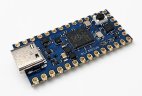
Adiuvo Engineering’s new ultra-compact, dual-chip Forgix development board pairs the Raspberry Pi RP2354 microcontroller with an Efinix Trion T8 FPGA in a breadboard-friendly Teensy form factor. Designed for developers exploring hardware-software co-design, the board combines dual-core Arm Cortex-M33 processing with 7,384 logic elements of programmable fabric.
The Forgix board utilizes a split architecture divided between software execution and custom digital hardware. It features the Raspberry Pi RP2354 MCU, which includes dual Arm Cortex-M33 cores (with optional RISC-V support) and 520 KB of internal SRAM, supplemented on-board by an external QSPI PSRAM chip.
— ADVERTISEMENT —
Sitting directly alongside the MCU is the Efinix Trion T8F49 FPGA, which offers 7,384 logic elements driven by an external ECS-2520MV oscillator, providing an accessible platform for high-speed signal processing, custom digital peripherals, or RTL hardware acceleration.

RP2350 block diagram
Physically, the Forgix mimics a standard, breadboard-friendly Teensy layout. It breaks out standard microcontroller interfaces including SPI, I2C, UART, ADC, and USB 1.1 lines to the header pins, alongside dedicated FPGA I/O rails operating at 3.3V.
The board includes a single USB Type-C interface for both power and programming, a user-configurable push button, an addressable RGB LED for status debugging, and a Tag-Connect TC2030 SWD footprint for hardware-level debugging of the MCU.
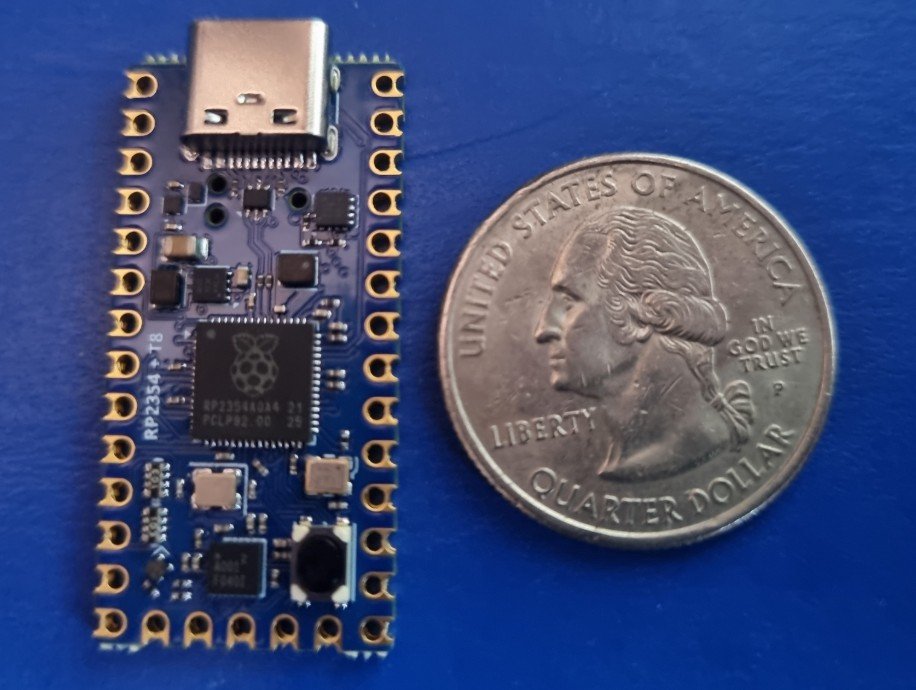
Forgix board
On the software side, Adiuvo has published an open-source binary framing protocol and utility called the “Forge FPGA Loader” on Bitbucket. Because the FPGA is driven in passive SPI mode (using Mode 3), the host PC runs a Python/Tkinter GUI or CLI that streams Efinity-generated .hex or .bin bitstreams over USB CDC serial directly through the RP2354 to the FPGA.
This stream-through method allows the system to completely bypass the MCU’s RAM boundaries, enabling full FPGA fabric configuration without needing to store the complete bitstream image in microcontroller memory first.
Further Information
The Forgix board is available now for $50.00, and full documentation alongside the open-source bootloader firmware can be found on the Adiuvo Engineering Bitbucket repository.

Please comment here...