


ESP32 Bus Pirate Update Adds RF Tools, USB Host Mode, Signal Analysis, and Cellular Plans
Feb 19, 2026 — by Giorgio Mendoza 9,689 views The ESP32 Bus Pirate project, originally introduced as a modern ESP32-S3 adaptation of the classic Bus Pirate debugging tool, has received a substantial update expanding its protocol support, signal analysis capabilities, and RF experimentation features.
The original Bus Pirate is an open-source hardware tool widely used for communicating with and debugging embedded systems over interfaces such as I²C, SPI, UART, and 1-Wire. The ESP32 Bus Pirate reimplements that concept in firmware form, allowing low-cost ESP32-S3 development boards to function as multi-protocol debugging and experimentation platforms.
— ADVERTISEMENT —

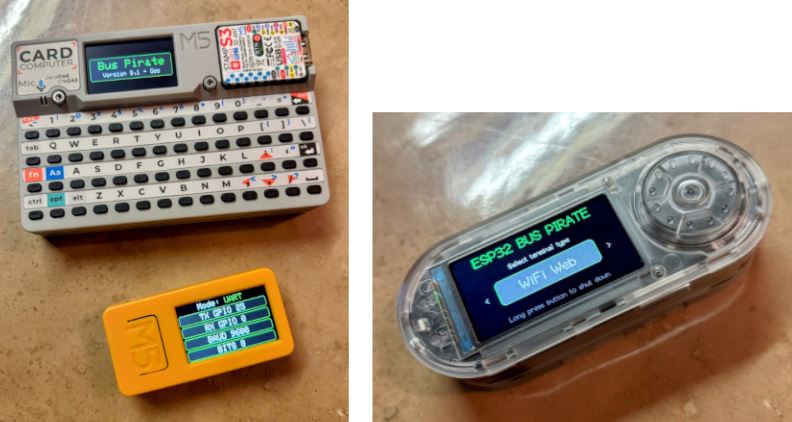
ESP32-Bus-Pirate Supported Devices
Since the previous release, the firmware has gained several structural and usability improvements. A profile system now allows users to save and reload complete pin configurations, making it easier to switch between hardware setups.
The command-line interface has been enhanced with autocorrection and TAB-based autocompletion, and the project has migrated to the latest ESP32 Arduino core. Flash storage allocated to the internal file system has also been expanded to approximately 4.5MB, up from around 1.5MB in earlier versions.
ESP32-Bus-Pirate Demo
A new Wizard feature acts as a pin activity analyzer, inspecting signal behavior and identifying patterns such as data bursts, PWM signals, or electrical noise. A pin scan utility can detect transitions across groups of pins, and new analog analysis tools allow observation of non-digital signals.
UART functionality has expanded significantly, adding automatic UART line detection across multiple pins, autobaud detection through RX timing analysis, and a UART emulator capable of mimicking devices such as GPS modules or bootloaders. A trigger system can automatically respond when defined patterns are detected.
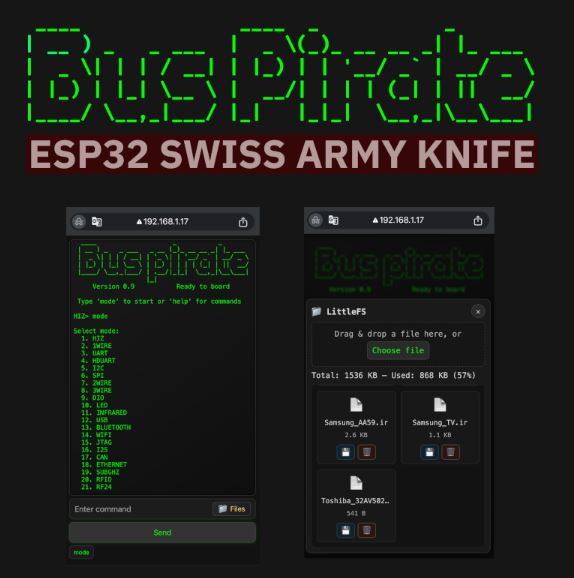
ESP32-Bus-Pirate Interfaces
Hardware compatibility has expanded to include the ESP32S3-DevKit N16R8 and the M5Stack StickS3. Previously supported devices such as the M5 Cardputer series, M5 AtomS3, LILYGO T-Embed, and Seeed Studio XIAO ESP32-S3 remain supported.
As before, any ESP32-S3 board with at least 8MB of flash memory can run the firmware, though pin mappings may require adjustment depending on the hardware.
Further Information
According to the developer, Geo-tp, upcoming additions include FM features and cellular 2G/3G/4G integration, both nearing completion, as well as ESP32-C5 5GHz Wi-Fi support and a custom board adapter designed to extend voltage and bus handling capabilities.

Can someone explain to a novice what this function does and what probloit solves?