


ESP32 Bit Pirate update adds WiFi Hotspot mode, Pirate Assistant, and Web Flasher
Jun 19, 2026 — by Giorgio Mendoza 20,664 views The ESP32 Bus Pirate project has been renamed ESP32 Bit Pirate as part of its continued development as an ESP32-S3-based multi-protocol firmware platform. The open-source project, developed by Geo-tp, turns supported ESP32-S3 boards into debugging and experimentation tools for wired protocols, radio interfaces, scripting, and browser-based interaction.
The project remains inspired by the original Bus Pirate, but it now extends further into web-based workflows and adapter-style use cases. ESP32 Bit Pirate can be used through a USB serial terminal, a Wi-Fi Web CLI, or standalone mode on supported devices such as the M5Stack Cardputer. A new WiFi Hotspot mode allows users to connect directly to the device and access the Web CLI without requiring an existing wireless network.
— ADVERTISEMENT —
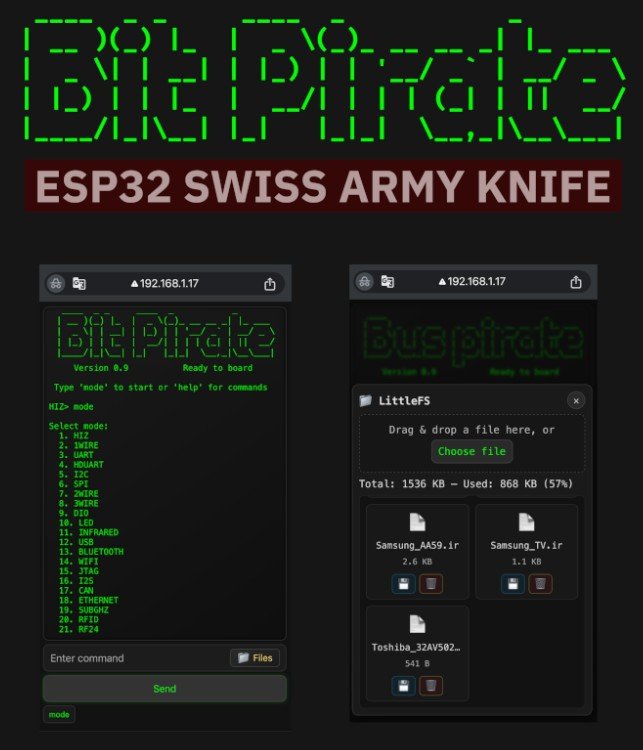
ESP32-Bit Pirate Demo
Another new addition is Pirate Assistant, an assistant integrated into the WebUI. According to the project description, this feature is intended to help users interact with the firmware by converting natural-language requests into firmware commands. The project also includes browser-based Web Serial tools, allowing access to the serial CLI from a compatible web browser without installing a separate terminal application.
Several USB adapter modes have also been added or expanded. The firmware now includes USB-UART, Flashrom, AVRDUDE, SUMP logic analyzer, OpenOCD, IR Toy/LIRC, and Sub-GHz CC1101 adapter modes. These additions allow supported ESP32-S3 boards to serve as general-purpose adapters for serial communication, programming, logic analysis, infrared tools, debugging, and Sub-GHz radio experimentation.

ESP32-Bit-Pirate Supported Devices
Protocol coverage remains broad. The README lists modes for I2C, SPI, UART, half-duplex UART, 1-Wire, 2-Wire, 3-Wire, digital I/O, infrared, USB, Bluetooth, Wi-Fi, Ethernet, JTAG, I2S, CAN, Sub-GHz, RFID, RF24, FM, and CELL. The firmware also includes sniffers for protocols such as I2C, UART, SPI, 1-Wire, 2-Wire, CAN, Wi-Fi, Bluetooth, and Sub-GHz.
Recent protocol-level improvements include better UART sniffing, autobaud detection, and signal analysis. Sub-GHz capture and replay have also been reworked for improved reliability, while I2C support has gained register tracing and safer register operations. The firmware continues to include tools for EEPROM and flash access, register manipulation, GPIO control, PWM, servo output, LED control, and scripting using Bus Pirate-style bytecode instructions or Python.
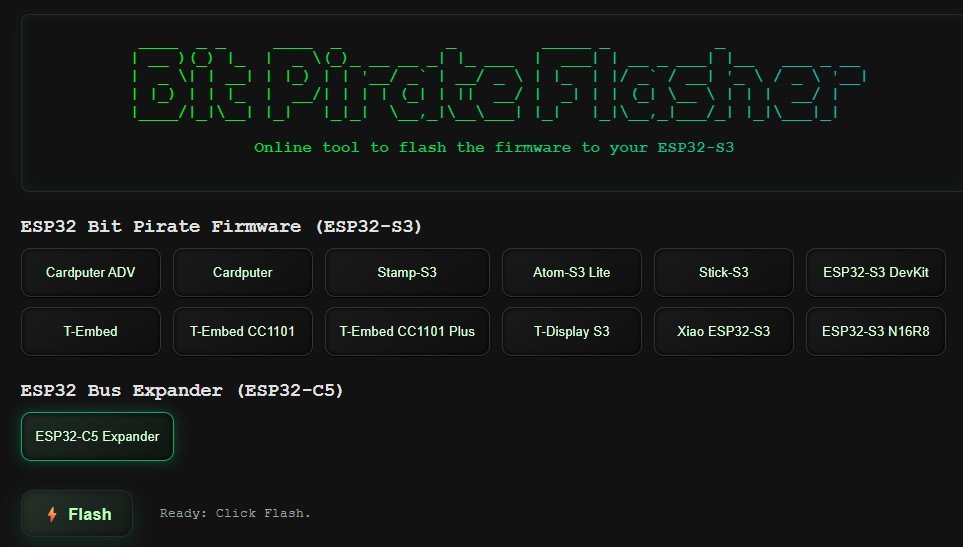
ESP32-Bit-Pirate WebFlasher
The project currently supports a range of ESP32-S3 devices, including the ESP32-S3 Dev Kit, LILYGO T-Display S3, LILYGO T-Embed, LILYGO T-Embed CC1101 and CC1101 Plus, M5 AtomS3 Lite, M5 Cardputer, M5 Cardputer ADV, M5 StampS3, M5 Stick S3, and Seeed Studio Xiao ESP32-S3. The Web Flasher also lists firmware targets for the ESP32-S3 N16R8 and ESP32 Bus Expander based on the ESP32-C5.
According to the project documentation, other ESP32-S3-based boards can also be supported if they include at least 8MB of flash memory. The firmware can be installed through the ESP32 Bit Pirate Web Flasher, with board-specific boot-mode instructions provided for supported hardware.
ESP32-Bit-Pirate Wiki
The updated Wiki now includes individual sections for each operating mode, along with guides for terminal selection, quick start, serial connection, Web Serial tools, instruction syntax, Python scripting, the LittleFS file system, Pirate Assistant, USB adapters, and device pinouts. Visual assets are also available for use in documentation, videos, and articles.
Further Information
The ESP32 Bit Pirate project is available through its GitHub repository, Web Flasher, Wiki, and related documentation.

Please comment here...