


ESP32 Bit Pirate 1.8 Adds Experimental SDR and Browser-Based Firmware Analysis
Oct 15, 2026 — by Giorgio Mendoza 308 views ESP32 Bit Pirate has reached version 1.8, adding experimental software-defined radio (SDR) functionality using the ESP32-S3’s internal Wi-Fi radio. The update also introduces browser-based firmware extraction tools, improved protocol debugging, expanded board compatibility, and updated Zigbee capabilities for ESP32-C5 and ESP32-C6 devices.
Previously covered on LinuxGizmos, ESP32 Bit Pirate 1.7 added LoRa support, Meshtastic analysis, and browser-based BPIO2 control. Version 1.8 extends the platform’s radio analysis capabilities by allowing the ESP32-S3 to capture raw I/Q samples directly from its integrated 2.4GHz Wi-Fi radio.
— ADVERTISEMENT —
The experimental SDR adapter accesses undocumented low-level radio functions, bypassing the standard Wi-Fi and Bluetooth protocol stacks. Captured samples are streamed over USB CDC to a browser-based interface that provides spectrum visualization, waterfall displays, and signal analysis without requiring an external SDR receiver.
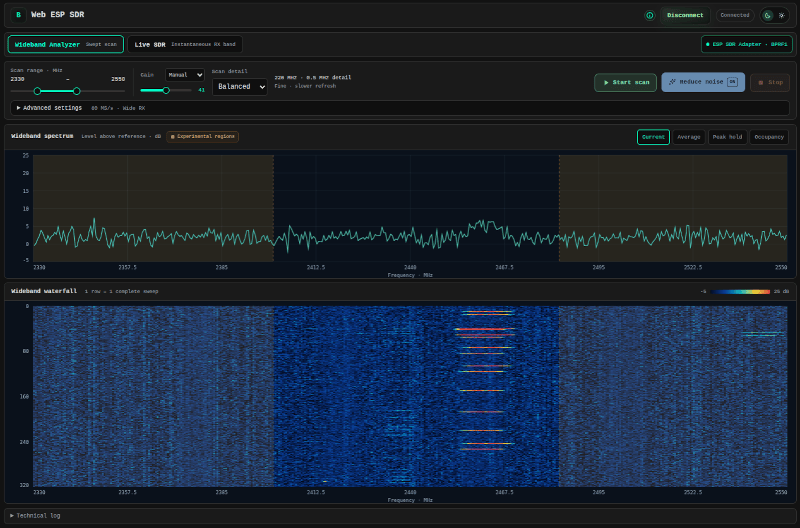
ESP32 Bit Pirate Web SDR Wideband Analyzer
The Web ESP SDR tool includes two complementary operating views. The Wideband Analyzer scans a selected frequency range to identify signal activity, while Live SDR allows users to examine signals around a specific center frequency in greater detail. The interface also provides adjustable scanning parameters, peak detection, and spectrum and waterfall visualization.
The implementation shares a similar underlying approach with the ESPARGOS ESP-SDR project, which also accesses raw I/Q samples from the ESP32’s internal Wi-Fi radio. However, the developer clarified that Bit Pirate uses an independent implementation, with its Wideband Analyzer providing broader frequency exploration alongside the narrowband analysis available in Live SDR.
The radio operates most reliably within the standard 2.4GHz ISM band, with a practical operating range of approximately 2.2–2.8GHz. Although low-level tuning is possible between 100MHz and 6GHz, operation outside the radio’s intended frequency range remains experimental and is not considered reliable. The implementation is intended for signal exploration rather than replacing dedicated SDR hardware.
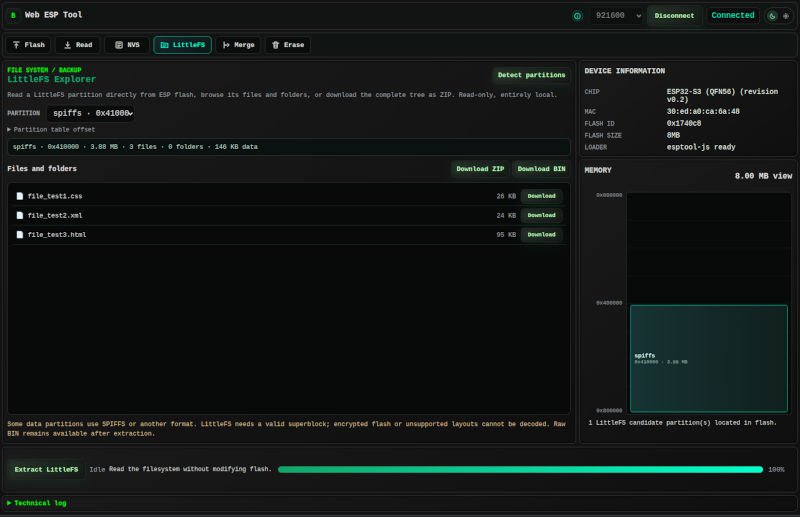
ESP32 Bit Pirate Web ESP Tool
Another addition is the expanded Web ESP Tool, which now supports extracting NVS partitions and LittleFS filesystems from ESP32 devices. Users can connect supported hardware through their browser to inspect stored configuration data, examine NVS keys and values, and browse files recovered from LittleFS partitions.
Version 1.8 also updates the I2C sniffer to use the ESP32-S3’s RMT peripheral for improved signal capture and optional address filtering. A new passive frequency measurement command reports SCL clock frequency, period, and HIGH/LOW timing. SPI flash support has been expanded with a larger device database and configurable WP/HOLD pins, while JTAG/SWD scanning and OpenOCD adapter timing have received improvements.
The companion ESP32 Bus Expander has also reached version 0.3, introducing a reworked Zigbee mode for ESP32-C5 and ESP32-C6 devices. The updated firmware supports IEEE 802.15.4 network scanning, device discovery, traffic monitoring, and experimentation with Zigbee coordinator functionality. Both variants can be programmed through the project’s Web Flasher.

v1.8 new supported devices
Hardware compatibility has expanded to include ESP32-S3 SuperMini boards with 4MB flash, the Unexpected Maker ProS3, and the M5Stack Cardputer ADV CC1101 accessory. Additional changes include ILI9341 SPI display driver support, infrared reception on the M5StickS3, and revised pin mappings for several supported boards.
Further Information
ESP32 Bit Pirate v1.8 is available as an open-source project through its GitHub release page. The project website provides access to the Web Flasher, browser-based tools, firmware downloads, and documentation.

Please comment here...