


ELM11-Feather Debuts with Native Lua and Reconfigurable FPGA Hardware
Aug 1, 2026 — by Giorgio Mendoza 260 views
First seen in March, Brisbane Silicon has now launched the ELM11-Feather to Crowd Supply. Priced at $39, the Feather-compatible development board combines native Lua support with the Arvore IDE and a configurable hardware architecture programmable in C, SystemVerilog, and VHDL.
The board uses a GOWIN GW1NR9-C FPGA with approximately 8K LUTs. Its default hardware overlay implements a processor running at 70 MHz, while alternative overlays can modify characteristics such as CPU frequency, core count, peripheral availability, and Lua virtual-machine acceleration.
— ADVERTISEMENT —
Brisbane Silicon describes the platform as full-stack programmable because developers can work at three interconnected levels. Lua handles the application layer, C provides the driver layer, and SystemVerilog or VHDL can be used to implement custom functions directly in the FPGA fabric.
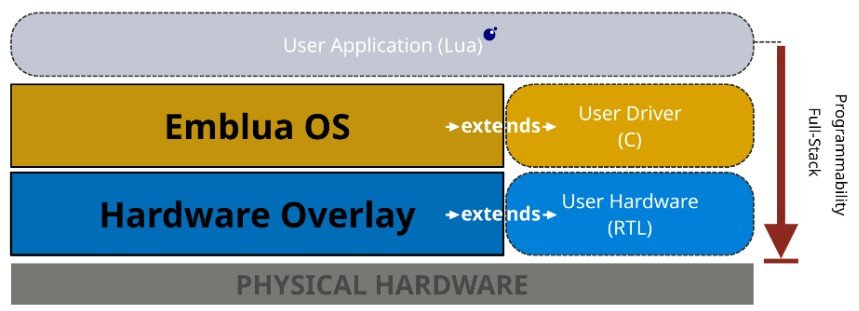
ELM11-Feather full-stack
Custom RTL modules can be connected to corresponding C drivers and exposed as functions within the Lua environment. Brisbane Silicon plans to publish the firmware API and board schematics under the MIT license after the crowdfunding campaign.
One example provided by the company involves implementing a quadrature encoder in hardware, adding its interface at the C driver layer, and then exposing functions for reading encoder direction and speed to Lua.
This approach resembles the programmable I/O concept used by the Raspberry Pi Pico, but extends customization beyond dedicated I/O state machines to the wider FPGA-based architecture.
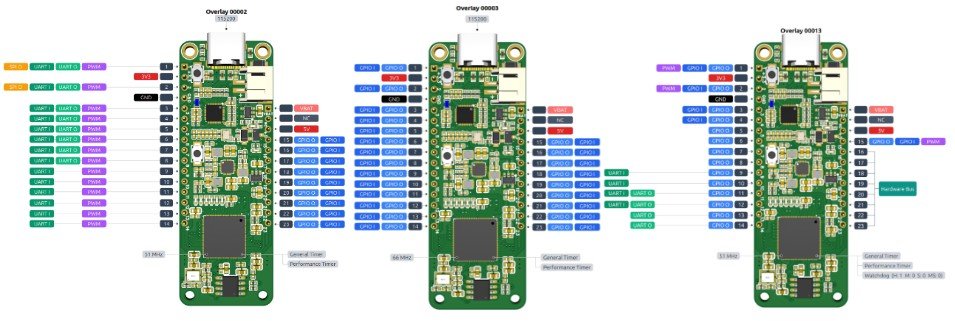
ELM11-Feather overlay examples
The accompanying Arvore IDE combines development and deployment across the Lua, C, and FPGA layers. It can create projects, edit programs, upload them to the board, install hardware overlays, and extend the Lua API. A beta version of the IDE is already available.
Measuring 22.86 × 64.65 × 4.85 mm, the board follows the Feather specification and supports existing FeatherWing expansion boards. Its 23 digital I/O pins can be configured for GPIO, PWM, UART, SPI, or I2C operation, depending on the capabilities provided by the installed hardware overlay.
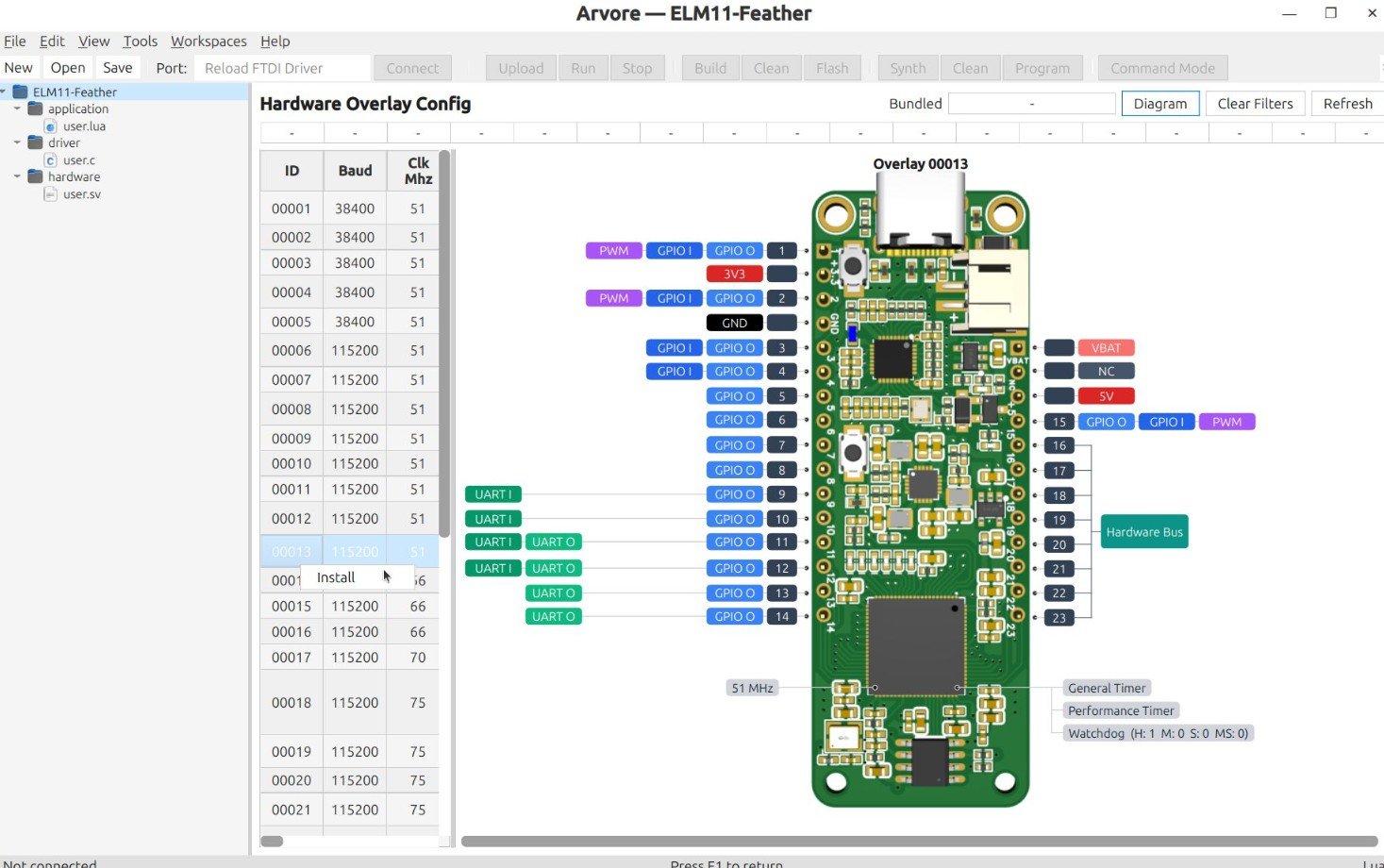
Arvore IDE
The overlay defines which capabilities are available, while individual pins can be reassigned at run time. The six Feather positions commonly reserved for analog inputs instead provide additional digital I/O on this board. The datasheet also distinguishes between run-time configuration, such as pin type and peripheral frequency, and compile-time overlay changes affecting the processor and available hardware resources.
Additional hardware includes five user-programmable LEDs, a user pushbutton, a reset button, a hardware watchdog, and four mounting holes. Power circuitry includes a 3.3 V regulator rated for up to 500 mA peak output and a built-in 500 mA LiPo charger with a charging-status LED.

ELM11-Feather
Lua programs can run interactively through a read-eval-print loop or execute from flash storage. The firmware can provide a separate REPL for each CPU core, along with timers, interrupts, watchdog support, and standard digital interfaces.
The platform also includes a Command Mode for inspecting and configuring the active hardware overlay. Developers can query available I/O capabilities, assign pin functions, adjust UART, PWM, and SPI settings, upload programs, configure startup behavior, and inspect memory usage.
Further Information

Please comment here...