


Efinix Sapphire RV64 brings 64-bit RISC-V and Linux to FPGAs
Oct 3, 2026 — by Giorgio Mendoza 695 views Efinix announced this week the Sapphire RV64, a configurable 64-bit RISC-V soft SoC intended for embedded Linux, edge AI and other applications requiring more memory and processing capability than the company’s existing 32-bit Sapphire architecture. The processor can be implemented across Efinix Titanium and Topaz FPGAs, as well as Trion devices from the T20 upward.
The Sapphire RV64 supports configurations with one to four 64-bit RISC-V processors and uses a seven-stage pipeline implementing the RV64IM instruction set, with optional A, F, D, C, Zba, Zbb, Zbs and Zicbom extensions. Configurations can include between 4KB and 512KB of on-chip RAM, multi-way L1 instruction and data caches, and an optional 64KB to 512KB L2 cache, branch prediction and hardware or software prefetching.
— ADVERTISEMENT —
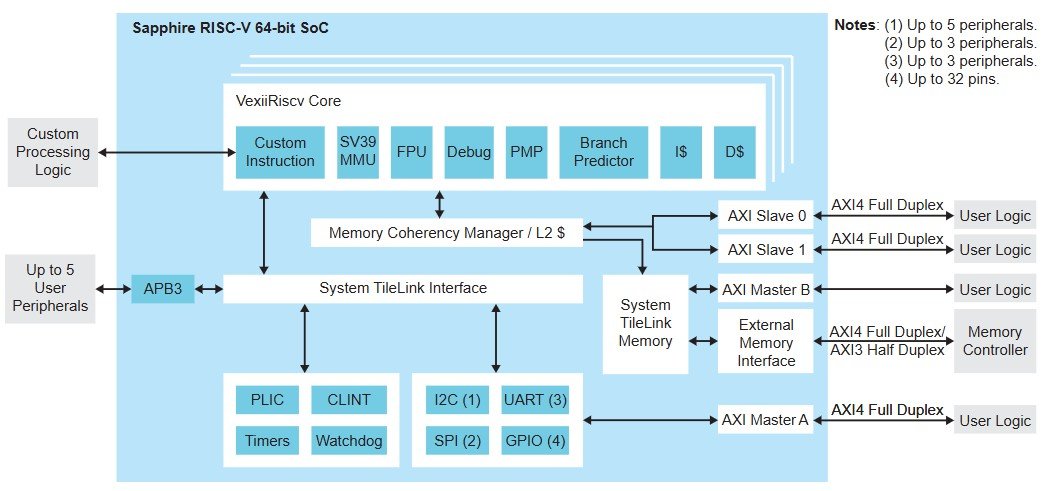
Sapphire RV64 SoC block diagram
For Linux-based systems, Efinix offers an optional SV39 memory management unit. External memory support includes DDR3, HyperRAM and LPDDR4x, with the latter operating at data rates up to 3,200Mbps. The additional memory and cache resources are intended to address workloads that exceed the addressing and performance limitations of the company’s 32-bit Sapphire RV32 implementations.
The architecture also retains Efinix’s custom instruction capability, allowing software to invoke accelerator logic implemented within the FPGA fabric. This can be used to offload functions such as signal processing, image processing or AI workloads while keeping application code on the RISC-V processor.
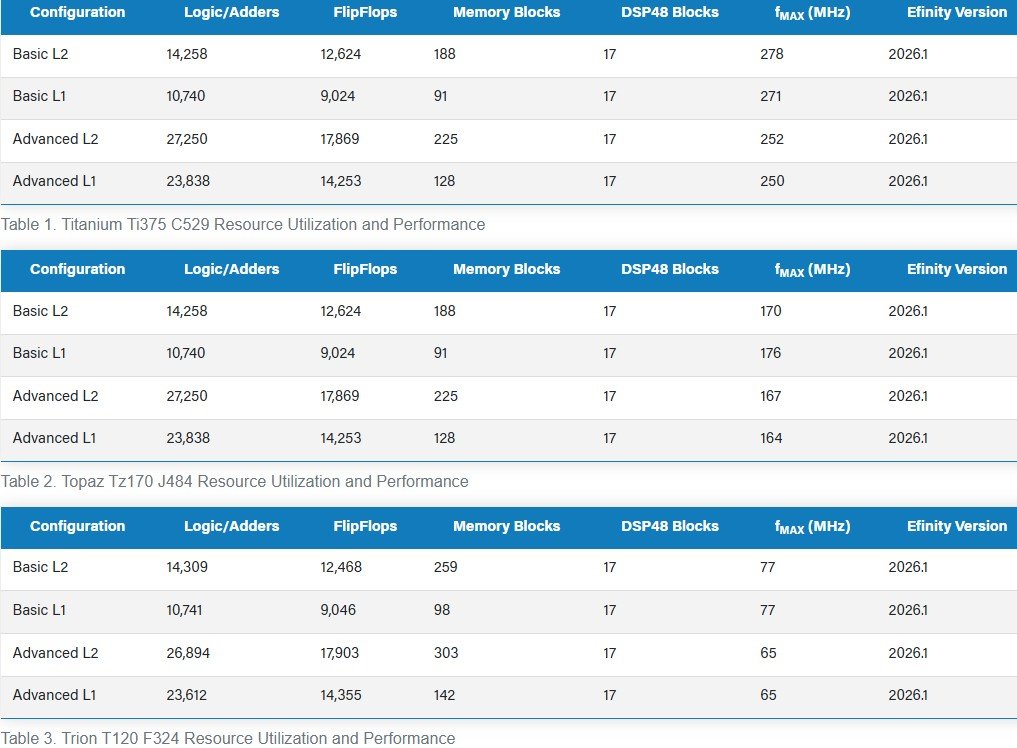
Sapphire RV64 performance across Efinix FPGAs
Sapphire RV64 is configured through the Efinity IP Manager and supported by the company’s Efinity Integrated Development Environment. Software development is handled through the Eclipse-based Efinity RISC-V Embedded Software IDE, which provides debugging, board support package integration and software development tools. Efinity 2026.1 or newer is required for the RV64 software flow.
One existing platform that can be used with the new architecture is the Titanium Ti375 C529 Development Kit. The board is based on the Ti375 FPGA, which already contains a hardened quad-core 32-bit RISC-V processor block with dedicated floating-point units and custom-instruction support. The Sapphire RV64 is instead implemented separately within the programmable FPGA fabric rather than replacing the Ti375’s hardened processor subsystem.
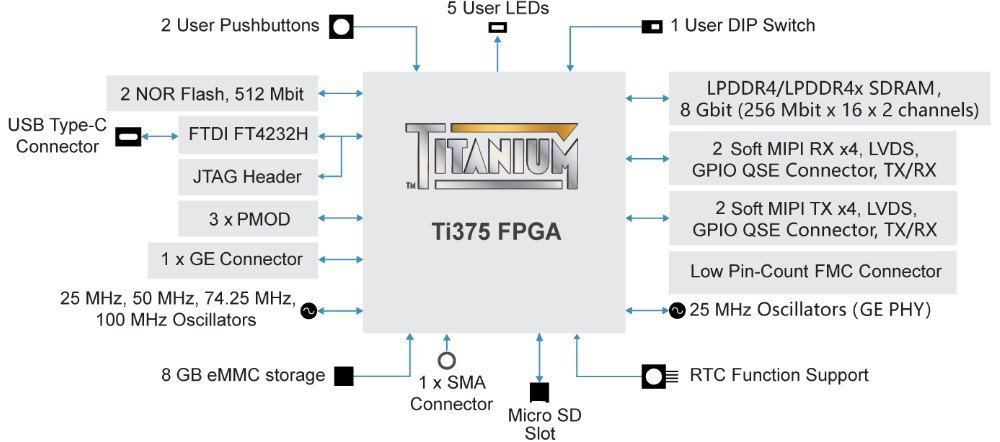
Titanium Ti375 C529 block diagram
The Ti375 C529 board includes 8Gbit, or 1GB, of LPDDR4/LPDDR4x memory connected over a 32-bit interface at rates up to 3.3Gbps. Storage includes 8GB of eMMC and two 512Mbit SPI NOR flash devices, while additional interfaces include Gigabit Ethernet, microSD, three PMOD connectors.
The board also provides an FMC expansion connector, high-speed QSE interfaces for MIPI, LVDS and GPIO, and onboard USB-to-dual-JTAG hardware for simultaneous FPGA and RISC-V debugging.
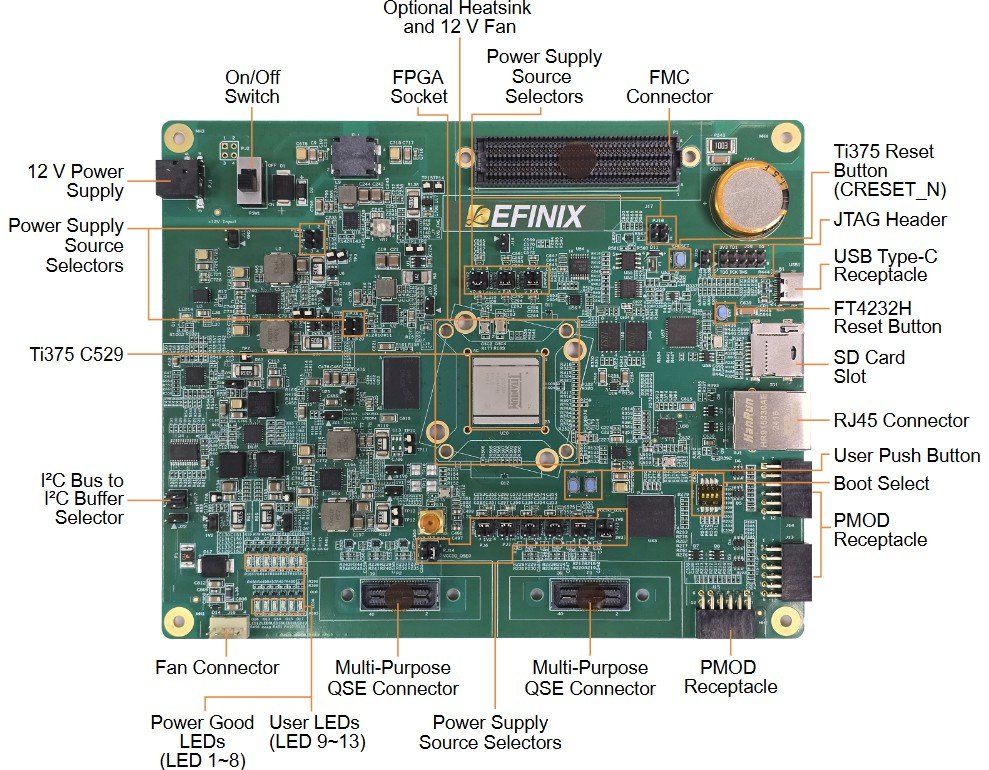
Titanium Ti375 C529 dev kit
Efinix’s Topaz family is also supported. LinuxGizmos previously covered the Topaz Tz170 J484 Development Kit, which includes LPDDR4 memory and originally shipped with a Sapphire SoC-based demonstration. The broader RV64 support therefore gives several existing Efinix development platforms a path from 32-bit Sapphire implementations to configurable 64-bit RISC-V processing.
Further Information
The Sapphire RV64 is available for all Titanium and Topaz FPGAs and for Trion devices starting with the T20. For more information, refer to the official product announcement.

Please comment here...