


Dabao Evaluation Board to Showcase Open-RTL Baochip-1x RISC-V MCU
Jan 25, 2026 — by Giorgio Mendoza 390 views Baochip has previewed the Baochip-1x, a mostly open RTL, RISC-V–based microcontroller fabricated on TSMC’s 22 nm process. Designed with openness and verifiability in mind, the MCU integrates a VexRiscv application core running at up to 350 MHz, alongside a quad-core I/O accelerator cluster clocked at 700 MHz.
The Baochip-1x uses a VexRiscv RV32IMAC processor with Sv32 MMU support, instruction and data caches, and optional cryptographic extensions.
— ADVERTISEMENT —
The SoC integrates 2 MB of SRAM and 4 MB of ReRAM, the latter serving as non-volatile storage comparable to on-chip flash. Peripheral support includes USB 2.0 High-Speed, SDIO, SPI, I²C, UART, ADC, camera interfaces, and a uDMA subsystem for efficient data movement.

Baochip-1x Block Diagram
A distinctive feature of the design is its quad-core PicoRV32-based I/O accelerator, which offloads real-time and event-driven tasks from the main CPU. Each PicoRV32 core includes local instruction RAM and FIFO access, coordinated through an event manager that enables deterministic handling of GPIO, interrupts, and peripheral events.

Waveform Example
To support software bring-up and verification, Baochip provides a Verilator-based simulation environment derived directly from the published RTL. This setup allows developers to observe internal SoC behavior at a fine-grained level, including CPU execution, bus activity, GPIO transitions, and peripheral interactions, using standard waveform viewers such as GTKWave.
Security and system integrity features are also integrated at the hardware level. The Baochip-1x includes dedicated cryptographic engines supporting AES, RSA, ECC, ECDSA, SHA-2, SHA-3, and a true random number generator (TRNG), along with always-on blocks such as a watchdog timer, real-time clock, and glitch detection circuitry.
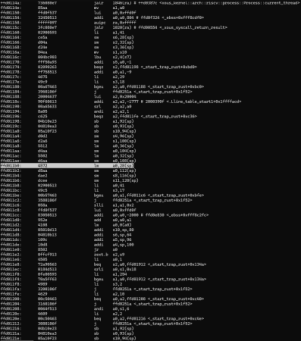
Codezoom Example
An accompanying Codezoom workflow extends simulation visibility by correlating program counter traces with the executing assembly code in real time. By hovering over waveform traces, developers can inspect the exact instructions running on the CPU at any point in the simulation, enabling detailed debugging of timing-sensitive code paths, interrupt handling, and cryptographic routines without requiring physical hardware.
While some analog and mixed-signal IP blocks remain closed, the project publishes a substantial portion of its RTL under the CERN-OHL-W-2.0 license. The open components are sufficient to support functional simulation, documentation generation, and register-level introspection. Developers can generate human-readable SoC documentation, C headers, and partial SVD files directly from the RTL.

Dabao Evaluation Board
Software development is centered around the Xous operating system and an official Rust-based SDK, with tooling support for build, flash, and simulation workflows.
According to the project documentation, development relied on open-source simulation tools such as Verilator, while final tape-out validation was performed using proprietary sign-off tools to verify the complete design, including closed-source analog and mixed-signal blocks.
Further Information
While the Crowd Supply campaign for the Baochip-1x has not yet launched, preliminary documentation and source materials outlining the current state of the design are available through the project’s public GitHub repository.

Please comment here...