


Home Assistant-compatible board pairs ESP32-S3 and ESP32-P4
Nov 6, 2026 Crowd Supply has introduced a campaign for LocalDot, an open-hardware board developed by AAElectronics that converts third-generation Amazon Echo Dots into Home Assistant voice devices. The 83 × 37mm PCB uses an ESP32-S3 and ESP32-P4 for connectivity and audio processing while retaining the original microphones, speaker, buttons, and LEDs.
 SparkFun today launched two ESP32-P4-based IoT RedBoards, offering either dual-band Wi-Fi 6 through an ESP32-C5 companion or wired Ethernet with Power over Ethernet. Both boards feature dual-core RISC-V processing, 32MB PSRAM, 16MB flash, MIPI camera and display connectors, and Arduino-style expansion headers for embedded and HMI applications.


 The Nano Pro Gen15 is a compact Linux mini PC powered by Intel’s Core Ultra X7 358H processor with integrated Arc B390 graphics. Developed by TUXEDO Computers, the system supports up to 128GB of DDR5 memory, dual NVMe SSDs, four 4K displays, and dual 2.5GbE connectivity. It can be used for software development, local AI workloads, and home server applications.
 Australian company Rapid Analysis has launched a new Kickstarter campaign for its Xerxes Home Lab platform, featuring updated carrier boards for Raspberry Pi Compute Modules and NVIDIA Jetson systems. The lineup includes the Xerxes Pi 2026, Xerxes Nano, and an RK3566-based compute module, targeting home servers, embedded systems, and local AI applications.

 Cincoze’s DX-1300 is a compact, fanless industrial computer based on Intel Core Ultra 200S processors, supporting up to 96GB of DDR5 memory and modular I/O expansion. Part of the company’s rugged DX series, the system is also compatible with the newly announced PPM-I360 external power protection module, designed to reduce electrical interference in industrial environments.
 Adafruit has previewed Floppsy Rev D, an RP2350-based floppy disk archiver and emulator designed to preserve and access legacy computer storage media. The standalone device supports floppy drives used with PCs and Apple Disk II systems, offering disk imaging, flux-level data capture, and emulation capabilities alongside a touchscreen interface and removable storage.
 LILYGO’s latest e-paper development board pairs an ESP32-S3 with a 4.7-inch display offering 960 × 540 resolution and 16-level grayscale. The board also includes battery monitoring, removable storage, and Wi-Fi and BLE connectivity for portable information displays and wireless embedded projects.
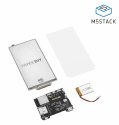 M5Stack has introduced the PaperDIY Assembly Kit, an ESP32-S3-based development platform featuring a 4.7-inch e-paper display with 960 × 540 resolution and 16-level grayscale. The kit combines Wi-Fi connectivity, battery power management, and expansion interfaces in an open design intended for custom information displays, electronic signage, and embedded development projects.
 The XPC nano NC50N by Shuttle is an upcoming barebone mini PC based on Intel’s N150 processor. The system supports up to 16GB of DDR5 memory, dual M.2 NVMe SSDs, and 2.5GbE networking, targeting digital signage, point-of-sale terminals, office environments, and multimedia applications.
 Geniatech has listed two M.2 AI accelerator cards targeting local inference workloads on embedded systems and edge devices. The AIM-M-R28 uses Rockchip’s RK1828 processor with 20 TOPS of computing performance, while the AIM-M-H10 is based on Hailo’s Hailo-10 architecture, delivering up to 40 TOPS for generative AI and computer vision applications.
 Bitmerse’s Romu recently debuted on Crowd Supply as an ultra-compact development board based on the Raspberry Pi RP2354A microcontroller. Designed to plug directly into a USB Type-A port, the board features capacitive touch input, an RGB LED and MicroPython support