


Banana Pi Previews Its First SOPHGO BM1688-Based Compute Module
Nov 15, 2025 — by Giorgio Mendoza 484 views Banana Pi has previewed the BPI-SM9 16-ENC-A3, a compact deep learning compute module built around the SOPHGO BM1688 processor. The module is described as targeting low-power AI workloads, hardware video acceleration, and mixed-precision neural inference across microservers, edge systems, industrial platforms, and AIoT devices.
The BM1688 datasheet does not appear to be available on the SOPHGO website yet, but Banana Pi notes that the processor integrates an eight-core Arm Cortex-A53 CPU running at 1.6GHz and provides 16 TOPS of INT8 performance.
— ADVERTISEMENT —
It also supports mixed-precision execution across INT4, INT8, FP16, BF16, and FP32, along with dedicated imaging hardware for HDR, 3D noise reduction, fog removal, lens distortion correction, and automatic exposure control.
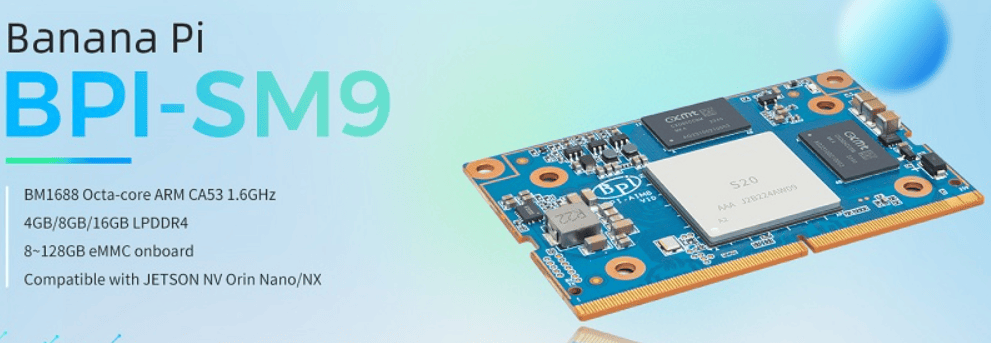
BPI-SM9
According to preliminary documentation, the module will include 8GB of LPDDR4x memory and 32GB of onboard eMMC storage. It is designed for multi-channel analytics and can process sixteen real-time 1080p30 video streams.
JPEG acceleration reaches 1080p at 480 frames per second and supports image sizes up to 32,768 × 32,768 pixels. The onboard ISP supports dual 8-megapixel inputs with HDR, 3D noise reduction, lens correction, and dehazing.
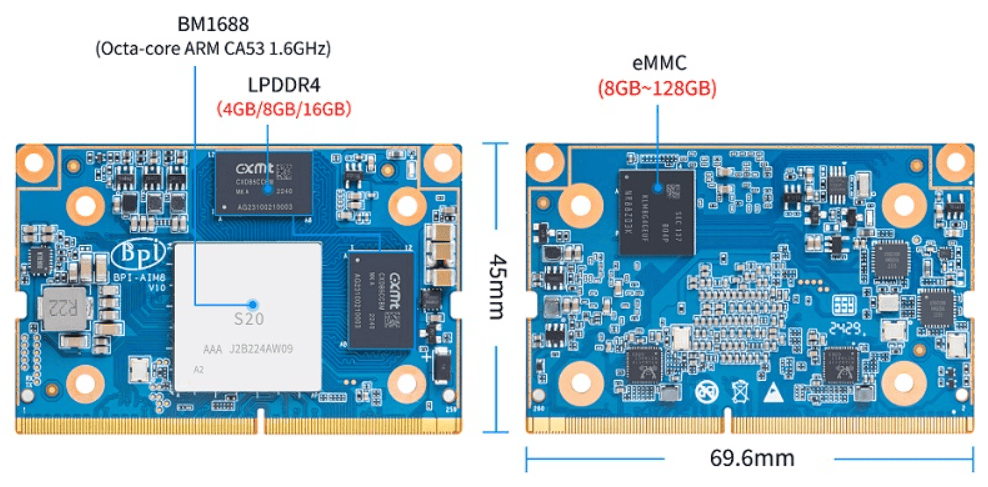
BPI-SM9 Dimensions
Peripherals are exposed through a 260-pin SO-DIMM connector. Interfaces include PCIe Gen3 with two ×2 ports, USB 3.0 and USB 2.0, dual Gigabit Ethernet, HDMI 2.0, SATA, CAN bus, SDIO, UART, I²C, SPI, PWM, ADC, and GPIO.
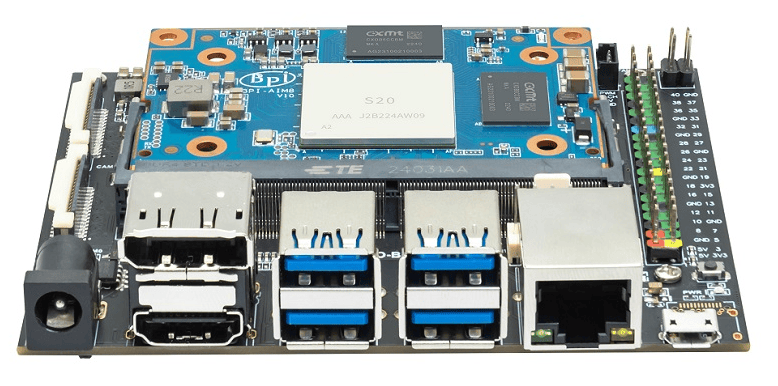
AI.DEV RZV2H Internal View
Banana Pi has released initial documentation comparing the BPI-SM9 with NVIDIA’s Jetson Orin Nano and Orin NX. According to the company, the module is designed to be pin-compatible with those platforms while offering a wider set of interfaces, including SATA and dual Gigabit Ethernet, for applications that require expanded connectivity.
The toolchain is said to support ONNX, Caffe, and TFLite formats and is compatible with TensorFlow, PyTorch, Paddle, TensorRT, BM1684, and BM1684X development environments.
Specifications listed for the BPI-SM9 16-ENC-A3 SoM include:
- Processor / SoC:
- 8-core Arm Cortex-A53 CPU @ 1.6 GHz
- SOPHGO BM1688 deep-learning processor
- Memory / Storage:
- 8 GB LPDDR4x (64-bit, 4266 Mbps)
- 32 GB eMMC 5.1
- Video Decode:
- H.264 / H.265: up to 16× 1080p @ 30 fps
- Supports resolutions up to 8192 × 8192 (8K / 4K / 1080p / 720p / D1 / CIF)
- Video Encode:
- H.264 / H.265: up to 10× 1080p @ 30 fps
- Supports 8K / 4K / 1080p / 720p / D1 / CIF
- Camera / Audio Input
- 6× VI inputs
- 2× I2S (dual-channel input and output, optional)
- Expansion:
- PCIe Gen3: 1 ×2 + 1 ×2 (RC & EP modes)
- Networking:
- 2× Gigabit Ethernet
- Display:
- 1× HDMI 2.0
- I/O Interfaces:
- 2× SATA 3.0
- 1× CAN, 1× SD / SDIO
- 4× UART, 4× I²C, 2× SPI
- 6× PWM, ADC
- GPIOs
- USB:
- 2× USB 3.0
- 2× USB 2.0
- Power:
- 12/3A DC input
- Operating Temperature:
- –20°C to +70°C
- Mechanical:
- 69.6 mm × 45 mm × 6 mm
- 260-pin SO-DIMM module connector
Further Information
Banana Pi has not announced pricing or availability for the BPI-SM9 16-ENC-A3 compute module. Additional documentation and preview materials are available on the company’s Wiki pages.

Please comment here...