


Arduino UNO Q Combines Qualcomm Dragonwing QRB2210 and STM32 MCU
Oct 7, 2025 — by Giorgio Mendoza 1,814 views
Qualcomm Technologies has announced its plan to acquire Arduino, marking a major development in the embedded and maker ecosystems. The acquisition aims to combine Qualcomm’s edge computing and AI expertise with Arduino’s large developer community and open hardware approach.
As part of the announcement, both companies introduced the Arduino UNO Q, a new dual-processor development board based on the Qualcomm Dragonwing QRB2210 platform, and the Arduino App Lab, a cross-platform development environment designed to integrate Linux, real-time, Python, and AI workflows.
— ADVERTISEMENT —
The acquisition follows Qualcomm’s earlier integrations of Edge Impulse and Foundries.io, reinforcing its effort to deliver a complete hardware-to-cloud stack for edge development.
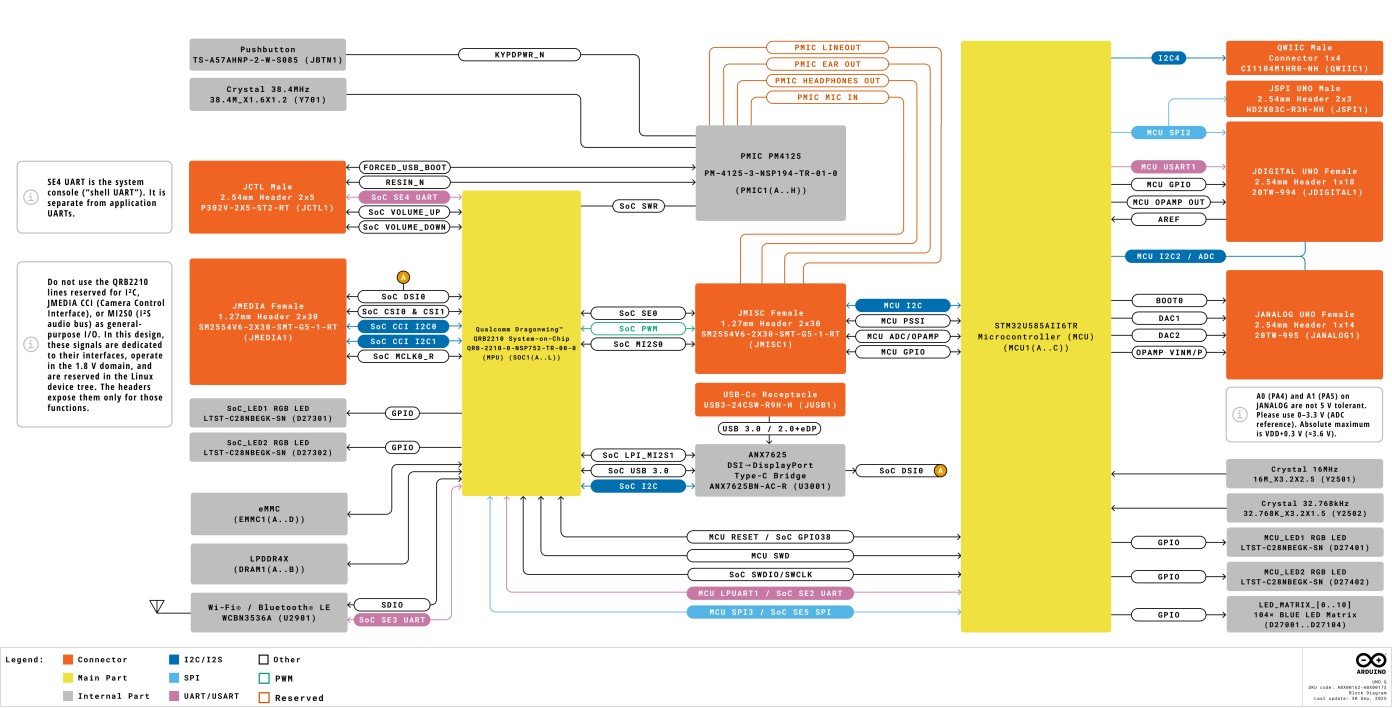
Arduino UNO Q Block Diagram
Arduino confirmed that it will retain its independent brand and open-source mission while gaining access to Qualcomm’s global ecosystem and advanced technology portfolio.
According to the announcement, Arduino’s community of more than 33 million active users will benefit from expanded tools for prototyping and commercialization, with continued support for hardware from multiple semiconductor vendors.
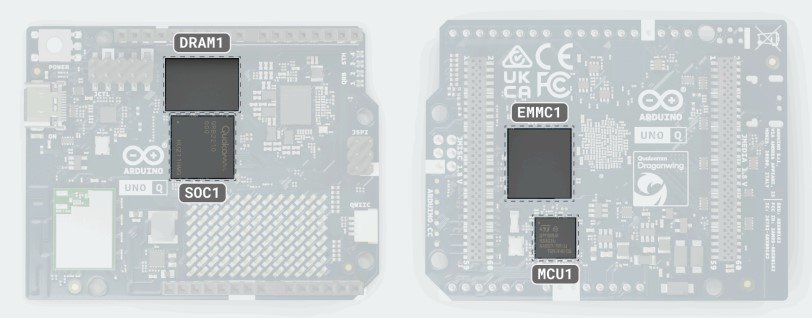
Arduino UNO Q Processing & Memory
The new Arduino UNO Q represents a shift from traditional microcontroller boards toward hybrid architectures that combine high-performance computing with real-time control.
The board features a Linux-capable Dragonwing QRB2210 quad-core processor with GPU and AI acceleration alongside a real-time STM32U585 microcontroller. This configuration enables projects that require both deterministic control and machine-learning inference, such as smart-home devices, robotics, and industrial systems.
UNO Q maintains compatibility with existing Arduino shields and the familiar UNO layout while extending connectivity with new high-speed interfaces for peripherals including cameras, displays, and sensors. It supports Debian Linux on the main processor and an RTOS on the microcontroller, allowing concurrent development of complex and low-latency applications within a single environment.
Alongside the hardware, Arduino introduced App Lab, a unified development environment that consolidates multiple programming domains into one interface.
App Lab integrates with the Edge Impulse platform for model training and optimization, enabling developers to build applications for object detection, sound recognition, and anomaly detection using real-world data. It also provides ready-to-use Arduino Apps and Bricks to simplify prototyping and deployment.

Arduino UNO Q Pinout
Nakul Duggal, Group General Manager for Automotive, Industrial, and Embedded IoT at Qualcomm Technologies, stated that the acquisition supports the company’s goal of democratizing access to advanced computing technologies.
Arduino CEO Fabio Violante said the partnership will help accelerate accessibility and innovation, while co-founder Massimo Banzi emphasized that Arduino will remain committed to openness and community collaboration.
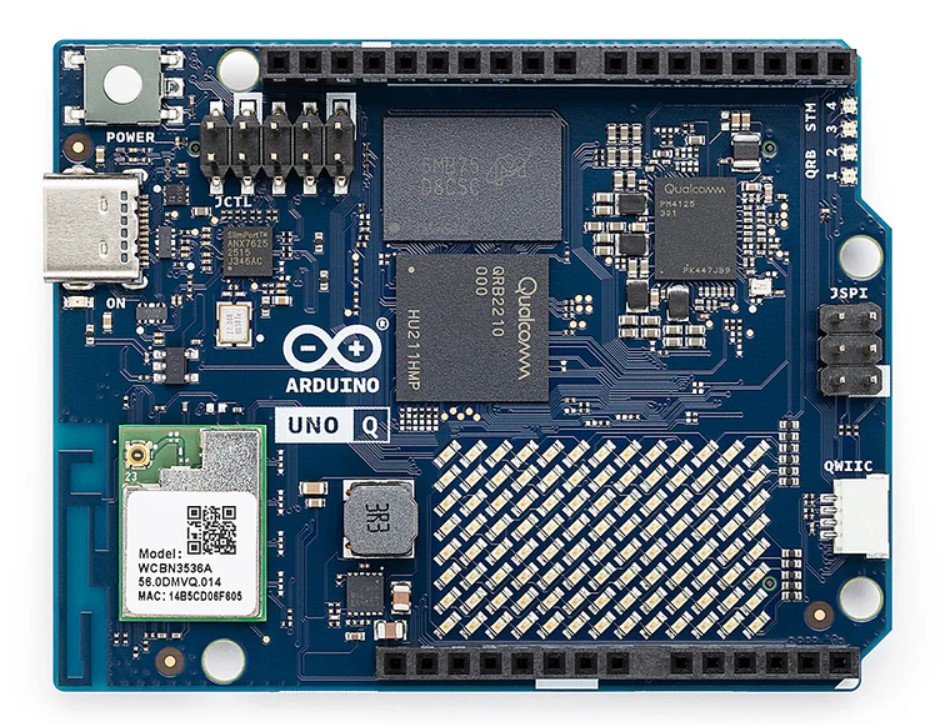
Arduino UNO Q
Specifications listed for the Arduino UNO Q:
- Microprocessor:
- Qualcomm Dragonwing QRB2210
- Quad-core Arm Cortex-A53 @ 2.0 GHz
- Adreno GPU 3D graphics accelerator
- Two ISPs (13 MP + 13 MP or 25 MP @ 30 fps)
- Microcontroller:
- STMicroelectronics STM32U585
- Arm Cortex-M33 up to 160 MHz
- 2 MB flash memory, 786 KB SRAM
- RAM:
- 2 GB LPDDR4
- Storage:
- 16 GB eMMC flash
- Connectivity:
- Wi-Fi 5 (2.4 GHz and 5 GHz) w/ onboard antenna
- Bluetooth 5.1 w/ onboard antenna
- Interfaces:
- I²C / I³C, SPI, UART, PSSI
- PWM, CAN, GPIO
- JTAG, ADC
- Video:
- Video output via USB-C
- MIPI DSI pins on JMEDIA header
- Audio:
- Microphone input, headphone output, & line output on JMISC header
- USB:
- 1x USB-C port w/ host/device role switching, power role switch, & video output
- Additional Features:
- 4x RGB user-controllable LEDs
- 8 × 13 blue LED matrix
- 1x Qwiic connector (3.3 V I²C)
- 1x push button
- JCTL connector for MPU remote debug
- Power Supply:
- 5 V DC (via USB-C max 3 A)
- Dimensions:
- 68.85 × 53.34 mm (UNO form factor)
- Operating Systems:
- Linux Debian on MPU
- Arduino Core on Zephyr RTOS
- Containerization:
- Docker and Docker Compose support
- Host Operating System Support for Arduino App Lab:
- Windows 10 or later (64-bit)
- macOS 11 or later (64-bit)
- Ubuntu 22.04 or later, and Debian Trixie (64-bit)
Further Information
The Arduino UNO Q can be pre-ordered for €47.60 through the Arduino Store, with shipping expected to begin on October 24. The board will also be available from distributors including RS Components, Digi-Key, Mouser, and Macfos. Additional details and demonstrations will be shared during Arduino’s “From Blink to Think” livestream event.

Please comment here...