All News | Boards | Chips | Devices | Software | LinuxDevices.com Archive | About | Contact | Subscribe
Follow LinuxGizmos:
Twitter Facebook Pinterest RSS feed
*   get email updates   *

Arduino Uno-like Board Gets Upgraded with Integrated Ethernet and USB Type-C

May 5, 2025 — by Giorgio Mendoza 305 views
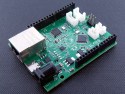
The UnoNet is a microcontroller board based on the ATmega328PB, designed with the same form factor and pin layout as the Arduino Uno Rev 3. It integrates Ethernet via a W5500 controller and includes a USB Type-C port, RJ45 connector, DC barrel jack, ICSP header, and reset button.

The ATmega328PB is clocked at 16 MHz and provides 32 KB of Flash memory (including 0.5 KB for the bootloader), 2 KB of SRAM, and 1 KB of EEPROM. All digital I/O pins support 5V logic levels and can source or sink up to 40 mA each. Internal pull-up resistors are available but disabled by default. PWM output is supported on select digital pins, and external interrupts can be configured on pins 2 and 3.

— ADVERTISEMENT —


UnoNet Arduino Uno 
(click image to enlarge)

Analog inputs A0 to A5 offer 10-bit resolution, with configurable reference voltage via the AREF pin. The board also supports TWI communication on pins A4 and A5, and includes a built-in LED on pin 13.

To accommodate Ethernet functionality, SPI pins 10 to 13 are dedicated to the onboard W5500 controller. These should not be used for general-purpose I/O, reducing the available digital pins to nine, with four capable of PWM output.

UnoNet Arduino Uno Pinout
(click image to enlarge)

The UnoNet uses a Silicon Labs CP2102N chip for USB-to-serial communication. From version 2.0 onward, a USB Type-C connector is used for both programming and power. The board also accepts external power via a DC barrel jack, with a recommended input range of 7 to 12 volts. Input below 7 volts may result in unstable 5V regulation, while exceeding 12 volts risks overheating the voltage regulator.

Several additional connectors are included for prototyping. J1 exposes the I2C interface, J2 breaks out the primary UART (Rx0/Tx0), and J3 and J4 are three-pin headers with pull-up resistors mapped to IO8 and IO9, often used for 1-Wire sensors.

UnoNet Arduino Uno Top View
(click image to enlarge)

Communication options include USB serial, hardware SPI, and TWI. Software-based serial communication is supported via the SoftwareSerial library. The board is compatible with standard Arduino Ethernet examples, provided a version of the Ethernet library that supports the W5500 chip is used.

To program the UnoNet using the Arduino IDE, the MiniCore platform must be installed to support the ATmega328PB variant. Further documentation is available through the MiniCore project and official Arduino sources.

The UnoNet measures 65 × 54 mm, with Ethernet and power connectors extending beyond the board edge. It includes four mounting holes for secure installation and follows the Arduino Uno Rev 3 pin mapping.

Further information

The UnoNet Arduino Uno is priced at kr 379.00 (~$39 USD) and is available from the ILABS online store.

(advertise here)


PLEASE COMMENT BELOW

Please comment here...