


Arduino expands lineup with Ventuno Q board pairing Dragonwing IQ8 and STM32H5
Mar 9, 2026 — by Giorgio Mendoza 443 views Arduino has introduced the Ventuno Q, a development board designed for robotics, embedded computing, and edge inference workloads. The platform combines a high-performance application processor with a real-time microcontroller in a dual-processor architecture intended for systems that process data and control physical hardware simultaneously.
The board integrates a Qualcomm Dragonwing IQ-8275 processor, which provides CPU, GPU, and NPU resources for neural network inference and data processing. The platform delivers up to 40 TOPS of AI compute, allowing the system to run vision models, speech processing pipelines, and multimodal workloads directly on the device.
— ADVERTISEMENT —
Alongside the application processor, Ventuno Q includes an STM32H5F5 microcontroller based on an Arm Cortex-M33 core running at 250 MHz. The microcontroller handles real-time control tasks such as motor control, industrial communication interfaces, and deterministic GPIO responses. Communication between the two processors is implemented through an RPC-based bridge.
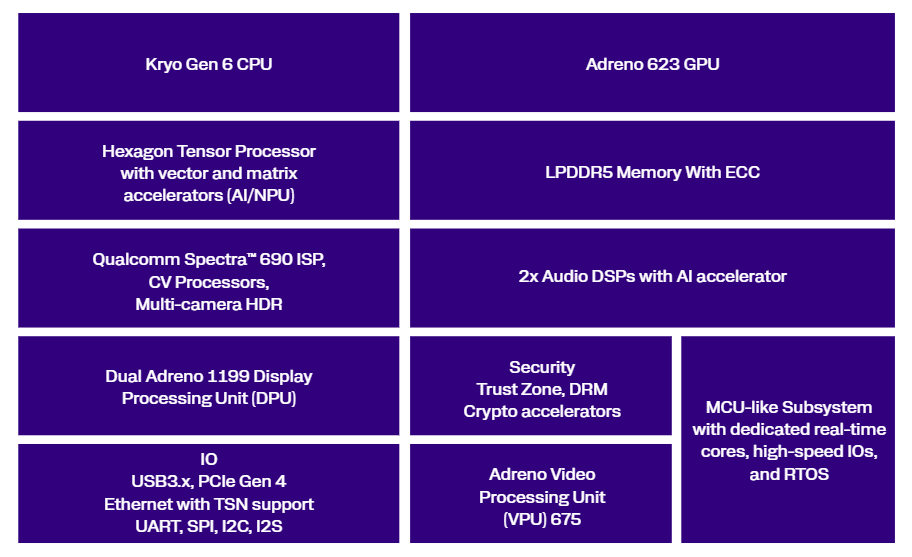
IQ8 series block diagram
Memory on the platform consists of 16 GB of LPDDR5 RAM, while storage includes 64 GB of onboard eMMC. Additional storage can be added through an M.2 connector supporting NVMe Gen4 drives.
Networking features include tri-band Wi-Fi 6 (2.4/5/6 GHz), Bluetooth 5.3, and a 2.5 Gb Ethernet port. The board also supports multiple camera interfaces, including three MIPI-CSI connectors, enabling multi-camera vision systems used in robotics and inspection applications.
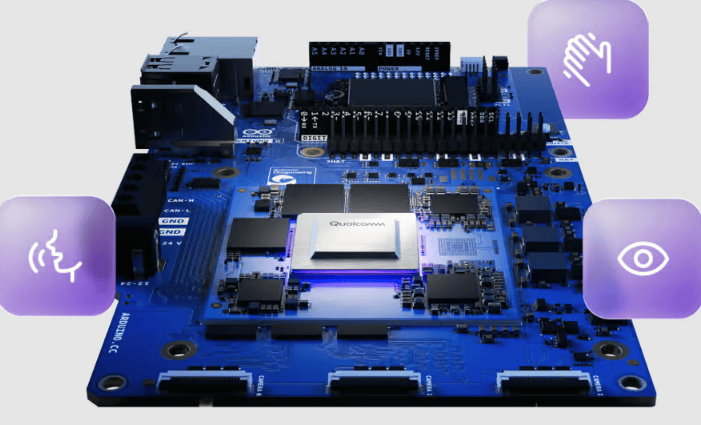
VENTUNO Q side view
Display support includes HDMI output, MIPI-DSI display interfaces, and DisplayPort Alt Mode via USB-C. Additional connectivity includes two USB 3.0 Type-A ports, USB-C with host/device switching, and additional USB interfaces available through expansion headers.
For robotics and industrial control applications, Ventuno Q provides CAN-FD support, PWM outputs, and deterministic GPIO control through the STM32 microcontroller.
The platform is also compatible with Arduino UNO shields, Raspberry Pi HATs through a 40-pin header, and Qwiic-compatible sensors, allowing developers to integrate existing hardware modules.
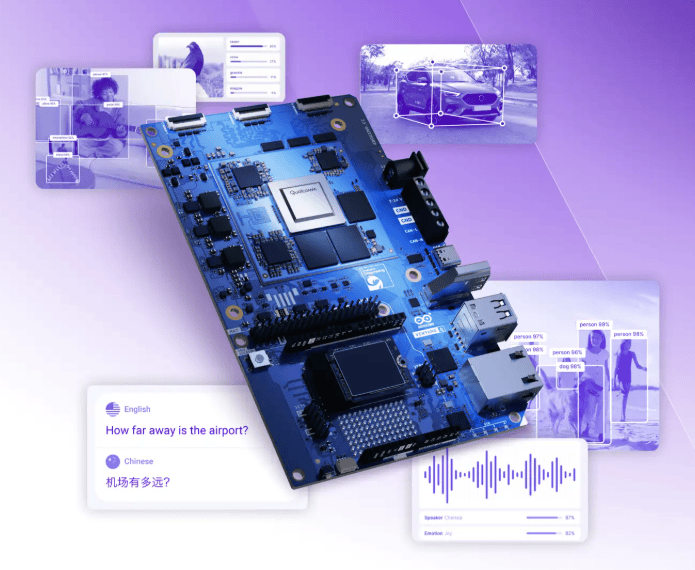
VENTUNO Q top view
The board runs Ubuntu or Debian Linux on the application processor, while the STM32 microcontroller runs an Arduino core based on Zephyr, as indicated in the official announcement.
Arduino also provides a development environment called Arduino App Lab, which allows developers to build applications combining embedded code, Linux software, and machine learning models in a unified workflow.
Specifications listed for the Arduino Ventuno Q include:
- Processor:
- Qualcomm Dragonwing IQ8 (IQ-8275)
- Octa-core Arm CPU
- Adreno GPU / VPU
- Hexagon Tensor AI processor (NPU) up to 40 TOPS
- Qualcomm Spectra 692 ISP
- Microcontroller:
- STM32H5F5
- Arm Cortex-M33 at 250 MHz
- 4 MB flash
- 1.5 MB RAM
- Memory:
- 16 GB LPDDR5 RAM
- Storage:
- 64 GB eMMC
- M.2 connector for NVMe Gen4 SSD expansion
- Connectivity:
- Tri-band Wi-Fi 6 (2.4 / 5 / 6 GHz)
- Bluetooth 5.3
- 1× 2.5 GbE Ethernet port
- Camera:
- USB camera support
- 3× MIPI-CSI camera connectors
- Display:
- 1× HDMI output
- MIPI-DSI display interface
- Audio:
- 2× microphone input
- Headphone output
- Ear output
- Line output
- USB:
- 1× USB-C port (host/device switching, video output)
- 2× USB 3.0 Type-A ports
- 2× additional USB 3.0 ports on JOMEGA header
- CAN:
- 1× CAN-FD PHY via screw terminal
- 3× CAN-FD interfaces on JOMEGA header
- 1× CAN-FD interface on UNO shield header
- Power:
- USB-C input (5 V up to 3 A)
- 5.5 × 2.1 mm power jack (12–24 V)
- Screw terminal input (7–24 V)
- Dimensions:
- 160 × 100 × 25.8 mm
Further Information
The Ventuno Q is currently listed as “coming soon,” with Arduino indicating that the board will be available through its store and distributors including DigiKey, Mouser, Farnell, RS, and Macfos.

Please comment here...