


Adiuvo Explorer Board aims to bring Artix UltraScale+ FPGA to $99 platform
May 3, 2026 — by Giorgio Mendoza 450 views
Adiuvo is developing the Explorer Board, a compact FPGA platform built around the Artix UltraScale+ AU7P, targeting embedded, signal processing, and high-speed I/O applications. The design aims to provide access to UltraScale+ capabilities at a lower price point.
The design is based on the AU7P FPGA, which provides approximately 37K LUTs, 75K flip-flops, 216 DSP slices, and 3.6 Mb of block RAM, along with integrated GTH transceivers. The device supports the MicroBlaze V soft processor, enabling embedded applications alongside programmable logic.
— ADVERTISEMENT —
To support more complex embedded workloads, the board includes external HyperRAM, allowing designs to extend beyond on-chip memory. This combination of FPGA fabric, soft-core processing, and external memory positions the platform for experimentation with embedded systems and digital signal processing.
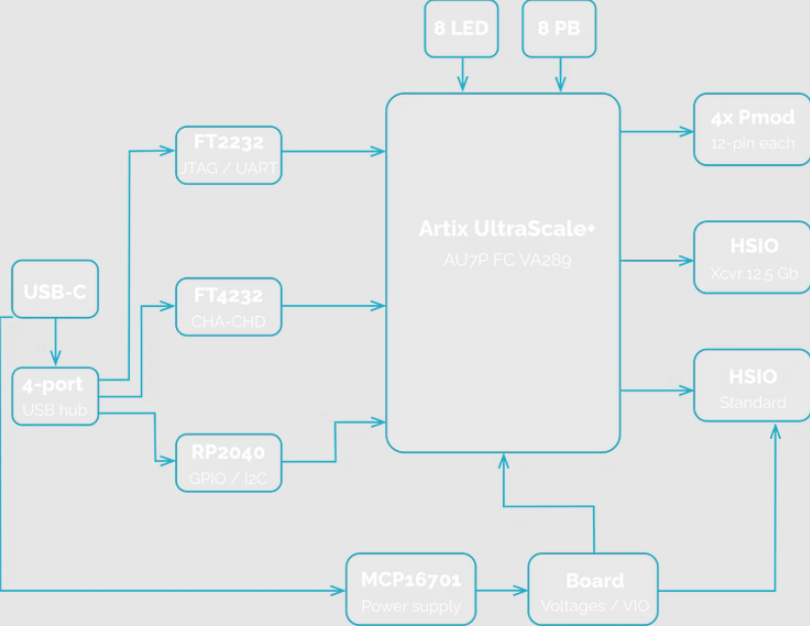
Adiuvo Explorer Board block diagram
One of the design considerations highlighted for the board is the use of an offset through-hole via (OTHV) layout technique to break out the FPGA package without relying on high-density interconnect (HDI) PCB technology. This approach is intended to reduce manufacturing cost while maintaining signal integrity.
The Explorer Board exposes multiple interfaces for peripheral connectivity and high-speed I/O. These include four Pmod connectors for general-purpose expansion, along with two HSIO interfaces—one supporting LVDS differential signaling and another providing access to the FPGA’s GTH transceivers. The board is also compatible with selected Zmod and SYZYGY modules, enabling use cases such as data acquisition and waveform generation.
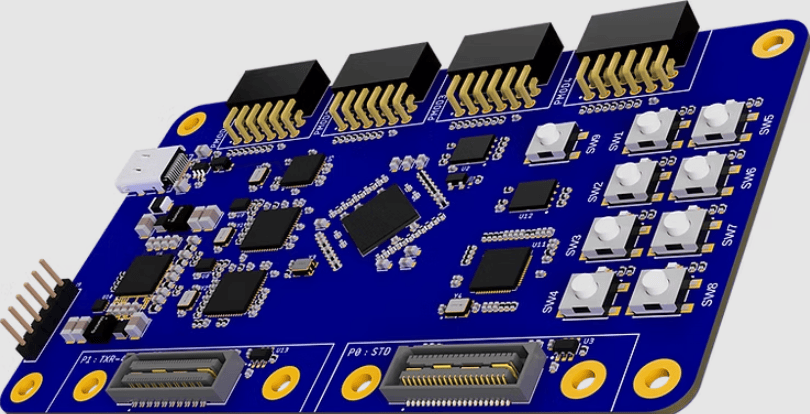
Adiuvo Explorer Board
Additional onboard features include user LEDs and push-buttons for basic interaction and debugging. Power is supplied via a USB-C connection, and the design includes access points for monitoring onboard power rails, allowing measurement of system power consumption during development.
Adiuvo indicates that design files, including schematics, bill of materials, and PCB layout, are expected to be released as open source following finalization.
Further Information
The Explorer Board is currently in development, with availability anticipated later in the year, potentially in the Q3 to Q4 timeframe based on statements from the developer. Additional details and registration of interest are available through the project website.

Please comment here...