


AAEON UP Squared Series Gains Mainline Linux Support for 40-Pin GPIO in Linux 6.18
Feb 22, 2026 — by Giorgio Mendoza 203 views AAEON announced that full mainline Linux support for the 40-pin Raspberry Pi-compatible GPIO header on its UP Squared series has been merged into Linux 6.18. The work, completed in collaboration with Bootlin, removes the need for the previously required out-of-tree DKMS driver.
The UP Board family combines Intel processors with a 40-pin expansion header routed through an onboard FPGA. The FPGA handles signal level shifting, pin multiplexing, switching, and direction control, allowing pins to operate as I2C, UART, PWM, or GPIO.
— ADVERTISEMENT —
While flexible, this architecture introduced challenges for Linux support because the FPGA functions both as a GPIO provider and as a consumer of SoC pins, an uncommon design pattern in the kernel.
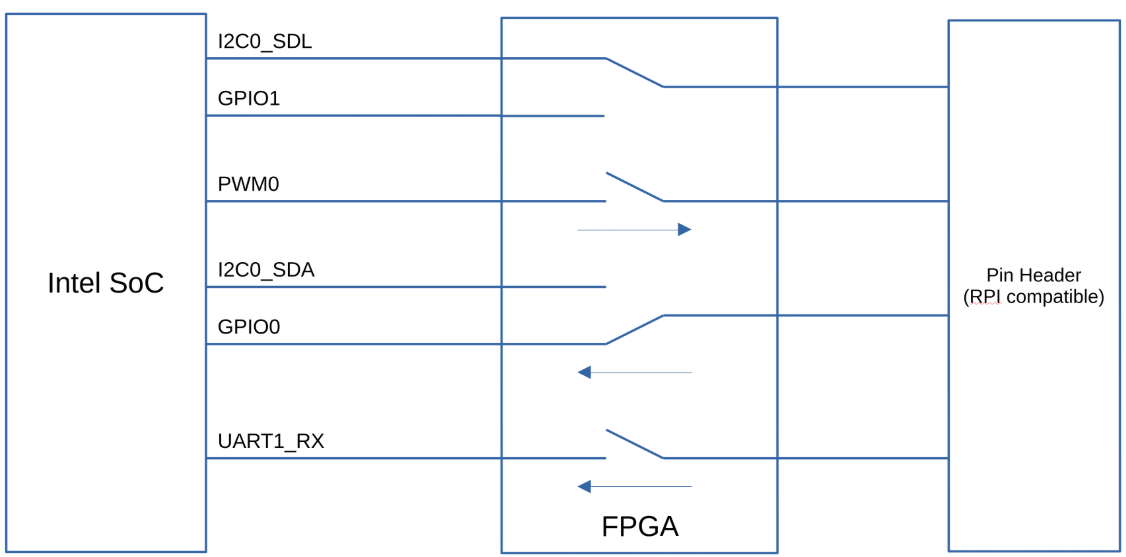
FPGA-based signal routing for the 40-pin header
Until now, AAEON distributed an out-of-tree driver to support the FPGA-managed I/O expansion. Previous upstream attempts in 2018 and 2022–2023 were not accepted due to reliance on Intel-specific pin control code and deviations from kernel best practices.
Bootlin reworked the driver stack to use generic kernel APIs, particularly gpiolib, instead of Intel-specific pinctrl macros. The upstreaming effort began with a five-patch submission in December 2024 introducing:
- An MFD (Multi-Function Device) driver for the FPGA
- An LED driver
- A new gpiolib API addition
- A revised pinctrl driver
- MAINTAINERS file updates
The MFD and LED drivers were merged in Linux 6.14, while the pinctrl work required additional refinement and nine iterations before final acceptance in Linux 6.18.

Raspberry Pi–compatible 40-pin header pinout
A key contribution of the effort is a new GPIO forwarder library integrated into the existing gpio-aggregator driver. This library enables the creation of virtual gpiochips that forward operations to underlying GPIO descriptors, matching the FPGA-mediated design of the UP Squared boards.
Enhancements include runtime registration and removal of GPIO descriptors, refactoring of forwarder registration logic, and expanded symbol exports for custom GPIO operation overrides. The UP Squared pinctrl driver overrides selected operations such as request and direction handling to synchronize SoC pin state with FPGA configuration.

AAEON UP Board family lineup
The finalized implementation uses pinctrl mappings to properly consume and assign SoC pins. Board detection is handled through DMI matching, with current support targeting the UP Squared (UP-APL01) platform. Additional UP family boards may be supported by extending mappings and ensuring required Intel pin groups are available.
With Linux 6.18, developers using the UP Squared series gain native, upstream support for the 40-pin header without relying on external modules. This simplifies kernel maintenance, distribution integration, and long-term support across standard Linux environments.
Further Information
Bootlin has published a detailed technical write-up describing the upstreaming process and architectural considerations, which can be found on its website.
Further expansion of pinctrl support across additional UP Board models is expected in future updates. More information on the UP Board family is available from AAEON’s official website.

Please comment here...